
Multiplying by 0 and 1
Any number times 0 is 0, and any number times 1 stays the same. They are the easiest rules in multiplication, but children often mix them up with adding.
Any number times 0 is 0
This page explains both rules with pictures, shows the usual mistakes and has a quick quiz.
4 × 0 means 4 groups of nothing: 4 empty plates. There is nothing to count, so 4 × 0 = 0. It works the other way too: 0 × 4 means no groups of 4, which is also nothing.
This is called the zero property of multiplication. It is true for every number: 1,000,000 × 0 = 0.
See it: pictures to draw with your child
Copy these onto paper or a whiteboard. A quick sketch makes the idea concrete before any written method.
Any number times 1 stays the same
6 × 1 means 6 groups of 1: six single cookies, which is 6. And 1 × 6 means one group of 6, which is also 6. So 6 × 1 = 6.
This is called the identity property, because the number keeps its identity: it does not change.
Don’t mix them up with addition
| Adding | Multiplying | Why they differ |
|---|---|---|
| 7 + 0 = 7 | 7 × 0 = 0 | Adding nothing changes nothing; 7 groups of nothing is nothing. |
| 7 + 1 = 8 | 7 × 1 = 7 | Adding one more makes 8; 7 groups of 1 is still 7. |
When your child hesitates, ask them to say it as groups: “7 groups of 0”, “7 groups of 1”. The picture answers the question.
Quiz: times 0 and times 1
Fill in the missing number.
A note on dividing
Dividing by 1 also leaves a number the same: 9 ÷ 1 = 9. And 0 shared between any number of people is 0: 0 ÷ 5 = 0. But you cannot divide by 0: there is no way to share 5 things into 0 groups. Children meet this in grade 3 alongside the division facts.
Why these rules matter later
The 0 rule is why numbers ending in 0 are easy to multiply (30 × 4 = 3 × 4 with a 0 on the end), and the 1 rule is the key to equivalent fractions in grade 4: multiplying by 2/2 is multiplying by 1.
Free facts on the times table chart
A times table chart from 0 to 10 has 121 facts. The 0 row and the 0 column hold 21 of them, and every answer there is 0. The 1 row and the 1 column hold 19 more, and every answer just repeats the other number.
So once your child knows these two rules, 40 of the 121 facts are done. Point them out on the multiplication chart. It is a big boost before the harder times tables.
0 and 1 in real life
- 5 boxes with 0 pencils in each: 5 × 0 = 0 pencils.
- 0 tickets at $8 each cost 0 × 8 = $0.
- 7 children with 1 hat each: 7 × 1 = 7 hats.
- 1 week of 7 days is 1 × 7 = 7 days.
Make up silly ones together: “How many legs on 0 elephants?” Children remember a rule better after they laugh at it.
A 1-minute check
Ask these six quickly, in this order, and listen for hesitation: 8 × 0, 8 + 0, 1 × 9, 9 + 1, 0 × 0, 1 × 1.
The answers are 0, 8, 9, 10, 0 and 1. A child who gets all six without stopping has the two rules sorted. If one trips them up, go back to the groups picture for that one. Then move on to the 2 times table.
Where this fits: the first steps in multiplication
- What is multiplication
- Repeated addition
- Arrays
- Multiplication properties
- Multiplying by 0 and 1 (this page)
- Multiplication strategies
- The times tables
- Practice the facts
What to say to your child
A short script for teaching it the first time. Pause after each line and let your child do the next step.
- “Here are 4 plates. I put nothing on them. How many cookies?” (0.)
- “So 4 groups of 0 is…” (0.) “4 × 0 = 0.”
- “Now one cookie on each plate. How many?” (4.) “4 groups of 1 is 4.”
- “What about 100 × 0?” (0.) “And 100 × 1?” (100.)
- “Careful: what is 5 + 0? And 5 × 0?” (5 and 0.)
More worked examples
Example 1: 9 × 0
9 groups of nothing: 0.
Example 2: 1 × 12
One group of 12: 12.
Example 3: 0 × 0
No groups of nothing: 0.
Example 4: (7 × 1) × 0
7 × 1 = 7, then 7 × 0 = 0.
Practice questions (answers below)
Ask these out loud or write them down. Check each answer, and ask “how did you get that?” for one or two.
- 6 × 0
- 6 × 1
- 1 × 15
- 0 × 9
- 8 × __ = 8
- __ × 11 = 0
- 7 + 0 and 7 × 0
- 25 × 1 × 0
Show the answers
- 0
- 6
- 15
- 0
- 1
- 0
- 7 and 0
- 0
Common mistakes
How to teach it at home
Empty plates
Set out plates with nothing on them and ask for the multiplication.
Quick-fire
Mix +0, ×0, +1, ×1 questions and see if your child spots the difference.
Silly big numbers
“What is a million times 0?” Children love that the answer is still 0.
By grade
- Grade 3 (3.OA.B.5, 3.OA.C.7): use properties of multiplication and know the facts, including × 0 and × 1.
- Grade 4: multiplying by 1 in the form 2/2 or 3/3 makes equivalent fractions.
- Grade 6: the identity and zero properties are written with letters: a × 1 = a, a × 0 = 0.
More for each grade: Grade 3 math and the CBSE class 3 maths guide.
Worksheets and practice
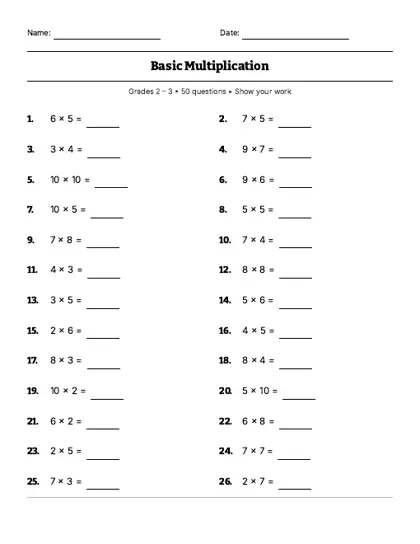
Multiplication facts worksheet: printable PDF with an answer key. · Make a fresh test
Multiplication practice · times tables · multiplication chart
Last reviewed
Questions parents ask
What is any number multiplied by 0?
Always 0. For example 9 × 0 = 0 and 0 × 250 = 0. This is the zero property of multiplication.
What is any number multiplied by 1?
The number itself. 9 × 1 = 9 and 1 × 250 = 250. This is the identity property.
Why is anything times 0 equal to 0?
Multiplying means counting equal groups. Groups of nothing contain nothing, and no groups contain nothing, so the total is 0.
What is the difference between 5 + 0 and 5 × 0?
5 + 0 = 5 because adding nothing changes nothing. 5 × 0 = 0 because 5 groups of nothing is nothing.
Can you divide by 0?
No. Dividing by 0 has no answer, because you cannot share things into zero groups. Dividing 0 by a number is fine: 0 ÷ 4 = 0.