
Multiplication as repeated addition
Repeated addition means adding the same number again and again: 5 + 5 + 5 + 5. Multiplication is the short way to write it: 4 × 5 = 20.
Adding the same number again and again
This is usually how children first meet multiplication. This page shows how to switch between the two, how to draw it on a number line, and when to move on to the times tables.
When you add the same number several times, you can write it as a multiplication. Count how many times the number is added, then multiply by the number.
- 6 + 6 + 6 = 3 × 6 = 18 (6 is added 3 times)
- 2 + 2 + 2 + 2 + 2 = 5 × 2 = 10 (2 is added 5 times)
- 10 + 10 + 10 + 10 = 4 × 10 = 40
It only works when every number is the same. 3 + 4 + 5 cannot be written as one multiplication.
See it: pictures to draw with your child
Copy these onto paper or a whiteboard. A quick sketch makes the idea concrete before any written method.
Repeated addition on a number line
Start at 0 and make equal jumps. 4 jumps of 5 land on 20, so 4 × 5 = 20. Number lines link repeated addition to skip counting: 5, 10, 15, 20.
Quiz: write it as a multiplication
Count how many times the number is added, then write the multiplication and the total.
When repeated addition gets slow
Adding is fine for 3 × 4. But 9 × 8 means adding 8 nine times, which is slow and easy to get wrong. That is why children move on from repeated addition to knowing the times tables from memory. Repeated addition explains what multiplication means; the times tables make it fast.
A good bridge is to add in bigger chunks. For 6 × 7: 7 + 7 = 14, so two 7s make 14, four 7s make 28, six 7s make 42. Doubling like this is the start of the times table tricks.
Both ways round
4 × 3 can mean 3 + 3 + 3 + 3 (four 3s) or 4 + 4 + 4 (three 4s). Both give 12. Children can pick the shorter addition. This is the turn-around rule, and it is easiest to see in arrays.
Skip counting is repeated addition
Counting in 2s, 5s and 10s is repeated addition said out loud. 5, 10, 15, 20 means 5 + 5 + 5 + 5, so the fourth number is 4 × 5.
That is why the first times tables children learn are the 2, 5 and 10 times tables. Your child can already count in those steps.
A quick check: ask “what is 6 × 5?” and let your child count in 5s on their fingers. Six fingers later they reach 30.
Repeated addition word problems
- Mia puts 4 stickers on each of 3 pages. How many stickers? 4 + 4 + 4 = 12, so 3 × 4 = 12.
- A bus ticket costs $2. How much do 5 tickets cost? 2 + 2 + 2 + 2 + 2 = 10, so 5 × 2 = $10.
- Leo walks 10 minutes to school every day for 5 days. How many minutes? 10 + 10 + 10 + 10 + 10 = 50, so 5 × 10 = 50 minutes.
Ask your child to write the addition first, then the multiplication. Soon they will skip the addition.
Bigger numbers
Repeated addition works with tens too. 20 + 20 + 20 is three 20s, so 3 × 20 = 60. Spotting “three 20s” instead of adding is the first step towards multiplying by multiples of 10, which children meet at the end of grade 3.
Where this fits: the first steps in multiplication
What to say to your child
A short script for teaching it the first time. Pause after each line and let your child do the next step.
- “Let’s add 2 + 2 + 2 + 2. What do you get?” (8.)
- “How many 2s did we add?” (4.)
- “So we added 2 four times. That is 4 × 2 = 8.”
- “Try 5 + 5 + 5. How many 5s?” (3.) “So it is…” (3 × 5 = 15.)
- “Which is quicker to write, 5 + 5 + 5 + 5 + 5 + 5 or 6 × 5?”
More worked examples
Example 1: 7 + 7 + 7
7 is added 3 times: 3 × 7 = 21.
Example 2: 4 + 4 + 4 + 4 + 4
4 is added 5 times: 5 × 4 = 20.
Example 3: 3 × 9 the short way
9 + 9 = 18, then + 9 = 27. Or turn it: 9 × 3 is nine 3s, which is longer, so add the 9s.
Practice questions (answers below)
Ask these out loud or write them down. Check each answer, and ask “how did you get that?” for one or two.
- 2 + 2 + 2
- 5 + 5 + 5 + 5
- 10 + 10 + 10
- 6 + 6 + 6 + 6
- Write 3 × 8 as an addition.
- Can 2 + 3 + 4 be written as one multiplication?
- A frog makes 5 jumps of 4. Where does it land?
- Write 4 × 7 as an addition two ways.
Show the answers
- 3 × 2 = 6
- 4 × 5 = 20
- 3 × 10 = 30
- 4 × 6 = 24
- 8 + 8 + 8 = 24
- No, the numbers are not the same.
- 20
- 7 + 7 + 7 + 7 or 4 + 4 + 4 + 4 + 4 + 4 + 4
Common mistakes
How to teach it at home
Coins
Count 5p, 10p or 10-rupee coins: “10, 20, 30: three 10s is 30.”
Hop it
Hop along a chalk number line in equal jumps.
Shopping
“3 packets at 4 each: 4 + 4 + 4, so 3 × 4.”
By grade
- Grade 2 (2.OA.C.4): write a repeated addition for an array.
- Grade 3 (3.OA.A.1): interpret products as equal groups and learn the facts.
- Next: arrays and times tables.
More for each grade: Grade 2 math and the CBSE class 2 maths guide; Grade 3 math and the CBSE class 3 maths guide.
Worksheets and practice
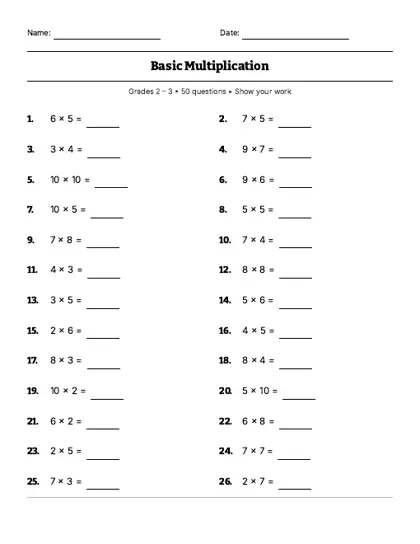
Multiplication facts worksheet: printable PDF with an answer key. · Make a fresh test
Multiplication practice · times tables · multiplication chart
Last reviewed
Questions parents ask
What is repeated addition in multiplication?
Repeated addition is adding the same number several times, such as 4 + 4 + 4. It can be written as a multiplication: 3 × 4 = 12.
How do you turn repeated addition into multiplication?
Count how many times the number is added and multiply by the number. 6 + 6 + 6 + 6 has four 6s, so it is 4 × 6 = 24.
Is multiplication just repeated addition?
For whole numbers, yes, that is a good first meaning. Later, multiplication also means scaling (making something 3 times bigger), which works for fractions and decimals too.
What grade learns repeated addition?
Grade 2, as the step before multiplication in grade 3.
What is 5 + 5 + 5 + 5 as a multiplication?
There are four 5s, so it is 4 × 5 = 20.