
4th grade factors and multiples
4th grade factors and multiples (class 4): a quiz for kids, then every skill in order with lessons, a checklist and a plan.
🧒 Kids: answer 10 grade 4 questions on factors and multiples. Read each one, then tap Check ✓!
🔢 Factors practice 🏆 Factors levels 🧮 GCF and LCM calculator
What children learn about factors in 4th grade
In grade 4, children find all the factor pairs of a whole number from 1 to 100, recognize it as a multiple of each of its factors, and decide whether it is prime or composite.
- 4.OA.B.4: find all factor pairs for a whole number from 1 to 100.
- 4.OA.B.4: recognize that a whole number is a multiple of each of its factors.
- 4.OA.B.4: decide whether a number from 1 to 100 is a multiple of a given one-digit number.
- 4.OA.B.4: decide whether a number from 1 to 100 is prime or composite.
- 4.OA.C.5: make and explain number patterns, such as multiples.
Other grades: 4th grade · 6th grade
The big idea in grade 4
Grade 4 is the year factors and multiples get their names (4.OA.B.4). Children find every factor pair of a number up to 100. They also learn that a number is a multiple of each of its factors.
They sort numbers into prime, with exactly two factors, and composite, with more than two. The number 1 is neither.
All of this rests on the times tables. A child who knows 6 × 7 = 42 instantly can see that 6 and 7 are factors of 42. A child who still counts in 7s will find factor pairs slow and tiring.
Arrays are the best picture. Every rectangle of counters is a factor pair, so 12 counters make 1 × 12, 2 × 6 and 3 × 4.
When your child gets stuck
Most grade 4 trouble is a missing factor, very often the middle pair, like 6 × 6 for 36. Teach your child to list factors in pairs, from both ends, and to stop when the pairs meet.
If your child mixes up factors and multiples, use the size rule. Factors are never bigger than the number; multiples are never smaller.
If prime or composite is a guess, go back to counters. A prime number of counters makes only one long line.
4th grade factors and multiples skills, in order
Work down the list. Each lesson explains the idea for parents with pictures and has a quiz for your child.
By the end of grade 4, your child should be able to…
- List every factor pair of 36, including 6 × 6.
- Say whether 7 is a factor of 56, and explain how you know.
- Write the first 10 multiples of 6.
- Say whether 51 is prime or composite (3 × 17).
- Explain why 1 is neither prime nor composite.
- Use the rule for 3 to test 147.
Unsure where your child is? The factors and multiples levels page has a short test for every step from factor pairs to word problems.
A 4-week plan for 4th grade factors and multiples
| When | Focus |
|---|---|
| Week 1 | Arrays and factor pairs to 50 |
| Week 2 | Factor pairs to 100, and multiples |
| Week 3 | Prime and composite numbers, and the sieve |
| Week 4 | Divisibility rules and common factors |
Add 5 minutes a day with the factors and multiples practice tool, and check answers with the GCF and LCM calculator.
More for grade 4
All 4th grade math · CBSE class 4: Equal Groups · 4th grade multiplication · Factors and multiples quiz for grades 4 to 6 · Factors and multiples for kids
What to say to your child
A short script for teaching it the first time. Pause after each line and let your child do the next step.
- “Make rectangles with 18 counters. How many can you find?” (1 × 18, 2 × 9, 3 × 6.)
- “Those are the factor pairs of 18.”
- “Is 18 a multiple of 6?” (Yes: 6 × 3 = 18.)
- “Now try 13 counters.” (Only one line: 13 is prime.)
- “Is 1 prime?” (No: it has only one factor.)
More worked examples
Example 1: factor pairs
The factor pairs of 48 are 1 × 48, 2 × 24, 3 × 16, 4 × 12 and 6 × 8.
Example 2: multiples
Is 72 a multiple of 8? Yes: 8 × 9 = 72.
Example 3: prime or composite
57 looks prime, but 5 + 7 = 12, so 3 is a factor: 57 = 3 × 19.
Practice questions (answers below)
Ask these out loud or write them down. Check each answer, and ask “how did you get that?” for one or two.
- Factor pairs of 24
- Factors of 30
- Is 9 a factor of 63?
- Is 6 a factor of 45?
- First 5 multiples of 8
- Is 29 prime?
- Is 39 prime?
- How many factors does 16 have?
- Is 84 a multiple of 4?
- Stretch: the only even prime
Show the answers
- 1 × 24, 2 × 12, 3 × 8, 4 × 6
- 1, 2, 3, 5, 6, 10, 15, 30
- Yes: 9 × 7
- No: 45 ÷ 6 = 7 r 3
- 8, 16, 24, 32, 40
- Yes
- No: 3 × 13
- 5: 1, 2, 4, 8, 16
- Yes: 4 × 21
- 2
Common mistakes
How to teach it at home
Five minutes a day
Short daily practice beats long weekend sessions.
Use real things
Counters, eggs in boxes, chocolate bars and packs of pens all show factors and multiples.
Ask how
Ask “how do you know?” after each answer. Explaining builds understanding faster than speed drills.
By grade
- Before: times tables to 10 × 10
- After: 6th grade GCF and LCM
Not sure where to start?
The free 4th grade math check-up tests every grade 4 topic in 18–22 minutes. It shows which topics are solid and which lesson to start with.
Worksheets and practice
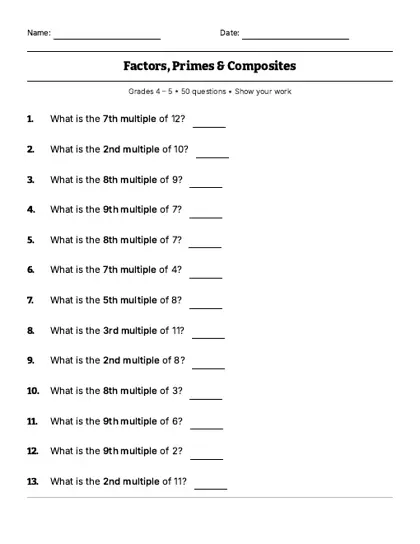
Factors and multiples worksheet: printable PDF with an answer key.
All worksheets · Multiplication practice trainer · 1-minute speed test
Last reviewed
Questions parents ask
What do 4th graders learn about factors and multiples?
All the factor pairs of numbers from 1 to 100, multiples of one-digit numbers, and whether a number is prime or composite (4.OA.B.4).
How can I help my 4th grader find factors?
Use counters to make rectangles, then teach listing in pairs from both ends. Quick times tables make it much easier.
Is there a 4th grade factors and multiples quiz?
Yes. The quiz at the top of this page has 10 mixed grade 4 questions, each marked straight away. Play again for a fresh set, or try the factors and multiples quiz for grades 4 to 6.
What is taught about factors in class 4 in India?
NCERT class 4 meets factors through equal groups and times tables. This page lists the skills in order, starting with factors and multiples, is it a factor?.
How much practice does a 4th grader need?
About 10 minutes a day: one short round with the practice tool and one question worked on paper. Short daily practice works better than long weekly sessions.