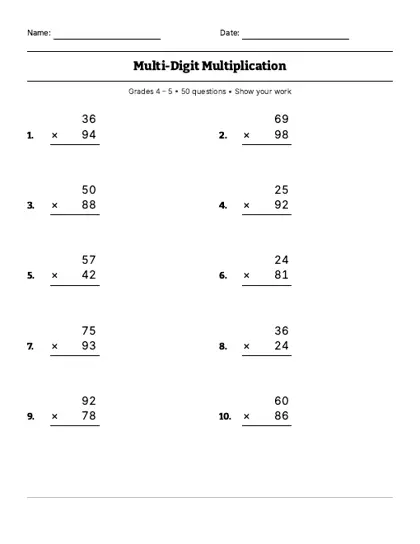
In grade 4 (class 4), children use their times tables to multiply bigger numbers: up to 4 digits by 1 digit and 2 digits by 2 digits. They learn the area model and partial products, multiply by 10, 100 and 1,000, estimate to check answers, and solve “times as many” and multi-step word problems. Fractions are multiplied by whole numbers for the first time.
4.OA.A.1–2: interpret and solve “times as many” comparisons.
4.OA.A.3: solve multi-step word problems and check with estimation.
4.OA.B.4: factors and multiples up to 100; prime and composite numbers.
4.NBT.B.5: multiply up to 4 digits by 1 digit and 2 digits by 2 digits using place value and area models.
Multiplying up to 4-digit by 1-digit and 2-digit by 2-digit numbers with the area model and partial products, multiplying by 10, 100 and 1,000, estimating, “times as many” problems, factors and multiples, and fraction × whole number.
Should 4th graders know the standard multiplication method?
Grade 4 focuses on place value strategies like the area model. The standard algorithm is expected to be fluent in grade 5, though many children start it in grade 4.
Is there a 4th grade multiplication quiz?
Yes. The quiz at the top of this page has 10 mixed 4th grade questions, marked one at a time with a hint for every mistake. Play again for a fresh set, or try the full multiplication quiz for every grade.
What is class 4 multiplication?
Class 4 in India and grade 4 in the US cover the same multiplication skills, listed in order on this page: multiplying by 10, 100, 1,000, 2-digit by 1-digit, 4-digit by 1-digit, area model.
How much multiplication practice does a 4th grader need?
About 10 minutes a day: 5 minutes of facts (trainer or speed test) and 5 minutes on the current skill. Short daily practice works better than long weekly sessions.