
Partial products multiplication
Partial products multiplication splits the numbers by place value, multiplies every part by every part, and adds the results. Nothing is carried.
How the partial products method works
It is the area model without the drawing. Each line is one box of the area model, written as a sum to add up.
Example: 34 × 26. Split them: 34 = 30 + 4 and 26 = 20 + 6.
- Ones × ones: 4 × 6 = 24
- Tens × ones: 30 × 6 = 180
- Ones × tens: 4 × 20 = 80
- Tens × tens: 30 × 20 = 600
- Add: 24 + 180 + 80 + 600 = 884
Work in a fixed order, smallest place first, so no product gets missed. Two 2-digit numbers always give 4 partial products.
  34
× 26
────
  24
 180
  80
 600
────
 884
See it: pictures to draw with your child
Copy these onto paper or a whiteboard. A quick sketch makes the idea concrete before any written method.
Start with 2-digit by 1-digit
Children meet partial products first with one small number. For 47 × 6 there are just two lines:
- 7 × 6 = 42
- 40 × 6 = 240
Add them: 42 + 240 = 282. Once two lines feel easy, move to four lines for 2-digit by 2-digit. The method is the same, there are just more pieces to keep track of.
How many partial products?
Multiply the number of digits. A 2-digit by 1-digit problem has 2 × 1 = 2 partial products. A 2-digit by 2-digit has 4, and a 3-digit by 2-digit has 6.
| Problem | Partial products | Total |
|---|---|---|
| 47 × 6 | 42 + 240 | 282 |
| 34 × 26 | 24 + 180 + 80 + 600 | 884 |
| 213 × 14 | 12 + 40 + 800 + 30 + 100 + 2,000 | 2,982 |
A zero digit gives a partial product of 0, so you can skip it. In 405 × 3 there are only two to write: 15 and 1,200.
Partial products quiz
Find the missing partial product, then add all four to get the total.
Area model, partial products and the standard method
All three find the same four pieces. They only write them down differently:
- Area model: draws a box for each piece. Best for seeing why it works.
- Partial products: lists each piece as a line. Faster to write, still nothing hidden.
- Standard method: squeezes the pieces into two rows with carrying. Fastest, but the place values are hidden.
For 34 × 26, the standard method’s first row (204) is 24 + 180, and its second row (680) is 80 + 600. Showing your child this link makes the standard method much less mysterious.
Partial products in your head
Partial products is also how many adults multiply in their head. To work out 26 × 35 at the shops, think 20 × 35 = 700 and 6 × 35 = 210, so 910 in total. That is two partial products instead of four, because 35 was kept whole.
Encourage your child to try it with prices: 18 items at $45 is 10 × 45 + 8 × 45 = 450 + 360 = $810.
More worked examples
58 × 7
8 × 7 = 56 and 50 × 7 = 350. Add: 56 + 350 = 406.
63 × 45
3 × 5 = 15, 60 × 5 = 300, 3 × 40 = 120, 60 × 40 = 2,400. Add: 2,835.
125 × 32
Six products: 10 + 40 + 200 + 150 + 600 + 3,000 = 4,000.
Where this fits: multiplying bigger numbers
What to say to your child
A short script for teaching it the first time. Pause after each line and let your child do the next step.
- “Let’s do 34 × 26. What is 34 made of?” (30 and 4.) “And 26?” (20 and 6.)
- “Start small. What is 4 × 6?” (24.) “Write it down.”
- “Now 30 × 6.” (180.) “And 4 × 20?” (80.) “And 30 × 20?” (600.)
- “Add all four lines.” (884.)
- “Estimate to check: 30 × 25 is 750. Is 884 close?” (Yes.)
More worked examples
Example 1: 23 × 4
12 + 80 = 92.
Example 2: 47 × 12
14 + 80 + 70 + 400 = 564.
Example 3: 36 × 25
30 + 150 + 120 + 600 = 900.
Example 4: 78 × 43
24 + 210 + 320 + 2,800 = 3,354.
Practice questions (answers below)
Ask these out loud or write them down. Check each answer, and ask “how did you get that?” for one or two.
- 26 × 3
- 54 × 7
- 23 × 14
- 45 × 32
- 67 × 21
- 38 × 56
- How many partial products for 234 × 56?
- 142 × 3
Show the answers
- 18 + 60 = 78
- 28 + 350 = 378
- 12 + 80 + 30 + 200 = 322
- 10 + 80 + 150 + 1,200 = 1,440
- 7 + 60 + 140 + 1,200 = 1,407
- 48 + 180 + 400 + 1,500 = 2,128
- 6
- 6 + 120 + 300 = 426
Common mistakes
How to teach it at home
Two colours
Write the tens in one colour and the ones in another, so each product shows which parts made it.
Check with a box
Draw the area model afterwards and see if each box matches a line.
Real totals
“23 children each bring 14 stickers. How many stickers?”
By grade
- Grade 4 (4.NBT.B.5): multiply up to 4 digits by 1 digit and 2 digits by 2 digits with place value strategies, such as partial products.
- Grade 5 (5.NBT.B.5): move from partial products to the standard algorithm.
- Before this: multiplying by multiples of 10, so 30 × 20 is easy.
More for each grade: Grade 4 math and the CBSE class 4 maths guide; Grade 5 math and the CBSE class 5 maths guide.
Worksheets and practice
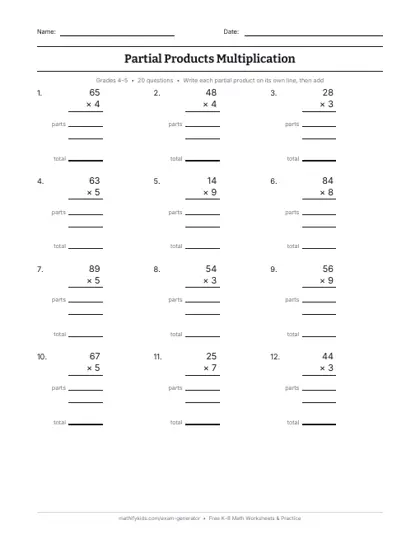
Partial products multiplication worksheet: printable PDF with an answer key. · Make a fresh test
Area model · lattice method · standard algorithm · Multiplication practice trainer · 1-minute speed test
Last reviewed
Questions parents ask
What is partial products multiplication?
A method that splits both numbers by place value, multiplies every part by every part, and adds the products. 34 × 26 = 24 + 180 + 80 + 600 = 884.
How many partial products are there?
Multiply the number of digits: 2-digit by 1-digit has 2, 2-digit by 2-digit has 4 and 3-digit by 2-digit has 6.
Is partial products the same as the area model?
It finds the same pieces. The area model draws them in boxes; partial products writes them as a list to add.
Why do schools teach partial products?
It shows the place value in every step, so children see why the standard method works and make fewer carrying mistakes.
What grade learns partial products?
Grade 4, as a place value strategy for 4.NBT.B.5, before the standard algorithm in grade 5.