
4-digit by 1-digit multiplication
To multiply a 4-digit number by a 1-digit number, multiply each place from the ones up, carrying as you go. 3,456 × 7 = 24,192.
Step 0: estimate
Round the 4-digit number to its thousands and multiply: 3,456 × 7 is about 3,000 × 7 = 21,000. A closer estimate rounds to the hundreds: 3,500 × 7 = 24,500.
Now your child knows the answer is in the twenty-thousands. An answer like 2,419 or 241,920 will stand out as wrong straight away.
See it: pictures to draw with your child
Copy these onto paper or a whiteboard. A quick sketch makes the idea concrete before any written method.
Method 1: split by place value
3,456 is 3,000 + 400 + 50 + 6. Multiply each part by 7 and add:
- 3,000 × 7 = 21,000
- 400 × 7 = 2,800
- 50 × 7 = 350
- 6 × 7 = 42
21,000 + 2,800 + 350 + 42 = 24,192. These are the partial products. Common Core grade 4 asks children to be able to explain the answer this way.
Method 2: the standard method
- Ones: 6 × 7 = 42. Write 2, carry 4.
- Tens: 5 × 7 = 35, plus 4 = 39. Write 9, carry 3.
- Hundreds: 4 × 7 = 28, plus 3 = 31. Write 1, carry 3.
- Thousands: 3 × 7 = 21, plus 3 = 24. Write 24.
- Answer: 24,192. Compare it with the estimate of 21,000 to 24,500. It fits.
 3,456
   × 7
──────
24,192
The rule never changes: multiply, then add the carry, then write the ones digit and carry the tens. Four digits just means doing it four times. Saying each step out loud keeps the carries in the right place.
Long multiplication step by step
Type any 4-digit × 1-digit problem, like 3,456 × 7. Each step and carry is shown.
When the number has a zero
Zeros cause most mistakes. In 4,032 × 6, the hundreds digit is 0:
- 2 × 6 = 12: write 2, carry 1.
- 3 × 6 = 18, plus 1 = 19: write 9, carry 1.
- 0 × 6 = 0, plus 1 = 1: write 1. Do not skip this column.
- 4 × 6 = 24: write 24.
The answer is 24,192. A child who skips the zero column gets a 4-digit answer like 2,592, which the estimate (4,000 × 6 = 24,000) catches at once.
A zero at the end is easier. For 2,450 × 3, multiply 245 × 3 = 735 and put the 0 back on: 7,350.
4-digit by 1-digit word problems
- A stadium has 4,250 seats in each section. How many seats in 6 sections? 4,250 × 6 = 25,500.
- A family drives 1,375 miles a month. How far in 4 months? 1,375 × 4 = 5,500 miles.
- A printer makes 2,608 pages an hour. How many pages in 9 hours? 2,608 × 9 = 23,472.
The second one has a neat shortcut: 1,375 × 4 is double 1,375 twice, so 2,750 and then 5,500. Encourage your child to look for a shortcut before reaching for the written method.
4-digit by 1-digit quiz
Estimate first, then multiply. Wrong answers show the place value parts.
Where this fits: multiplying bigger numbers
What to say to your child
A short script for teaching it the first time. Pause after each line and let your child do the next step.
- “3,456 × 7. First, about how big? 3,000 × 7 is…” (21,000.)
- “Start with the ones: 6 × 7.” (42.) “Write 2, carry the 4.”
- “Tens: 5 × 7 is 35, add the carried 4.” (39.) “Write 9, carry 3.”
- “Keep going for the hundreds and thousands.” (24,192.)
- “Is it close to 21,000? Close enough, and a bit more because we rounded down.”
More worked examples
Example 1: 2,143 × 3
No carrying: 6,429.
Example 2: 1,825 × 4
7,300.
Example 3: 5,609 × 8
44,872. The 0 still gets its own step: 0 × 8 + 7 carried = 7.
Example 4: 9,999 × 9
89,991. Or 10,000 × 9 − 9.
Practice questions (answers below)
Ask these out loud or write them down. Check each answer, and ask “how did you get that?” for one or two.
- 1,234 × 2
- 2,415 × 3
- 3,108 × 5
- 4,672 × 6
- 5,050 × 4
- 6,789 × 7
- 8,006 × 9
- Estimate 7,812 × 6
Show the answers
- 2,468
- 7,245
- 15,540
- 28,032
- 20,200
- 47,523
- 72,054
- About 8,000 × 6 = 48,000 (exact 46,872)
Common mistakes
How to teach it at home
Big shopping
“A TV costs $1,249. How much for 3 TVs?”
Year of savings
Multiply a monthly amount by 6 or 9 months.
Check on a calculator
Work it out on paper, then check. Find the step that went wrong if they differ.
By grade
- Grade 3 (3.NBT.A.3): multiply by multiples of 10, the building block for each place.
- Grade 4 (4.NBT.B.5): multiply a whole number of up to four digits by a one-digit number, and explain it with equations, arrays or area models.
- Next: 2-digit by 2-digit multiplication.
More for each grade: Grade 4 math and the CBSE class 4 maths guide.
Worksheets and practice
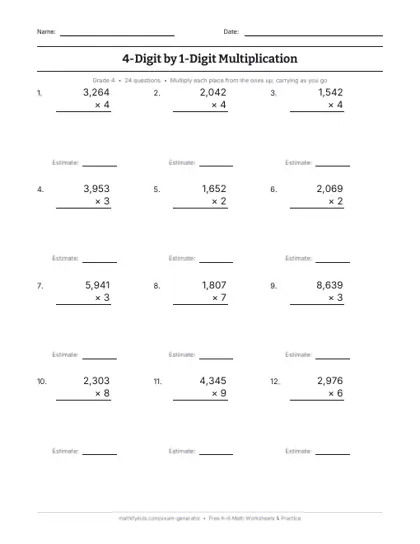
4-digit by 1-digit multiplication worksheet: printable PDF with an answer key. · Make a fresh test
2-digit by 1-digit · estimating products · Multiplication practice trainer · 1-minute speed test
Last reviewed
Questions parents ask
How do you multiply a 4-digit number by a 1-digit number?
Multiply the ones, tens, hundreds and thousands in turn, adding each carry: 3,456 × 7 = 24,192. Or split it: 21,000 + 2,800 + 350 + 42.
What grade learns 4-digit by 1-digit multiplication?
Grade 4 in the Common Core (4.NBT.B.5).
How do you estimate 4-digit by 1-digit multiplication?
Round to the nearest thousand or hundred and multiply: 3,456 × 7 is about 3,500 × 7 = 24,500.
What do you do with a zero in the number?
Multiply it like any other digit: 0 times anything is 0, then add the carry. Never skip the column.
What is the biggest answer for 4-digit by 1-digit?
9,999 × 9 = 89,991, so the answer always has 4 or 5 digits.