
Common factors
A common factor divides two or more numbers exactly. The common factors of 12 and 18 are 1, 2, 3 and 6.
What is a common factor?
A factor divides a number with nothing left over. A common factor divides two or more numbers. 3 is a common factor of 12 and 18, because 12 ÷ 3 = 4 and 18 ÷ 3 = 6.
Every pair of whole numbers has at least one common factor: 1. The biggest common factor has its own name, the greatest common factor (GCF), also called the HCF.
How to find common factors
- List the factors of the first number in pairs: 12 = 1 × 12, 2 × 6, 3 × 4.
- List the factors of the second number the same way: 18 = 1 × 18, 2 × 9, 3 × 6.
- Circle the numbers in both lists: 1, 2, 3 and 6.
- The greatest one is the GCF: 6.
Listing in pairs is the key. Children who list one at a time often miss a factor, like the 6 in 18.
Common factors in a Venn diagram
A Venn diagram puts the shared factors in the middle, where the circles overlap. The factors that belong to only one number go on the outside.
Ask your child to draw one for 16 and 24. The overlap should hold 1, 2, 4 and 8.
Common factors of some pairs
| Numbers | Common factors | GCF |
|---|---|---|
| 8 and 12 | 1, 2, 4 | 4 |
| 12 and 18 | 1, 2, 3, 6 | 6 |
| 15 and 25 | 1, 5 | 5 |
| 16 and 24 | 1, 2, 4, 8 | 8 |
| 18 and 27 | 1, 3, 9 | 9 |
| 20 and 30 | 1, 2, 5, 10 | 10 |
| 24 and 36 | 1, 2, 3, 4, 6, 12 | 12 |
| 9 and 16 | 1 | 1 |
When the only common factor is 1, as for 9 and 16, the numbers are relatively prime.
Common factor finder
Type two or three numbers. The common factors are in bold, and the greatest is highlighted.
Where common factors are used
- Simplifying fractions: divide the top and bottom by a common factor. 12/18 ÷ 6 = 2/3. See simplifying fractions.
- Equal groups: 12 apples and 18 oranges can go into 2, 3 or 6 equal bags with none left over.
- Factoring in algebra: 6x + 9 = 3(2x + 3), because 3 is a common factor of 6 and 9.
Common factors quiz
Pick a common factor, or type the greatest common factor. Wrong answers show both factor lists.
What to say to your child
A short script for teaching it the first time. Pause after each line and let your child do the next step.
- “Let’s list every factor of 12, in pairs.” (1 and 12, 2 and 6, 3 and 4.)
- “Now every factor of 18.” (1 and 18, 2 and 9, 3 and 6.)
- “Which numbers are in both lists? Circle them.” (1, 2, 3 and 6.)
- “Those are the common factors. Which is the greatest?” (6.)
- “So 12 cookies and 18 sweets fit into at most 6 equal party bags.”
More worked examples
Example 1: Common factors of 16 and 40
Factors of 16: 1, 2, 4, 8, 16. Factors of 40: 1, 2, 4, 5, 8, 10, 20, 40. Common factors: 1, 2, 4 and 8. The GCF is 8.
Example 2: Common factors of 14 and 15
Factors of 14: 1, 2, 7, 14. Factors of 15: 1, 3, 5, 15. The only common factor is 1, so they are relatively prime.
Example 3: Common factors of 12, 18 and 30
Factors of 30: 1, 2, 3, 5, 6, 10, 15, 30. The numbers in all three lists are 1, 2, 3 and 6.
Example 4: A shortcut
The common factors of two numbers are exactly the factors of their GCF. The GCF of 24 and 36 is 12, so the common factors are 1, 2, 3, 4, 6 and 12.
Practice questions (answers below)
Ask these out loud or write them down. Check each answer, and ask “how did you get that?” for one or two.
- List the common factors of 6 and 9.
- List the common factors of 10 and 15.
- List the common factors of 12 and 16.
- List the common factors of 18 and 24.
- What is the greatest common factor of 20 and 28?
- Do 8 and 21 have a common factor other than 1?
- List the common factors of 30 and 45.
- List the common factors of 12, 20 and 28.
Show the answers
- 1, 3
- 1, 5
- 1, 2, 4
- 1, 2, 3, 6
- 4
- No: they are relatively prime.
- 1, 3, 5, 15
- 1, 2, 4
Common mistakes
How to teach it at home
Party bags
Share 12 sweets and 18 stickers into equal bags. How many bags can you make with none left over?
Two lists
Write the factors of two house numbers and circle the ones in both.
Venn on the floor
Use two hula hoops or loops of string to sort factor cards into a real Venn diagram.
By grade
- Grade 4 (4.OA.B.4): find all factor pairs of a number to 100, the first step.
- Grade 5: common factors to simplify fractions and compare them.
- Grade 6 (6.NS.B.4): the greatest common factor of two numbers to 100, and the distributive property.
- India: NCERT class 6 teaches common factors in chapter 5, Prime Time.
More for each grade: Grade 4 math and the CBSE class 4 maths guide; Grade 5 math and the CBSE class 5 maths guide; Grade 6 math and the CBSE class 6 maths guide.
Worksheets and practice
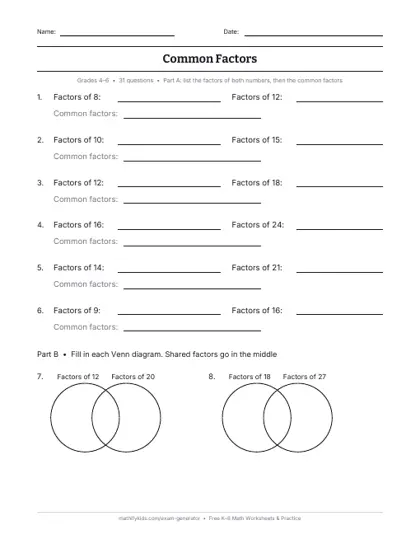
Common factors worksheet: printable PDF with an answer key. · Make a fresh test
Practice common factors online · GCF and LCM calculator · Factors and multiples worksheet
Last reviewed
Questions parents ask
What are common factors?
Numbers that divide two or more numbers exactly. The common factors of 8 and 12 are 1, 2 and 4.
How do you find common factors?
List the factors of each number in pairs, then circle the numbers that appear in every list.
What are the common factors of 12 and 18?
1, 2, 3 and 6. The greatest common factor is 6.
What is the difference between common factors and the GCF?
Common factors are all the numbers that divide both. The GCF is the largest of them, and every common factor is a factor of the GCF.
Can two numbers have only 1 as a common factor?
Yes. Numbers like 8 and 15 share no factor except 1. They are called relatively prime, or coprime.