
GCF and LCM word problems
In GCF and LCM word problems, the hard part is choosing. Splitting into the largest equal groups needs the GCF. Things happening together again need the LCM.
How to tell if a problem needs the GCF or the LCM
Ask one question: am I splitting things up, or waiting for things to line up?
- Splitting a set into the largest equal groups, pieces or squares uses the greatest common factor.
- Waiting until two repeating things match up uses the least common multiple.
| GCF clue words | LCM clue words |
|---|---|
| greatest number of groups or bags | when will they happen together again |
| largest size, longest pieces | smallest number you can buy |
| split, share, cut, arrange into rows | repeat, every, at the same time |
| with nothing left over | the same number of each |
| the answer is smaller than the numbers | the answer is bigger than the numbers |
Check the size of your answer
A GCF answer is never bigger than the smaller number in the story. If you are sharing 24 pencils, you cannot make 72 bags.
An LCM answer is never smaller than the bigger number. If one bus comes every 15 minutes, the buses cannot meet again after 5 minutes. This quick check catches most mix-ups.
Four steps for any GCF or LCM word problem
- Find the numbers in the story and what they count.
- Decide: splitting (GCF) or lining up (LCM)?
- Work it out by listing factors or multiples, or with prime factors.
- Answer the question asked. Some stories want the number of groups, others want what is in each group.
10 worked examples: GCF and LCM word problems
Cover the answer and try each one first.
1. Party bags (GCF)
Mia has 24 pencils and 36 erasers. She makes identical party bags with nothing left over. What is the greatest number of bags she can make?
Answer: Identical bags, nothing left over, greatest number: GCF. Factors of 24: 1, 2, 3, 4, 6, 8, 12, 24. Factors of 36: 1, 2, 3, 4, 6, 9, 12, 18, 36. GCF = 12, so 12 bags, each with 2 pencils and 3 erasers.
2. Two buses (LCM)
Bus A leaves every 12 minutes and bus B every 15 minutes. They both leave at 8:00. When do they next leave together?
Answer: Leave together again: LCM. Multiples of 15: 15, 30, 45, 60. 60 is a multiple of 12, so the LCM is 60 minutes. They leave together at 9:00.
3. Ribbon pieces (GCF)
Two ribbons are 18 cm and 30 cm long. Both are cut into pieces of the same length, as long as possible, with none left. How long is each piece?
Answer: Longest equal pieces: GCF. GCF(18, 30) = 6, so each piece is 6 cm. That gives 3 pieces and 5 pieces.
4. Hot dogs and buns (LCM)
Hot dogs come in packs of 10 and buns in packs of 8. What is the fewest hot dogs you can buy to have exactly one bun for each?
Answer: Same number of each, smallest amount: LCM. Multiples of 10: 10, 20, 30, 40. 40 is a multiple of 8. Buy 40 hot dogs (4 packs) and 40 buns (5 packs).
5. Square tiles (GCF)
A floor is 20 m by 28 m. It is covered with the largest square tiles that fit exactly. How long is each side of a tile?
Answer: Largest square that fits both sides: GCF. GCF(20, 28) = 4, so the tiles are 4 m by 4 m, in 5 rows of 7.
6. Flashing lights (LCM)
One light flashes every 4 seconds and another every 6 seconds. They flash together now. After how many seconds do they flash together again?
Answer: Happen together again: LCM. Multiples of 6: 6, 12. 12 is a multiple of 4, so after 12 seconds.
7. Flower bunches (GCF)
A florist has 45 roses and 60 tulips. Each bunch must be the same, with no flowers left. What is the greatest number of bunches?
Answer: GCF(45, 60) = 15, so 15 bunches, each with 3 roses and 4 tulips.
8. Running laps (LCM)
Sam runs a lap in 6 minutes and Ana in 9 minutes. They start together. When are they both back at the start?
Answer: Back at the start together: LCM. Multiples of 9: 9, 18. 18 is a multiple of 6, so after 18 minutes (Sam 3 laps, Ana 2).
9. Class teams (GCF)
A school has 32 girls and 40 boys. Teams must be equal, each with the same number of girls and of boys, and everyone plays. What is the most teams?
Answer: GCF(32, 40) = 8, so 8 teams, each with 4 girls and 5 boys.
10. Plates and cups (LCM)
Plates come in packs of 6 and cups in packs of 9. What is the smallest number of each you can buy to have the same number?
Answer: LCM(6, 9) = 18. Buy 18 plates (3 packs) and 18 cups (2 packs).
Word problem quiz
First decide GCF or LCM, then solve. Wrong answers explain the clue.
What to say to your child
A short script for teaching it the first time. Pause after each line and let your child do the next step.
- “Read the story. Are we splitting things up, or waiting for things to line up?”
- “Splitting into the biggest equal groups means the greatest common factor.”
- “Waiting for things to happen together means the least common multiple.”
- “Will the answer be smaller or bigger than the numbers in the story?”
- “Now find it, and check that it makes sense in the story.”
Practice questions (answers below)
Ask these out loud or write them down. Check each answer, and ask “how did you get that?” for one or two.
- 18 apples and 27 pears go into identical baskets, none left. Most baskets?
- Two clocks chime every 8 and 12 minutes. They chime together now. When next?
- Rods of 16 cm and 24 cm are cut into equal pieces, as long as possible. Piece length?
- Pens come in 5s and caps in 4s. Fewest pens to match the caps exactly?
- 36 red and 48 blue beads into identical necklaces, none left. Most necklaces?
- Two lighthouses flash every 10 and 14 seconds. When do they flash together?
- A 12 by 18 garden is split into the largest equal squares. Side length?
- Juice in packs of 6 and muffins in packs of 4. Fewest of each to match?
Show the answers
- GCF(18, 27) = 9
- LCM(8, 12) = 24 minutes
- GCF(16, 24) = 8 cm
- LCM(5, 4) = 20
- GCF(36, 48) = 12
- LCM(10, 14) = 70 seconds
- GCF(12, 18) = 6
- LCM(6, 4) = 12
Common mistakes
How to teach it at home
Snack sharing
Share 12 crackers and 18 grapes into identical plates. How many plates at most?
Clap together
One person claps every 3 beats, another every 4. Count to find when you clap together.
Shopping packs
Look at packs at the shop. How many of each do you need to match exactly?
By grade
- Grade 4 (4.OA.B.4): factor pairs and multiples, the skills behind these problems.
- Grade 6 (6.NS.B.4): find the GCF of two numbers to 100 and the LCM of two numbers to 12, and use them in problems.
- India: NCERT class 6 has common factor and common multiple puzzles in chapter 5, Prime Time.
More for each grade: Grade 6 math and the CBSE class 6 maths guide.
Worksheets and practice
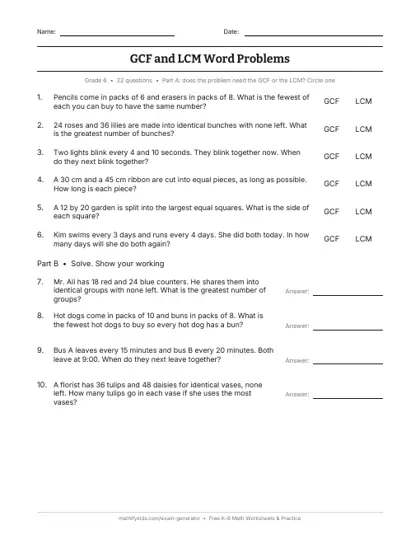
GCF and LCM word problems worksheet: printable PDF with an answer key. · Make a fresh test
Practice: GCF or LCM? · Practice word problems online · GCF and LCM calculator · GCF and LCM mixed (PDF)
Last reviewed
Questions parents ask
How do you know if a word problem is GCF or LCM?
If you are splitting things into the largest equal groups, pieces or squares, use the GCF. If you are finding when things happen together again, or the smallest amount that matches, use the LCM.
What are GCF word problem clue words?
Greatest number of groups, largest size, longest pieces, split, share, arrange into rows, and with nothing left over.
What are LCM word problem clue words?
Together again, at the same time, every, repeat, smallest number to buy, and the same number of each.
Is the GCF answer smaller or bigger than the numbers?
Smaller or equal. The GCF can never be bigger than the smaller number, while the LCM can never be smaller than the bigger number.
What grade does GCF and LCM word problems?
Grade 6 in the US (6.NS.B.4) and class 6 in India, after children know factors and multiples from grade 4.