
Before and after numbers
The number just before is 1 less, and the number just after is 1 more. The number between two others sits in the middle.
The idea: 1 less and 1 more
“Before” and “after” are about the counting order. The number just before 15 is 14, because 14 is 1 less. The number just after 15 is 16, because 16 is 1 more.
“Between” means in the middle. 15 is between 14 and 16. Children who understand this can find their way around any number, not just count from 1.
See it: pictures to draw with your child
Copy these onto paper or a whiteboard. A quick sketch makes the idea concrete before any written method.
On a number line
On a number line, before is one step to the left and after is one step to the right. Children can point and move a finger along.
The number line also shows “between” clearly. Ask your child to find two numbers with a gap and name the number in the gap.
Before and after a ten
The hardest cases cross a ten. The number after 39 is 40, and the number before 40 is 39. Many children say 30 before 40, because they think of the tens.
Practice these on the hundreds chart. The number before a ten is at the end of the row above.
Find before and after on the hundreds chart
Tap a number, then say the number before it and after it. Check by looking left and right.
Bigger numbers
Grade 1 works with numbers to 120. The number after 109 is 110, and the number before 101 is 100. The same rule works: 1 less and 1 more.
Later, the same idea gives 10 more and 10 less, and 100 more and 100 less. See 10 more and 10 less.
Before and after in real life
House numbers, page numbers and the floors in a building all use before and after. Ask your child which page comes after page 23, or which house is next door.
Waiting in a queue works too. Who is just before you, and who is just after? These small questions build the habit of thinking 1 more and 1 less without counting from 1.
Key words
- Before: the number that comes just before in counting: 1 less.
- After: the number that comes just after: 1 more.
- Between: the number in the middle of two others.
- 1 more: add 1: the next counting number.
- 1 less: take 1 away: the counting number before.
Teaching tip: use your body
Stand on a floor number line, or on stair steps. “Before” is a step back and “after” is a step forward.
Young children understand moving their own body long before they understand a picture. After a few days, move to a finger on a paper line.
A week of practice
Ten minutes a day is plenty. Short, regular practice beats one long session at the weekend.
- Day 1: after: say the next number for numbers to 20.
- Day 2: before: say the number before.
- Day 3: between: find the middle number.
- Day 4: around a ten: 29 and 30, 39 and 40.
- Day 5: the quiz on this page, then a round of before and after practice.
If one day goes badly, repeat it rather than moving on. Each day builds on the one before.
Quiz: before, after and between
Before is 1 less. After is 1 more.
Where this fits: number sense step by step
What to say to your child
A short script for teaching it the first time. Pause after each line and let your child do the next step.
- “What number comes after 7?” (8.)
- “And before 7?” (6.)
- “What number is between 6 and 8?” (7.)
- “What comes after 29?” (30.)
- “What comes before 50?” (49.)
More worked examples
Example 1: After
The number after 46 is 47, because 47 is 1 more.
Example 2: Before
The number before 60 is 59.
Example 3: Between
The number between 18 and 20 is 19.
Example 4: Past 100
The number after 109 is 110.
Practice questions (answers below)
Ask these out loud or write them down. Check each answer, and ask “how did you get that?” for one or two.
- What comes after 13?
- What comes before 13?
- What is between 24 and 26?
- What comes after 39?
- What comes before 70?
- What comes after 99?
- What is between 99 and 101?
- What comes before 101?
- What comes after 119?
- Stretch: what number is 2 before 50?
Show the answers
- 14
- 12
- 25
- 40
- 69
- 100
- 100
- 100
- 120
- 48
Common mistakes
How to teach it at home
Floor line
Tape numbers on the floor. Stand on one and step before or after as you call it out.
Card sandwich
Pick a number card. Your child finds the cards just before and after it and makes a sandwich.
Lift buttons
In a lift or on stairs, ask which floor is just before or just after.
By grade
- Kindergarten (K.CC.A.2, K.CC.C.7): count on from any number and compare numbers to 10.
- Grade 1 (1.NBT.A.1): count to 120 from any number, so before and after work with bigger numbers.
- In India, class 1 Mango Treat and Fun with Numbers use before, after and between.
- Next: the number line and comparing numbers.
More for each grade: Kindergarten math; Grade 1 math and the CBSE class 1 maths guide.
Worksheets and practice
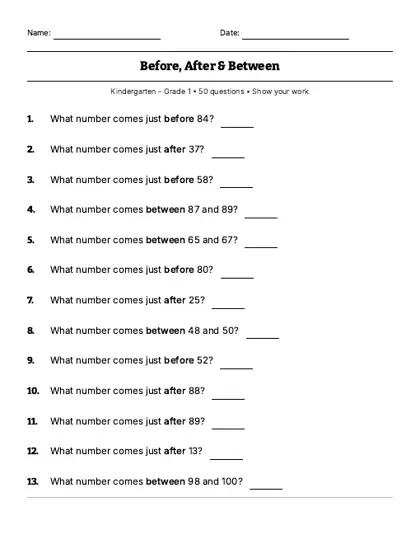
Before, after and between worksheet: printable PDF with an answer key. · Make a fresh test
Number sense practice · hundreds chart · number sense for kids · number chart · counting worksheet · hundreds chart worksheet · before, after and between (PDF)
Last reviewed
Questions parents ask
What does before and after mean in math?
The number before is 1 less, and the number after is 1 more. Before 15 is 14, and after 15 is 16.
What number is between 6 and 8?
7. It is 1 more than 6 and 1 less than 8.
How do you teach before and after numbers?
Use a number line or stairs. Before is a step back and after is a step forward.
What comes after 29?
30. After a 9 comes the next ten.
What grade learns before and after?
Kindergarten and grade 1, as part of counting (K.CC.A.2 and 1.NBT.A.1).