
10 more and 10 less
To find 10 more or 10 less, change only the tens digit: 10 more than 46 is 56. No counting by ones needed.
The idea: only the tens digit changes
Adding 10 adds one more ten. So 10 more than 46 is 5 tens and 6 ones: 56. The ones digit stays the same.
Taking away 10 takes away one ten. 10 less than 46 is 36. Children who see this stop counting on ten times and start using place value.
See it: pictures to draw with your child
Copy these onto paper or a whiteboard. A quick sketch makes the idea concrete before any written method.
The hundreds chart trick
On a hundreds chart, each row has 10 numbers. Moving straight down one row adds 10, and moving straight up takes 10 away.
Ask your child to put a finger on 46, then move down. They land on 56. Up from 46 is 36. After a few goes, they can picture the chart without it.
Crossing a hundred
Sometimes the tens digit is 9. 10 more than 95 is 105, because 9 tens and 1 more ten make 10 tens, which is 1 hundred.
Going down, 10 less than 104 is 94. There are no tens to take, so take 1 hundred and turn it into 10 tens. Base-ten blocks make this easy to see.
Check with the place value calculator
Type any number to see 10, 100 and 1,000 more and less, and which digit changed.
100 more and 100 less
Grade 2 (2.NBT.B.8) does the same with hundreds. 100 more than 352 is 452: only the hundreds digit changes.
The same thinking works for 1,000 more and less. 1,000 more than 4,507 is 5,507. Each time, find the place being changed and change only that digit.
Key words
- 10 more: add one ten. The tens digit goes up by 1.
- 10 less: take away one ten. The tens digit goes down by 1.
- Tens digit: the second digit from the right.
- Hundreds chart: a 10 by 10 grid of the numbers 1 to 100.
- Regroup: trade 10 tens for 1 hundred, or 1 hundred for 10 tens.
Teaching tip: say it in tens
Read numbers as tens and ones out loud: “46 is 4 tens and 6 ones.” Then ask: “What is one more ten?” Most children answer “5 tens and 6 ones” straight away.
If your child still counts on 47, 48, 49, praise the right answer, then show the shortcut on the hundreds chart. The shortcut makes the next step, mental addition of tens, much easier.
A week of practice
Ten minutes a day is plenty. Short, regular practice beats one long session at the weekend.
- Day 1: 10 more on the hundreds chart: move down a row.
- Day 2: 10 less: move up a row.
- Day 3: say it in tens without the chart.
- Day 4: crossing 100, with blocks or coins.
- Day 5: the quiz on this page, then one round of 10 more, 10 less practice.
If one day goes badly, repeat it rather than moving on. Each day builds on the one before.
Quiz: 10, 100 and 1,000 more or less
Change only one digit. Watch for a 9 or a 0!
Where this fits: place value step by step
What to say to your child
A short script for teaching it the first time. Pause after each line and let your child do the next step.
- “What is 46 in tens and ones?” (4 tens and 6 ones.)
- “Add one more ten. How many tens now?” (5.)
- “So what number is it?” (56.)
- “What happened to the 6?” (It stayed the same.)
- “What is 10 less than 46?” (36.)
More worked examples
Example 1: 10 more
10 more than 73 is 83. The tens digit goes from 7 to 8.
Example 2: 10 less
10 less than 58 is 48.
Example 3: crossing 100
10 more than 97 is 107. 9 tens and 1 more ten is 10 tens, which is 1 hundred.
Example 4: 100 less
100 less than 625 is 525.
Practice questions (answers below)
Ask these out loud or write them down. Check each answer, and ask “how did you get that?” for one or two.
- 10 more than 34
- 10 less than 81
- 10 more than 90
- 10 less than 106
- 100 more than 268
- 100 less than 503
- 10 more than 299
- 1,000 more than 2,450
- What is 10 more than 10 less than 57?
- Stretch: 100 less than 1,040
Show the answers
- 44
- 71
- 100
- 96
- 368
- 403
- 309
- 3,450
- 57
- 940
Common mistakes
How to teach it at home
Hundreds chart hop
Point to a number on a printed hundreds chart. Your child says 10 more and 10 less, then checks by moving down and up.
Coin swap
Make a number with ₹10 and ₹1 coins, or dimes and pennies. Add one ₹10 coin. What is the new amount?
Lift game
Pretend the hundreds chart is a building. Each floor is 10. Call out “up 2 floors from 34” and so on.
By grade
- Grade 1 (1.NBT.C.5): find 10 more or 10 less than a two-digit number in your head, without counting.
- Before this, children find 1 more and 1 less: see before, after and between and the hundreds chart.
- Grade 2 (2.NBT.B.8): mentally add or take away 10 or 100 from numbers between 100 and 900.
- In India, the class 3 chapters House of Hundreds I and II use the same patterns.
- Next: expanded form and regrouping.
More for each grade: Grade 1 math and the CBSE class 1 maths guide; Grade 2 math and the CBSE class 2 maths guide.
Worksheets and practice
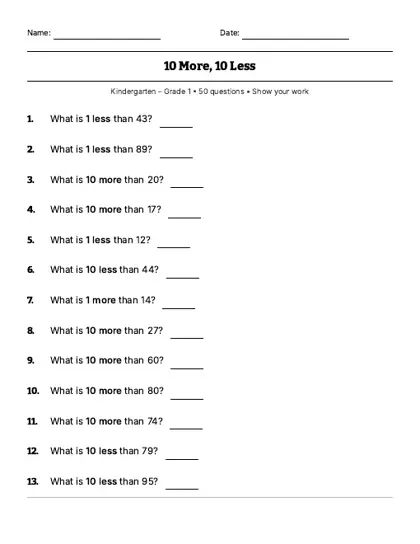
10 more 10 less worksheet: printable PDF with an answer key. · Make a fresh test
Place value practice · place value calculator · place value for kids · place value chart · place value worksheet · tens and ones worksheet
Last reviewed
Questions parents ask
What is 10 more than a number?
Add one ten. Only the tens digit changes: 10 more than 46 is 56.
How do you find 10 less?
Take one away from the tens digit. 10 less than 46 is 36.
What is 10 more than 95?
105. 9 tens and 1 more ten make 10 tens, which is 1 hundred.
Why use a hundreds chart?
Each row is 10 numbers long, so moving down a row adds 10 and moving up takes 10 away.
What grade learns 10 more and 10 less?
Grade 1 under Common Core 1.NBT.C.5. Grade 2 adds 100 more and 100 less (2.NBT.B.8).