
Place value of large numbers
Large numbers are read in groups of three digits called periods: ones, thousands and millions. Commas mark where each period starts.
The idea: periods of three
Every period has the same three places: hundreds, tens and ones. The ones period is plain ones, the next is thousands, and the next is millions.
So 305,042,100 is three periods: 305 million, 042 thousand and 100. Read each period as a small number, then say its name.
See it: pictures to draw with your child
Copy these onto paper or a whiteboard. A quick sketch makes the idea concrete before any written method.
The place value chart to hundred millions
The chart below shows nine places in three periods. The red lines are where the commas go.
Each digit’s value is the digit times its place. In 1,234,567, the 2 is in the hundred thousands place, so it is worth 200,000.
Each place is 10 times the place to its right
This is the big idea of grade 4 (4.NBT.A.1). A digit moved one place left is worth 10 times as much.
In 7,700, the 7 in the thousands place is worth 7,000, which is 10 times the 700 next to it. The same pattern runs all the way up to millions.
Try a big number
Type any number up to 999,999,999. The chart shows each period and what each digit is worth.
Reading and writing large numbers
To read a number, start at the left period. Read it, say its name, then move to the next. 4,000,050 is four million fifty: the empty thousands period is skipped.
To write a number from words, draw three boxes for each period first. Fill each period from the words, and put 0 in every empty place. Four million fifty becomes 4 | 000 | 050.
Comparing large numbers
First count the digits. A number with more digits is bigger: 1,000,000 is bigger than 999,999.
If they have the same number of digits, compare from the left, place by place. The first place where the digits differ decides. See comparing numbers for more.
Key words
- Period: a group of three places: ones, thousands, millions.
- Million: 1,000,000, a thousand thousands.
- Standard form: the number in digits with commas, like 4,000,050.
- Word form: the number in words: four million fifty.
- Expanded form: the values of the digits added: 4,000,000 + 50.
Teaching tip: commas first
Before reading any big number, ask your child to put in the commas, counting three digits from the right. Most reading mistakes vanish once the periods are marked.
Real numbers make it stick. City populations, distances to planets and cricket or football crowd sizes are all large numbers children want to read.
A week of practice
Ten minutes a day is plenty. Short, regular practice beats one long session at the weekend.
- Day 1: put commas in big numbers, then read them aloud.
- Day 2: the value of a digit in millions.
- Day 3: write numbers from words, with zeros in empty places.
- Day 4: compare and order large numbers.
- Day 5: the quiz on this page, then one round of large numbers practice.
If one day goes badly, repeat it rather than moving on. Each day builds on the one before.
Quiz: large numbers
Find the period first, then the place.
Where this fits: place value step by step
What to say to your child
A short script for teaching it the first time. Pause after each line and let your child do the next step.
- “Four million fifty has how many digits?” (7: 4, then six more.)
- “How many periods?” (Three: millions, thousands, ones.)
- “What is the millions period?” (4.)
- “What is in the thousands period?” (000, so we skip it.)
- “Read it all.” (Four million fifty.)
More worked examples
Example 1: value of a digit
In 6,482,019, the 4 is in the hundred thousands place, so it is worth 400,000.
Example 2: words to digits
Twelve million three thousand five is 12,003,005.
Example 3: 10 times
In 5,500, the first 5 is worth 5,000 and the second is worth 500: 10 times less.
Example 4: comparing
3,456,789 or 3,465,000? Millions and hundred thousands match. Ten thousands: 5 vs 6, so 3,465,000 is bigger.
Practice questions (answers below)
Ask these out loud or write them down. Check each answer, and ask “how did you get that?” for one or two.
- Put commas in 7500000.
- Value of 8 in 8,420,000
- Value of 3 in 2,735,104
- Write two million forty thousand in digits.
- Write 9,006,300 in words.
- Which is bigger, 989,999 or 1,000,001?
- How many thousands in 1 million?
- 10 times 450,000
- Round 4,675,000 to the nearest million.
- Stretch: what is 1,000 thousands?
Show the answers
- 7,500,000
- 8,000,000
- 30,000
- 2,040,000
- nine million six thousand three hundred
- 1,000,001
- 1,000
- 4,500,000
- 5,000,000
- 1,000,000
Common mistakes
How to teach it at home
Population hunt
Look up the population of your town, state and country. Read each number aloud and compare them.
Big number dictation
Say a large number. Your child writes it, then checks with the place value calculator.
Times 10 chain
Start at 4. Multiply by 10 again and again, reading each answer: 40, 400, 4,000 … up to 4 million.
By grade
- Grade 4 (4.NBT.A.1 and 4.NBT.A.2): numbers to 1,000,000, each place 10 times the next, standard, expanded and word form, comparing.
- Grade 5 (5.NBT.A.1): the same 10 times pattern, extended to decimals.
- In India, large numbers are read with lakhs and crores: see the Indian place value system and the class 7 chapter Large Numbers Around Us.
- Next: rounding large numbers.
More for each grade: Grade 4 math and the CBSE class 4 maths guide; Grade 5 math and the CBSE class 5 maths guide.
Worksheets and practice
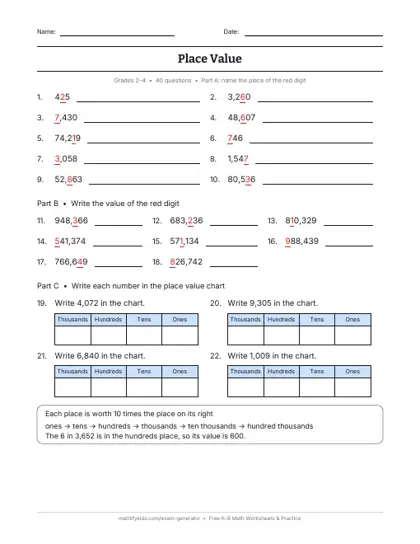
Place value worksheet: printable PDF with an answer key. · Make a fresh test
Place value practice · place value calculator · place value for kids · place value chart · place value worksheet
Last reviewed
Questions parents ask
What are periods in place value?
Groups of three places: ones, thousands and millions. Commas separate them, and each is read as one chunk.
How do you read a large number?
Put in the commas, then read each period from the left and say its name: 2,500,000 is two million five hundred thousand.
How many zeros are in a million?
Six: 1,000,000. It is a thousand thousands.
What does each place is 10 times the next mean?
A digit is worth 10 times as much as the same digit one place to its right. 700 is 10 times 70.
What grade learns large numbers?
Grade 4 under Common Core 4.NBT.A.1 and 4.NBT.A.2, with numbers up to 1,000,000.