
Expanded form
Expanded form writes a number as the value of each digit added together: 4,507 = 4,000 + 500 + 7. Quiz for kids, parent help below.
🧒 Kids: stretch the number out!
Each digit is worth something. In 4,507 the 4 is worth 4,000, the 5 is worth 500 and the 7 is worth 7. Add them: 4,000 + 500 + 7. Then try the quiz!
▶ Quiz 🔢 More practice 🧮 Calculator
💡 Trick: Write the digit, then one zero for every place to its right. Skip any 0!
More on place value: Tens and ones · Hundreds, tens and ones · Expanded form · Number names · Place value and face value
This part is for grown-ups: the key idea, pictures to draw, what to say, common mistakes, questions with answers and a free worksheet.
The trick: each digit, then its zeros
For each digit, write the digit and then a zero for every digit to its right. In 4,507, the 4 has three digits after it, so it is 4,000. The 5 has two, so it is 500. A 0 digit is skipped, because it adds nothing.
- 352: 300 + 50 + 2
- 4,507: 4,000 + 500 + 7
- 60,040: 60,000 + 40
- 9,009: 9,000 + 9
Patterns to spot
- The number of parts equals the number of digits that aren’t 0.
- Each part has the same number of zeros as places to its right.
- Adding the parts always gives the number back.
- Expanded form with multiplication shows the digit times its place: 5 × 100.
- The parts get 10 times smaller from left to right, when no digit is 0.
- Going back to standard form, each empty place gets a 0.
Key words
- Standard form: the usual way to write a number with digits, like 4,507.
- Expanded form: the number written as the sum of the values of its digits: 4,000 + 500 + 7.
- Expanded notation: another name for expanded form, sometimes with multiplication: 4 × 1,000 + 5 × 100 + 7 × 1.
- Word form: the number written in words: four thousand five hundred seven.
- Value of a digit: what the digit is worth in its place. The 5 in 4,507 is worth 500.
Why it matters: Expanded form shows exactly what each digit is worth. It is the idea behind mental maths, partial sums and the area model for multiplication, and later it explains decimals.
See it: pictures to draw with your child
Draw these on paper, or build them with sticks, blocks or coins. Seeing the groups makes the digits make sense.
What your child already knows
Children already know that each digit has a value, such as the 3 in 352 being 300. Expanded form simply writes those values out with + signs between them.
In real life: Paying ₹4,507 with notes is expanded form: four ₹1,000 notes, five ₹100 notes and seven ₹1 coins. Cheques and receipts write amounts in words, which is the next step.
Three ways to write the same number
| Form | 4,507 | 60,040 |
|---|---|---|
| Standard form | 4,507 | 60,040 |
| Expanded form | 4,000 + 500 + 7 | 60,000 + 40 |
| Expanded with multiplication | 4 × 1,000 + 5 × 100 + 7 × 1 | 6 × 10,000 + 4 × 10 |
| Word form | four thousand five hundred seven | sixty thousand forty |
Grade 2 uses the first, second and fourth rows. Grade 4 adds expanded form with multiplication. In grade 5, the same idea extends to powers of 10, like 4 × 10³.
Worked examples
Example 1: Standard to expanded
- Write 3,862 in expanded form.
- The 3 is worth 3,000, the 8 is worth 800, the 6 is worth 60 and the 2 is worth 2.
- So 3,862 = 3,000 + 800 + 60 + 2.
Example 2: With a zero
- Write 5,027 in expanded form.
- 5 is worth 5,000.
- The 0 adds nothing, so skip it.
- 2 is worth 20 and 7 is worth 7.
- So 5,027 = 5,000 + 20 + 7.
Example 3: Expanded to standard
- Write 7,000 + 40 + 3 as one number.
- Draw four boxes: thousands, hundreds, tens and ones.
- Put 7, 0, 4, 3.
- The number is 7,043.
Common mistakes
What to say to your child
A short script for your first session. Pause after each line and let your child answer.
- “What is the 4 in 4,507 worth?” (4,000.)
- “How do you know?” (It has three digits after it.)
- “What is the 5 worth?” (500.)
- “What about the 0?” (Nothing, so we skip it.)
- “Add them back: 4,000 + 500 + 7?” (4,507.)
Questions to try (answers below)
Ask these out loud or write them down. The last one is a stretch.
- Write 846 in expanded form.
- Write 2,519 in expanded form.
- Write 7,080 in expanded form.
- 600 + 30 + 5
- 9,000 + 70 + 1
- 40,000 + 300 + 2
- Write 3 × 1,000 + 4 × 10 as one number.
- 500 + ? + 4 = 594
- Stretch: 5,000 + 13 tens + 4
Show the answers
- 800 + 40 + 6
- 2,000 + 500 + 10 + 9
- 7,000 + 80
- 635
- 9,071
- 40,302
- 3,040
- 90
- 5,134
Games to play at home
Arrow cards
Make cards for 1,000s, 100s, 10s and 1s. Lay 4,000, 500 and 7 on top of each other, right-aligned, to make 4,507.
Expand the price
Pick prices from a shop leaflet and write them in expanded form, then check by adding.
Dice expand
Roll four dice to make a four-digit number. Write it in expanded form. A partner checks by adding the parts.
A 5-day plan for expanded form
Ten minutes a day is enough. Short, regular practice works far better than one long session.
- Day 1: Learn it with the pictures above: draw them on paper or build them with blocks, and talk them through.
- Day 2: Read the script together, then ask the first four questions.
- Day 3: Do the quiz at the top of the page and read the working for anything missed.
- Day 4: Play one of the games at home for ten minutes.
- Day 5: Ask the rest of the questions, then do a round of the matching practice skill.
By grade
Grade 2 (Common Core 2.NBT.A.3) reads and writes numbers to 1,000 in standard form, expanded form and words. Grade 4 (4.NBT.A.2) does the same for numbers to 1,000,000. In India, expanded form is taught from class 3 with numbers to 999 and continues with lakhs.
CBSE families: see the class 4 parent guide for Thousands Around Us.
More for each grade: Grade 2 math and the CBSE class 2 maths guide; Grade 3 math and the CBSE class 3 maths guide; Grade 4 math and the CBSE class 4 maths guide.
What comes next
Next, learn number names and place value and face value. Expanded form is the idea behind partial sums and the area model. For decimals, see decimal place value.
Worksheet and more practice
Print a free worksheet with an answer key, or keep practicing online with place value practice.
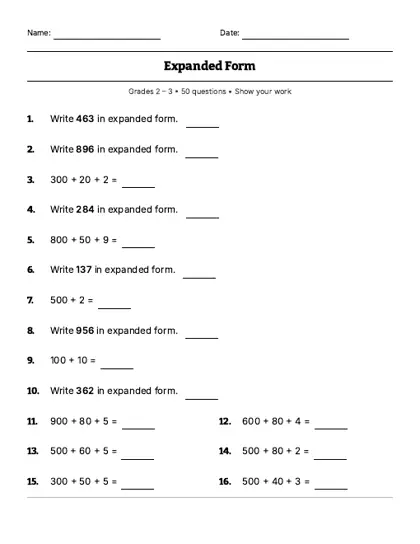 Expanded form
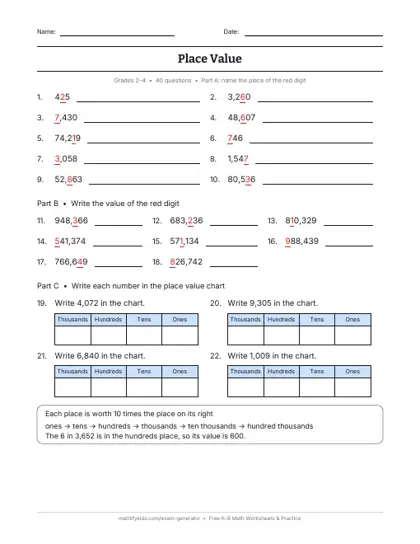 Place value
Printable worksheets: hundreds, tens and ones worksheet · number names worksheet · make a fresh place value test
More: place value for kids · place value calculator · practice · place value chart · decimal place value
Last reviewed
Questions parents ask
What is expanded form?
A number written as the sum of the values of its digits. 4,507 in expanded form is 4,000 + 500 + 7.
What happens to zeros in expanded form?
They are left out, because a 0 adds nothing. 6,040 is 6,000 + 40.
What is expanded form with multiplication?
Each part is written as a digit times its place: 4 × 1,000 + 5 × 100 + 7 × 1.
What is the difference between expanded form and standard form?
Standard form is the usual number, 4,507. Expanded form splits it into parts: 4,000 + 500 + 7.
What grade learns expanded form?
Grade 2 under Common Core 2.NBT.A.3, with numbers to 1,000. Grade 4 extends it to 1,000,000 (4.NBT.A.2).