
Number patterns for kids
A number pattern follows a rule, like “add 2” or “take away 5”. Find the rule, and you can find any missing number.
The idea: find the rule
A number pattern is a list of numbers that follows a rule. In 3, 5, 7, 9 the rule is “add 2”. The next number is 11.
To find the rule, look at two numbers next to each other and ask: what changed? Then check that the same change works all the way along.
See it: pictures to draw with your child
Copy these onto paper or a whiteboard. A quick sketch makes the idea concrete before any written method.
Skip-count patterns
The first patterns most children meet are skip counts: 2, 4, 6, 8, and 5, 10, 15, 20. Grade 2 skip counts by 5s, 10s and 100s (2.NBT.A.2).
Skip counting is the start of the times tables. See skip counting for each one.
Shrinking patterns
Patterns can go down too. 50, 45, 40, 35 takes away 5 each time. 20, 18, 16 takes away 2.
Shrinking patterns are harder, because counting back is harder than counting on. A number line helps: each jump goes left.
See patterns on the hundreds chart
Tap Count by 2s, 5s or 10s. Each pattern makes its own shape on the chart.
Growing patterns
Some patterns grow by more each time: 1, 2, 4, 7, 11. The jumps are +1, +2, +3, +4. The next jump is +5, giving 16.
These are a stretch for grade 2, but they are a good puzzle. Write the jumps above the numbers so the rule is easy to see.
Number patterns in real life
House numbers on one side of a street often go up in 2s: 2, 4, 6, 8. Calendars go up by 7 down each column, because a week has 7 days.
Ask your child to spot a pattern on the calendar. What do the Mondays have in common? Finding real patterns makes the rule feel useful, not just a puzzle.
Key words
- Pattern: numbers that follow a rule.
- Rule: what to do to get the next number, like add 3.
- Term: one number in the pattern.
- Missing number: a gap to fill using the rule.
- Skip count: count on by the same number each time.
Teaching tip: write the jumps
Ask your child to write the jump above each gap: +2, +2, +2. The rule jumps out, and a mistake shows up straight away.
Then ask them to make their own pattern for you to solve. Making patterns is harder than finding them, and great practice.
A week of practice
Ten minutes a day is plenty. Short, regular practice beats one long session at the weekend.
- Day 1: patterns that add 1, 2 or 10.
- Day 2: skip-count patterns by 5s and 10s.
- Day 3: shrinking patterns that take away.
- Day 4: find the missing number in the middle.
- Day 5: the quiz on this page, then a round of number patterns practice.
If one day goes badly, repeat it rather than moving on. Each day builds on the one before.
Quiz: what number is missing?
Look at two numbers next to each other. What is the rule?
Where this fits: number sense step by step
What to say to your child
A short script for teaching it the first time. Pause after each line and let your child do the next step.
- “Look at 2, 4, 6. What changes each time?” (It goes up by 2.)
- “So what comes next?” (8.)
- “Now 20, 15, 10. What changes?” (It goes down by 5.)
- “What comes next?” (5.)
- “Can you make a pattern for me?” (Makes one.)
More worked examples
Example 1: Add
4, 8, 12, 16: the rule is add 4, so the next is 20.
Example 2: Take away
30, 27, 24: the rule is take away 3, so the next is 21.
Example 3: Missing middle
10, 20, __, 40: the rule is add 10, so the missing number is 30.
Example 4: Growing
2, 3, 5, 8: the jumps are +1, +2, +3, so the next is 12.
Practice questions (answers below)
Ask these out loud or write them down. Check each answer, and ask “how did you get that?” for one or two.
- 5, 10, 15, __
- 2, 4, 6, __
- 30, 40, __, 60
- 20, 18, 16, __
- 100, 90, 80, __
- 7, 10, 13, __
- 1, 3, 5, 7, __
- What is the rule in 12, 22, 32?
- Stretch: 1, 2, 4, 7, __
Show the answers
- 20
- 8
- 50
- 14
- 70
- 16
- 9 (odd numbers)
- add 10
- 11
Common mistakes
How to teach it at home
Clap patterns
Clap and count on every second clap: 2, 4, 6. Then switch to 5s.
Pattern guess
Say three numbers in a pattern. Your child says the rule and the next number.
Stair patterns
Go up stairs two at a time and count: 2, 4, 6. Come down in 2s: 10, 8, 6.
By grade
- Grade 1 (1.OA.C.5): count on and back, which is how patterns are found.
- Grade 2 (2.NBT.A.2, 2.OA.C.3): skip count by 5s, 10s and 100s, and spot even and odd patterns.
- In India, class 1 Utsav is a chapter on patterns.
- Next: skip counting, even and odd numbers and the number patterns chart.
More for each grade: Grade 1 math and the CBSE class 1 maths guide; Grade 2 math and the CBSE class 2 maths guide.
Worksheets and practice
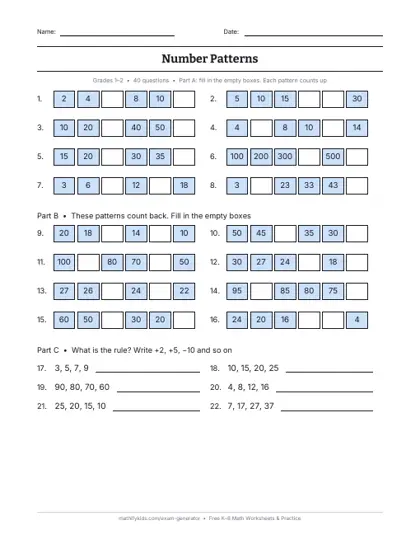
Number patterns worksheet: printable PDF with an answer key. · Make a fresh test
Number sense practice · hundreds chart · number sense for kids · number chart · counting worksheet · hundreds chart worksheet · number patterns chart
Last reviewed
Questions parents ask
What is a number pattern?
A list of numbers that follows a rule, such as add 2: 2, 4, 6, 8.
How do you find the rule in a number pattern?
Look at two numbers next to each other and see what changed. Check the same change works for every pair.
How do you find a missing number in a pattern?
Find the rule, then use it on the number just before the gap.
What is a growing pattern?
A pattern where the jump gets bigger each time, like 1, 2, 4, 7 (+1, +2, +3).
What grade learns number patterns?
Grades 1 and 2 meet counting and skip-count patterns. Growing patterns are a grade 2 stretch.