
Estimation for kids
An estimate is a sensible guess, close to the real number, made without counting every one. Estimate first, then count to check.
The idea: a sensible guess
An estimate is a guess that is close, not exact. If a jar holds 32 beans, “about 30” is a great estimate. “About 100” is not.
Estimating builds number sense, because children have to think about how big a number is. It also helps them check answers later: is it about right?
See it: pictures to draw with your child
Copy these onto paper or a whiteboard. A quick sketch makes the idea concrete before any written method.
Use a benchmark
A benchmark is an amount you already know. Show your child what 10 beans look like in a small jar. Then show a bigger jar and ask: is it more or less than 10?
Benchmarks of 10, 20 and 50 work well. A child can say “that is about two tens, so about 20.”
Estimate, then count
Always count after estimating. The aim is not to win, but to get closer each time.
Ask “was it more or less than your guess?” Over a few weeks, estimates get much closer, which is exactly the number sense you want.
Estimating on a number line
Children can estimate where a number goes on a line with only the ends marked. Where is 50 on a line from 0 to 100? About halfway.
Where is 25? About a quarter of the way. This links estimation to the number line and later to rounding.
Estimation in real life
Grown-ups estimate all the time. About how long will the drive take? About how many people are coming? Do we have enough juice?
Say your own estimates out loud so your child hears them. “There are about 20 grapes left, so that’s enough for both of us.” It shows that estimating is a normal, useful skill.
Key words
- Estimate: a sensible guess, close to the real number.
- Exact: the real number, found by counting.
- About: close to, but not exactly.
- Benchmark: an amount you already know, like 10.
- Closer: an estimate nearer to the real number.
Teaching tip: praise close guesses
Children often think an estimate is “wrong” if it isn’t exact. Praise a close guess: “You said 30 and it was 32. That’s a great estimate!”
Avoid wild guesses by giving choices at first, like “about 10, 30 or 100?”. Later, let your child guess freely.
A week of practice
Ten minutes a day is plenty. Short, regular practice beats one long session at the weekend.
- Day 1: show 10 objects, then estimate a bigger group.
- Day 2: estimate, then count a jar of pasta.
- Day 3: estimate in groups of ten.
- Day 4: estimate where a number goes on a 0 to 100 line.
- Day 5: the quiz on this page, then a round of estimating practice.
If one day goes badly, repeat it rather than moving on. Each day builds on the one before.
Quiz: about how many?
Don’t count them all. Pick the closest estimate.
Where this fits: number sense step by step
What to say to your child
A short script for teaching it the first time. Pause after each line and let your child do the next step.
- “This jar has 10 buttons.” (Show.)
- “Look at this bigger jar. More or less than 10?” (More.)
- “About how many? 20, 50 or 100?” (20.)
- “Let’s count to check.” (Counts 23.)
- “Was 20 close?” (Yes, very close!)
More worked examples
Example 1: A jar
A jar looks about twice as full as the 10 jar. Estimate about 20. Counting gives 22.
Example 2: Groups of ten
Split a pile into a few rough tens in your head. Three tens is about 30.
Example 3: A number line
On a 0 to 20 line, 15 is three quarters of the way along.
Example 4: Check the answer
A child adds 18 + 21 and gets 93. Estimate: about 20 + 20 = 40. So 93 must be wrong.
Practice questions (answers below)
Ask these out loud or write them down. Check each answer, and ask “how did you get that?” for one or two.
- About how many fingers do 3 people have?
- A small cup of pasta or a big bowl: which holds about 100?
- Estimate: 19 + 21
- Where is 50 on a 0 to 100 line?
- Is 48 closer to 40 or 50?
- A bag looks like 3 jars of 10. Estimate.
- Is 12 closer to 10 or 20?
- Estimate the children in a class
- Stretch: about how many days are in 3 months?
Show the answers
- about 30 (exactly 30)
- the big bowl
- about 40
- halfway
- 50
- about 30
- 10
- about 20 to 30
- about 90
Common mistakes
How to teach it at home
Jar of the week
Fill a jar with something new each week. Everyone estimates, then you count together.
Shopping estimate
Estimate how many apples are in a bag before you buy it.
Steps to the door
Estimate how many steps it is to the door, then walk and count.
By grade
- Kindergarten (K.CC.B.5): count up to 20 objects; estimating first makes counting meaningful.
- Grade 2 (2.MD.A.3): estimate lengths, and use estimates to check answers.
- Estimation leads to rounding in grade 3. See how to round numbers.
- Next: the number line and rounding.
More for each grade: Kindergarten math; Grade 1 math and the CBSE class 1 maths guide; Grade 2 math and the CBSE class 2 maths guide.
Worksheets and practice
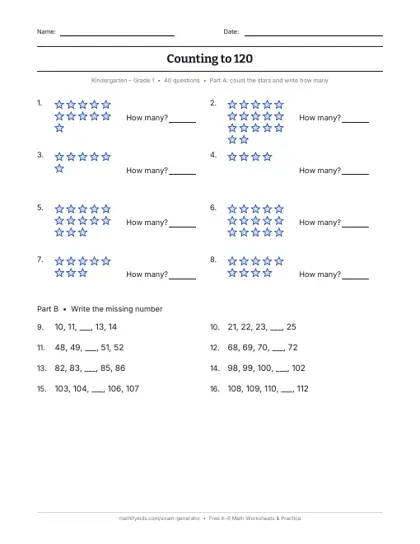
Counting worksheet: printable PDF with an answer key. · Make a fresh test
Number sense practice · hundreds chart · number sense for kids · number chart · counting worksheet · hundreds chart worksheet · how to round numbers
Last reviewed
Questions parents ask
What is estimation for kids?
Making a sensible guess that is close to the real number, without counting every one.
Why is estimation important?
It builds a feel for how big numbers are, and it helps children check whether an answer makes sense.
How do you teach estimation?
Start with a benchmark, like a jar of 10. Estimate a bigger group, then count to check, and talk about how close it was.
Is an estimate wrong if it isn’t exact?
No. A good estimate is close. 30 is a great estimate for 32.
What grade learns estimation?
Children start estimating in kindergarten and grade 1, and grade 2 estimates lengths (2.MD.A.3). Rounding follows in grade 3.