
Teen numbers
Teen numbers are 11 to 19. Each one is 10 and some more: 14 is 10 and 4. Quiz for kids, parent help below.
🧒 Kids: 10 and some more!
Fill one ten frame and you have 10. Put some more on a second frame. 10 and 4 more is 14!
▶ Quiz 🔢 More practice 💯 Hundreds chart
💡 Trick: Say 16 as “ten and six”. The 1 is the ten, the 6 is the extra ones!
More on number sense: Ten frames · Subitizing · Number line · Teen numbers · Ordinal numbers
This part is for grown-ups: the key idea, pictures to draw, what to say, common mistakes, questions with answers and free printables.
The trick: say “ten and…”
Ask your child to say each teen number as “ten and…”. Then write it: the 1 for the ten, then the extra ones. Fourteen becomes “ten and four”, and the digits come out in the right order.
- 10 and 3: 13
- 10 and 7: 17
- 18 is 10 and…: 8
- 12 is 10 and…: 2
Patterns to spot
- Every teen number starts with 1, for one ten.
- The second digit counts the extra ones.
- Each teen number is 1 more than the one before.
- 19 and 1 more makes 20, which is 2 tens.
- 13 to 19 end in “teen”, which means ten.
- Two ten frames show every teen number.
Key words
- Teen numbers: the numbers 11 to 19. Each one is 10 and some more.
- Ten: a group of 10 ones, like a full ten frame or a bundle of 10 sticks.
- Ones: the extra ones after the ten. In 16 there are 6.
- Tens place: the first digit of a teen number, always 1, meaning one ten.
- Ones place: the second digit. In 17 it is 7.
- Decade: a group of ten numbers, like the teens or the twenties.
Why it matters: Teen numbers are the first numbers bigger than 10. Seeing 14 as 10 and 4 is the start of place value, and it makes adding past 10 much easier.
See it: pictures to draw with your child
Draw these on paper, or build them with buttons, blocks or toys. Seeing the groups makes the numbers make sense.
What your child already knows
Children who can count to 20 already say the teen numbers. This page adds the structure inside them: a ten and some ones. Ten frames and fingers both show it.
In real life: Ten fingers and some toes, a box of 10 crayons and some loose ones, or 10 rupees and some coins. Ask: “How many in the box, and how many more?”
Why teen numbers sound backwards
In English, “fourteen” says the 4 first, but we write the 1 first. That is why many children write 41 for fourteen.
“Eleven” and “twelve” are even harder, because they don’t sound like “ten and one” or “ten and two”. Saying the numbers the long way helps for a few weeks.
| Number | Say it the long way | Ten frames |
|---|---|---|
| 11 | ten and one | 1 full frame and 1 |
| 12 | ten and two | 1 full frame and 2 |
| 13 | ten and three | 1 full frame and 3 |
| 14 | ten and four | 1 full frame and 4 |
| 15 | ten and five | 1 full frame and 5 |
| 16 | ten and six | 1 full frame and 6 |
| 17 | ten and seven | 1 full frame and 7 |
| 18 | ten and eight | 1 full frame and 8 |
| 19 | ten and nine | 1 full frame and 9 |
Many other languages say teen numbers as “ten-four”. Children who hear the number that way find teen numbers easier, so it is worth borrowing the habit at home.
Worked examples
Example 1: Build 17
- Fill one ten frame with 10 counters.
- Put 7 more on a second frame.
- 10 and 7 make 17.
Example 2: Split 15
- 15 starts with 1, so it has one ten.
- The 5 means 5 more ones.
- 15 is 10 and 5.
Example 3: Fix 41 for fourteen
- Fourteen is “ten and four”.
- Write the ten first, as 1, then the 4.
- The number is 14.
Common mistakes
What to say to your child
A short script for your first session. Pause after each line and let your child answer.
- “How many in a full ten frame?” (10.)
- “I add 3 more. How many now?” (13.)
- “Say it the long way.” (Ten and three.)
- “Which digit shows the ten?” (The 1.)
- “What is 10 and 8?” (18.)
- “How many more than 10 is 15?” (5.)
Questions to try (answers below)
Ask these out loud, with objects or pictures to hand. The last one is a stretch.
- 10 and 2
- 10 and 9
- 16 is 10 and…
- 11 is 10 and…
- Write fourteen in digits
- A full ten frame and 5 more
- What is 1 more than 19?
- Which is bigger, 13 or 31?
- Stretch: 10 and 10
Show the answers
- 12
- 19
- 6
- 1
- 14
- 15
- 20
- 31
- 20
Games to play at home
Ten and some more
Put 10 buttons in a cup. Add a few loose buttons and ask your child to say the number as “ten and…”.
Teen number war
Use cards 1 to 9 and add 10 to each card. The higher teen number wins.
Fingers and toes
Hold up 10 fingers and wiggle some toes. How many altogether?
A 5-day plan for teen numbers
Ten minutes a day is enough. Short, regular practice works far better than one long session.
- Day 1: Learn it with the pictures above: draw them on paper or build them with real objects, and talk them through.
- Day 2: Read the script together, then ask the first four questions.
- Day 3: Do the quiz at the top of the page and read the working for anything missed.
- Day 4: Play one of the games at home for ten minutes.
- Day 5: Ask the rest of the questions, then do a round of the matching practice skill.
By grade
Kindergarten (Common Core K.NBT.A.1) shows teen numbers as ten ones and some more ones, using drawings or objects. Grade 1 (1.NBT.B.2) adds that the 1 in a teen number means one ten. In India, NCERT class 1 covers numbers 10 to 20 in “Making 10”.
CBSE families: the class 1 parent guide for Making 10 covers numbers 10 to 20.
More for each grade: Kindergarten math; Grade 1 math and the CBSE class 1 maths guide.
What comes next
Next, learn tens and ones for all two-digit numbers, then counting to 120. For adding past 10, see make 10.
Worksheets and more practice
Print a free worksheet with an answer key, or keep practicing online with number sense practice.
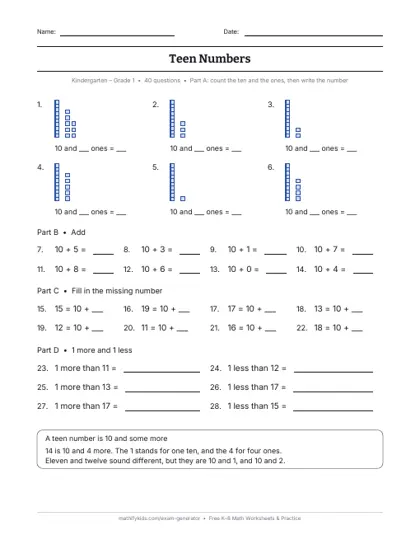 Teen numbers
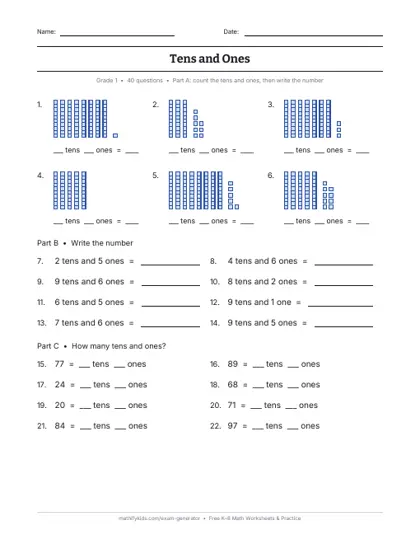 Tens and ones
More printables: teen numbers worksheet · tens and ones worksheet · make a fresh test
More: number sense for kids · hundreds chart · practice · number chart · place value
Last reviewed
Questions parents ask
What are teen numbers?
The numbers 11 to 19. Each one is made of one ten and some more ones, like 15 = 10 + 5.
Why do children write teen numbers backwards?
Because the names say the ones first. “Fourteen” sounds like 4 then 10, but we write 14. Saying “ten and four” helps.
How do you teach teen numbers?
Use two ten frames or bundles of 10 sticks. Fill one ten, add some more, and say the number as “ten and…”.
Is 20 a teen number?
No. 20 is two tens. Teen numbers are 13 to 19, and 11 and 12 are usually taught with them.
What grade learns teen numbers?
Kindergarten, under Common Core K.NBT.A.1. Grade 1 builds on it with tens and ones (1.NBT.B.2).