
Dividing by 3 and 4
Divide by 4 by halving twice, and by 3 by counting in 3s or thinking of the 3 times table. Practice for kids, parent help below.
🧒 Kids: divide by 3 and 4!
Use the tricks. Then tap Practice!
▶ Practice ⏱️ 1-minute challenge
Facts to learn
- 12 ÷ 3 = 4
- 21 ÷ 3 = 7
- 27 ÷ 3 = 9
- 16 ÷ 4 = 4
- 28 ÷ 4 = 7
- 36 ÷ 4 = 9
💡 Trick: 36 ÷ 4? Half of 36 is 18, half of 18 is 9!
More facts: ÷ 2, 5 and 10 · ÷ 3 and 4 · ÷ 6, 7, 8 and 9 · ÷ 0 and 1 · Fact families · Within 100
This part is for grown-ups: the trick that makes these facts easy, pictures to draw, what to say, common mistakes, questions with answers and a free worksheet.
The trick: halve twice for 4, count in 3s for 3
Dividing by 4 is the same as halving and then halving again, because 4 is 2 × 2. Children who can halve can divide by 4 without knowing the 4 times table by heart. Dividing by 3 has no halving shortcut, so count in 3s until you reach the number, or ask “3 times what makes this?” using the 3 times table.
- 24 ÷ 4: halve twice: 24 → 12 → 6
- 32 ÷ 4: 32 → 16 → 8
- 18 ÷ 3: count in 3s: 3, 6, 9, 12, 15, 18. Six 3s
- 27 ÷ 3: 3 × 9 = 27, so 9
Patterns to spot
- Numbers that divide by 4 are always even, and halving them gives another even number.
- The digits of a number that divides by 3 add up to a multiple of 3: 27 → 2 + 7 = 9.
- Dividing by 4 gives half the answer of dividing by 2: 24 ÷ 2 = 12, 24 ÷ 4 = 6.
- 12 is in both tables: 12 ÷ 3 = 4 and 12 ÷ 4 = 3.
- The answers go up by 1 each time the number goes up by 3 (for ÷ 3) or 4 (for ÷ 4).
See it: pictures to draw with your child
Draw these on paper or a whiteboard. Seeing the counters makes the fact stick.
Facts you already know
There are 20 facts in the 3 and 4 tables up to 40 ÷ 4. Some are already known from the 2 and 10 tables: 12 ÷ 4 = 3 pairs with 12 ÷ 3 = 4, and 20 ÷ 4 = 5 pairs with 20 ÷ 5 = 4. Children who can halve can work out every ÷ 4 fact, which leaves only a handful of ÷ 3 facts to learn.
In real life: Look for 3s and 4s: “A car has 4 wheels. There are 28 wheels in the car park. How many cars?” “Share 18 apples among 3 friends.” Tricycles and three-legged stools make good stories too.
Worked examples
Example 1: 28 ÷ 4 by halving
- Half of 28 is 14.
- Half of 14 is 7.
- So 28 ÷ 4 = 7.
- Check: 7 × 4 = 28.
Example 2: 21 ÷ 3 with an array
- Draw 21 dots in 3 equal rows.
- Each row has 7 dots.
- So 21 ÷ 3 = 7.
Example 3: a grouping story
- “There are 24 legs on the chairs.
- Each chair has 4 legs.
- How many chairs?”
- 24 ÷ 4: halve to 12, halve to 6.
- 6 chairs.
Common mistakes
What to say to your child
A short script for your first session. Pause after each line and let your child answer.
- “Here are 12 cars. Put them into rows of 4.” (Makes 3 rows.)
- “How many rows?” (3.) “So 12 ÷ 4 = 3.”
- “Now put the same 12 into rows of 3. How many rows?” (4.) “12 ÷ 3 = 4.”
- “What is half of 20? And half of that?” (10, then 5!) “So 20 ÷ 4 = 5.”
- “Which trick would you use for 18 ÷ 3?” (Count in 3s: 6!)
Questions to try (answers below)
Ask these out loud or write them down. The last one is a stretch.
- 9 ÷ 3
- 15 ÷ 3
- 24 ÷ 3
- 16 ÷ 4
- 32 ÷ 4
- 40 ÷ 4
- ? ÷ 4 = 9
- There are 27 children in teams of 3. How many teams?
- Stretch: 48 ÷ 4
Show the answers
- 3
- 5
- 8
- 4
- 8
- 10
- 36
- 9 teams
- 12
Games to play at home
Wheel count
Count wheels on cars or tricycles in a picture book and divide to find how many.
Halving race
Call out an even number and race to halve it twice.
Share in threes
Deal a pile of cards into 3 equal piles and count each pile.
A 5-day plan for dividing by 3 and 4
Ten minutes a day is enough. Short, regular practice helps facts stick far better than one long session.
- Day 1: Learn it with objects. Use the pictures above with real counters, fingers or toys.
- Day 2: Read the script together, then ask the first four questions.
- Day 3: Play one round in the practice tool at the top of the page, with no timer.
- Day 4: Play one of the games above for ten minutes.
- Day 5: Ask the rest of the questions, then try the 1-minute challenge and write down the score.
Next week, repeat the round in the practice tool and compare the fact map. When most facts are green, move on to the next page.
By grade
Grade 3 (3.OA.A.2 and 3.OA.B.6) uses division as sharing and as an unknown-factor problem: 32 ÷ 4 asks 4 × ? = 32. By the end of grade 3, children divide within 100 fluently (3.OA.C.7). In India, the 3 and 4 tables and their division facts are class 3 maths.
More for each grade: Grade 3 math and the CBSE class 3 maths guide.
What comes next
Next come the harder facts: dividing by 6, 7, 8 and 9. Halving twice for ÷ 4 leads straight to halving three times for ÷ 8. Keep the 3 and 4 times tables going alongside, and see arrays for more pictures.
Worksheet and more practice
Print a free worksheet with an answer key, or keep practicing online with the division practice trainer.
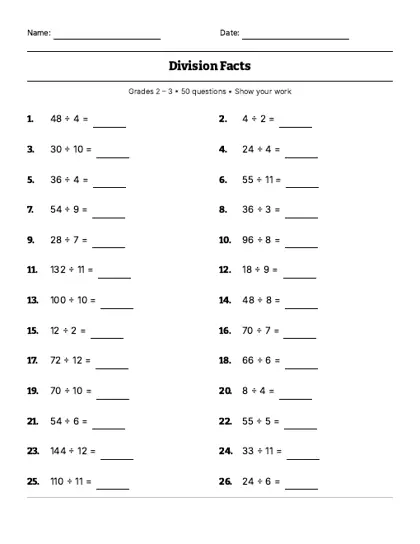 Division facts
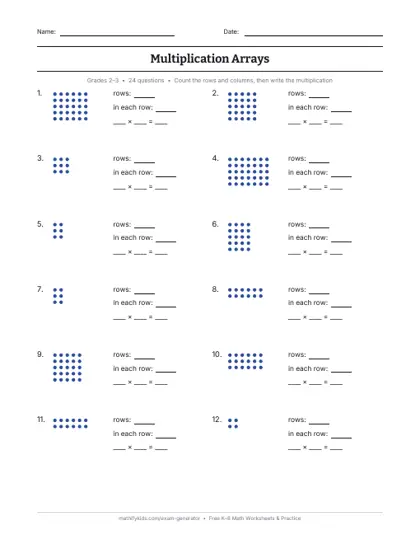 Multiplication arrays
More: division for kids · division facts lesson · division chart · times tables
Last reviewed
Questions parents ask
What is the trick for dividing by 4?
Halve the number twice. 36 ÷ 4: half of 36 is 18, half of 18 is 9. So 36 ÷ 4 = 9.
How do you divide by 3?
Count in 3s until you reach the number and count how many 3s you said, or ask “3 times what makes this?” using the 3 times table.
How can I tell if a number divides by 3?
Add its digits. If the total is 3, 6, 9 or another multiple of 3, the number divides by 3. 27: 2 + 7 = 9, so yes.
Should my child learn the 3 and 4 tables before dividing?
Learning them together works best. Each division fact is a times table fact turned around: 4 × 7 = 28, so 28 ÷ 4 = 7.
What grade learns dividing by 3 and 4?
Grade 3 (class 3), after the 2, 5 and 10 facts.