
Division as repeated subtraction
Take the same number away again and again until nothing is left. Count how many times: that is the answer to the division.
The idea: take away equal groups
How many 5s are in 20? Take 5 away from 20, then another 5, and keep going: 20, 15, 10, 5, 0. You took 5 away four times, so 20 ÷ 5 = 4.
This is the grouping side of division. It matches what children do with real objects: “put the sweets in bags of 5” means taking 5 away again and again. Counting the bags gives the answer.
Repeated subtraction is also the mirror of multiplication as repeated addition. 5 + 5 + 5 + 5 = 20 builds up to 20. 20 − 5 − 5 − 5 − 5 = 0 breaks it back down.
See it: pictures to draw with your child
Copy these onto paper or a whiteboard. A quick sketch makes the idea concrete before any written method.
How to divide by repeated subtraction
- Write the number you are dividing (the dividend).
- Take away the divisor and write what is left.
- Keep taking away the divisor, making a tally mark each time.
- Stop when you reach 0, or when what is left is smaller than the divisor.
- Count the tally marks. That is the quotient. Anything left over is the remainder.
Example: 18 ÷ 3. 18 − 3 = 15, 15 − 3 = 12, 12 − 3 = 9, 9 − 3 = 6, 6 − 3 = 3, 3 − 3 = 0. Six tally marks, so 18 ÷ 3 = 6.
Keeping count with a tally
The hardest part is not the subtracting but keeping track of how many times you subtracted. Children often lose count or count the starting number by mistake.
A simple fix is a two-column table. Write the subtraction on the left and a tally mark on the right. At the end, count only the tally marks. For bigger numbers, write a 1 beside each step and add them up.
Counters help too. Take away a group of counters, put it in a pot, and at the end count the pots.
When you can’t reach 0
Try 17 ÷ 5: 17 − 5 = 12, 12 − 5 = 7, 7 − 5 = 2. Now 2 is less than 5, so you can’t take away another 5. You subtracted 3 times with 2 left over: 17 ÷ 5 = 3 r 2.
The rule for stopping is the same rule as in all division: the remainder must be smaller than the divisor. Read more in division with remainders.
Faster: take away bigger chunks
Repeated subtraction gets slow with big numbers. 96 ÷ 4 would take 24 steps. Instead, take away a bigger chunk of 4s at once: 10 fours is 40.
96 − 40 = 56 (10 fours), 56 − 40 = 16 (10 more fours), 16 − 16 = 0 (4 fours). Add the counts: 10 + 10 + 4 = 24. So 96 ÷ 4 = 24.
This faster version has its own name, partial quotients, and it is a common grade 4 and 5 method. Repeated subtraction is where it starts.
Quiz: divide by taking away
Take the divisor away until you reach 0, and count the steps.
Where this fits: division step by step
- What is division
- Division as repeated subtraction (this page)
- Division on a number line
- Dividend, divisor and quotient
- Dividing by 2, 5 and 10
- Division facts
- Checking division with multiplication
- Division with remainders
- Interpreting remainders
- 2-digit by 1-digit division
- 3-digit by 1-digit division
- Partial quotients
- Short division
- Long division
- Zeros in the quotient
- Estimating quotients
- Long division with 2-digit divisors
- Division word problems
What to say to your child
A short script for teaching it the first time. Pause after each line and let your child do the next step.
- “Here are 15 blocks. Make a tower of 3 and move it to the side.”
- “How many are left?” (12.) “Make another tower of 3.”
- “Keep going until there are none left.” (Makes 5 towers.)
- “How many towers?” (5.) “So 15 ÷ 3 = 5. We took away 3, five times.”
- “What if we started with 16?” (5 towers and 1 left over!)
More worked examples
Example 1: 12 ÷ 4
12 − 4 = 8, 8 − 4 = 4, 4 − 4 = 0. Three subtractions, so 12 ÷ 4 = 3.
Example 2: 30 ÷ 6
30, 24, 18, 12, 6, 0. Five subtractions, so 30 ÷ 6 = 5.
Example 3: with a remainder: 23 ÷ 4
23, 19, 15, 11, 7, 3. Five subtractions, and 3 is less than 4. 23 ÷ 4 = 5 r 3.
Example 4: bigger chunks: 84 ÷ 7
84 − 70 = 14 (10 sevens), 14 − 14 = 0 (2 sevens). 10 + 2 = 12, so 84 ÷ 7 = 12.
Practice questions (answers below)
Ask these out loud or write them down. Check each answer, and ask “how did you get that?” for one or two.
- 8 ÷ 2
- 15 ÷ 5
- 12 ÷ 3
- 24 ÷ 6
- 28 ÷ 7
- 27 ÷ 9
- 19 ÷ 5
- 26 ÷ 4
- How many 8s can you take from 40?
- Stretch: 75 ÷ 5 using chunks of 50 and 25
Show the answers
- 4
- 3
- 4
- 4
- 4
- 3
- 3 r 4
- 6 r 2
- 5
- 10 + 5 = 15
Common mistakes
How to teach it at home
Tower building
Build towers of the same height from a pile of blocks and count them.
Coin piles
Take 5p or 5-cent coins away from a pile in equal stacks.
Countdown
Count back from 30 in 3s together and keep score on your fingers.
By grade
- Grade 3 (3.OA.A.2): division as how many groups of a given size.
- Grade 3 (3.OA.B.6): understand division as an unknown-factor problem.
- Grade 4 (4.NBT.B.6): repeated subtraction grows into partial quotients for bigger numbers.
- Next: division on a number line, which draws the same idea as jumps.
More for each grade: Grade 3 math and the CBSE class 3 maths guide.
Worksheets and practice
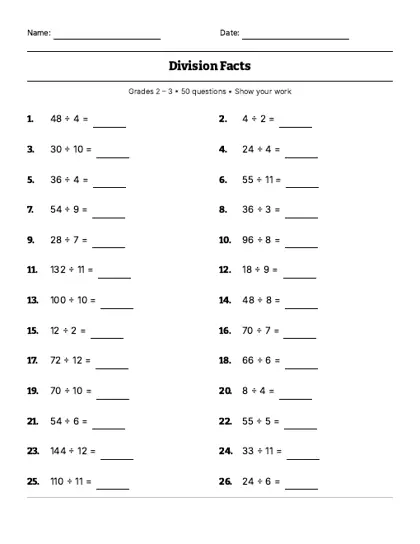
Division facts worksheet: printable PDF with an answer key. · Make a fresh test
Division practice · division speed test · division chart · division for kids
Last reviewed
Questions parents ask
What is division as repeated subtraction?
Taking the divisor away from the dividend again and again until you reach 0, then counting the subtractions. 20 − 5 − 5 − 5 − 5 = 0, so 20 ÷ 5 = 4.
How do you find the remainder with repeated subtraction?
Stop when what is left is smaller than the divisor. That amount is the remainder: 17 ÷ 5 = 3 r 2.
Is repeated subtraction the same as grouping?
Yes. Each subtraction takes away one group of the divisor, so counting them counts the groups.
Why is repeated subtraction slow for big numbers?
Because each step only takes one group. Taking away chunks of 10 or 100 groups at once, called partial quotients, is much faster.
What grade learns division by repeated subtraction?
Grade 3 (class 3), when division is first introduced.