
Dividend, divisor and quotient
The dividend is the number being divided, the divisor is what you divide by, and the quotient is the answer.
The three parts of a division
In 12 ÷ 3 = 4:
- 12 is the dividend: the number being shared or divided.
- 3 is the divisor: the number you divide by. It is the number of groups, or the size of each group.
- 4 is the quotient: the answer.
If something is left over, that part is the remainder. In 13 ÷ 3 = 4 r 1, the remainder is 1.
These words appear in textbooks, tests and long division from grade 4 on, so it pays to learn them early.
See it: pictures to draw with your child
Copy these onto paper or a whiteboard. A quick sketch makes the idea concrete before any written method.
How to remember which is which
- Dividend comes first, both in the sentence and in the alphabet order of “divide-nd”: it is the number at the start.
- Divisor is the one that does the dividing. Think “the divisor is the divider”.
- Quotient comes from Latin for “how many times”. It answers how many times the divisor fits.
A sentence helps: “The dividend is divided by the divisor to give the quotient.” Say it while pointing at 20 ÷ 5 = 4.
Three ways to write a division
The same division can be written three ways, and the parts move around:
- With ÷: 12 ÷ 3 = 4. Dividend first, then divisor.
- With a long division bracket: the divisor sits outside on the left, the dividend sits inside, and the quotient goes on top.
- As a fraction: 12/3 = 4. The dividend is on top (the numerator) and the divisor below (the denominator).
Children often swap the numbers when they first meet the long division bracket. Point out that the number inside the “house” is always the one being shared. See long division for the full method.
How the parts match multiplication
Multiplication has factors and a product: 3 × 4 = 12. In the matching division, the product becomes the dividend, and the factors become the divisor and quotient: 12 ÷ 3 = 4.
So to check a division, multiply the quotient by the divisor. You should get the dividend back. With a remainder, add it on: quotient × divisor + remainder = dividend. The checking division lesson practices this.
Useful facts about the parts
- The remainder is always smaller than the divisor. If it isn’t, another group fits.
- If the dividend and divisor are the same, the quotient is 1: 9 ÷ 9 = 1.
- If the divisor is 1, the quotient equals the dividend: 9 ÷ 1 = 9.
- The divisor can never be 0. See dividing by 0 and 1.
- A bigger divisor gives a smaller quotient: 24 ÷ 3 = 8, but 24 ÷ 6 = 4.
Quiz: name the part
Find the dividend, divisor, quotient or remainder.
Where this fits: division step by step
- What is division
- Division as repeated subtraction
- Division on a number line
- Dividend, divisor and quotient (this page)
- Dividing by 2, 5 and 10
- Division facts
- Checking division with multiplication
- Division with remainders
- Interpreting remainders
- 2-digit by 1-digit division
- 3-digit by 1-digit division
- Partial quotients
- Short division
- Long division
- Zeros in the quotient
- Estimating quotients
- Long division with 2-digit divisors
- Division word problems
What to say to your child
A short script for teaching it the first time. Pause after each line and let your child do the next step.
- “Look at 20 ÷ 5 = 4. Which number did we share?” (20.) “That’s the dividend.”
- “What did we divide by?” (5.) “That’s the divisor.”
- “And the answer, 4, is the quotient.”
- “Now point to each one as I say it: dividend, divisor, quotient.”
- “In 21 ÷ 5 = 4 r 1, what is the 1?” (The remainder: the leftover.)
More worked examples
Example 1: naming parts
In 35 ÷ 7 = 5, the dividend is 35, the divisor is 7 and the quotient is 5.
Example 2: with a remainder
In 38 ÷ 6 = 6 r 2, the dividend is 38, the divisor 6, the quotient 6 and the remainder 2.
Example 3: as a fraction
In 18/2 = 9, 18 is the dividend (top), 2 the divisor (bottom) and 9 the quotient.
Example 4: finding the dividend
The divisor is 4 and the quotient is 8. The dividend is 4 × 8 = 32.
Practice questions (answers below)
Ask these out loud or write them down. Check each answer, and ask “how did you get that?” for one or two.
- In 24 ÷ 4 = 6, what is the divisor?
- In 45 ÷ 9 = 5, what is the quotient?
- In 56 ÷ 8 = 7, what is the dividend?
- In 23 ÷ 5 = 4 r 3, what is the remainder?
- Divisor 6, quotient 7. What is the dividend?
- Dividend 36, divisor 9. What is the quotient?
- In 40/8 = 5, which number is the divisor?
- Can a remainder be 6 when the divisor is 5?
- Stretch: dividend 50, quotient 7, remainder 1. What is the divisor?
Show the answers
- 4
- 5
- 56
- 3
- 42
- 4
- 8
- No: it must be less than 5
- 7
Common mistakes
How to teach it at home
Name the parts
When you share something at home, ask your child to name the dividend, divisor and quotient.
Flash cards
Write a division on a card and colour each part a different colour.
Teach it back
Ask your child to explain the three words to another family member.
By grade
- Grade 3 (3.OA.A.2): understand division and its parts as sharing and grouping.
- Grade 4 (4.NBT.B.6): find quotients and remainders with up to 4-digit dividends.
- Grade 5 (5.NBT.B.6): divide by 2-digit divisors, where the words appear in every step.
- Next: checking division with multiplication.
More for each grade: Grade 3 math and the CBSE class 3 maths guide; Grade 4 math and the CBSE class 4 maths guide.
Worksheets and practice
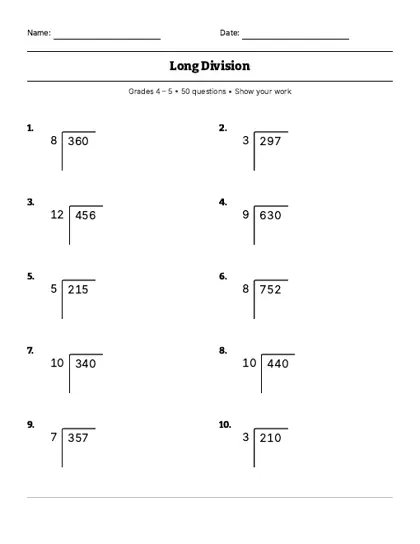
Division with remainders worksheet: printable PDF with an answer key. · Make a fresh test
Division practice · division speed test · division chart · division for kids
Last reviewed
Questions parents ask
What is the dividend in division?
The number being divided. In 20 ÷ 4 = 5, the dividend is 20.
What is the divisor in division?
The number you divide by. In 20 ÷ 4 = 5, the divisor is 4.
What is the quotient in division?
The answer to a division. In 20 ÷ 4 = 5, the quotient is 5.
How do the dividend, divisor and quotient fit together?
Dividend ÷ divisor = quotient, and quotient × divisor = dividend. With a remainder: quotient × divisor + remainder = dividend.
Where does the dividend go in long division?
Inside the bracket. The divisor sits outside on the left, and the quotient is written on top.