
Short division: the bus stop method
Short division is a quick written method: divide each digit and carry any remainder, written small, to the next digit.
What is short division?
Short division is a compact way to divide by a 1-digit number. It uses the same thinking as long division, but you do the multiplying and subtracting in your head and write the remainder as a small digit beside the next one.
In the UK and India it is often called the bus stop method, because the bracket looks like a bus shelter with the divisor waiting outside. It is common in class 4 and 5 textbooks.
See it: pictures to draw with your child
Copy these onto paper or a whiteboard. A quick sketch makes the idea concrete before any written method.
Step by step: 735 ÷ 6
- Write 735 under the bracket and 6 outside.
- 7 ÷ 6 = 1 r 1. Write 1 on top. Write the remainder 1 small, in front of the 3: it makes 13.
- 13 ÷ 6 = 2 r 1. Write 2 on top. Carry 1 to the 5: it makes 15.
- 15 ÷ 6 = 2 r 3. Write 2 on top. There are no more digits, so 3 is the remainder.
Answer: 735 ÷ 6 = 122 r 3. Check: 122 × 6 + 3 = 735.
Short division and long division side by side
| Short division | Long division | |
|---|---|---|
| Divisors | Best for 1-digit divisors | Any divisor, including 2-digit |
| Writing | One line; remainders carried small | Every multiply and subtract written |
| Mental work | More: subtract in your head | Less: everything is on paper |
| Best for | Quick work once facts are secure | Learning the steps, and big divisors |
The answers are always the same. Short division is long division with the working hidden. See long division for the full version.
When the first digit is smaller than the divisor
In 184 ÷ 8, 1 ÷ 8 doesn’t go. Write nothing (or 0) above the 1 and carry the 1 to the 8, making 18. 18 ÷ 8 = 2 r 2. Carry 2 to the 4, making 24. 24 ÷ 8 = 3. Answer: 23.
When a middle digit doesn’t go, write 0 above it and carry the whole digit. 1,209 ÷ 4: 1 doesn’t go, 12 ÷ 4 = 3, 0 ÷ 4 = 0, 9 ÷ 4 = 2 r 1. Answer: 302 r 1. See zeros in the quotient.
Is your child ready for short division?
Short division needs quick recall of the times tables, because each step asks something like “how many 7s in 45, and what is left?” in the head. If facts are slow, every step becomes a struggle.
A good test: can your child answer 38 ÷ 6 = 6 r 2 in a few seconds? If yes, short division will feel fast and satisfying. If not, spend a little time on division facts within 100 and remainders first.
See the steps written out
Short division hides these steps. The tool shows them all, so your child can see where each carried digit comes from.
Quiz: short division
Divide each digit and carry the remainder.
Where this fits: division step by step
- What is division
- Division as repeated subtraction
- Division on a number line
- Dividend, divisor and quotient
- Dividing by 2, 5 and 10
- Division facts
- Checking division with multiplication
- Division with remainders
- Interpreting remainders
- 2-digit by 1-digit division
- 3-digit by 1-digit division
- Partial quotients
- Short division (this page)
- Long division
- Zeros in the quotient
- Estimating quotients
- Long division with 2-digit divisors
- Division word problems
What to say to your child
A short script for teaching it the first time. Pause after each line and let your child do the next step.
- “Let’s do 96 ÷ 4 the bus stop way. How many 4s in 9?” (2, with 1 left.)
- “Write 2 on top. Write the 1 small next to the 6. What number is that?” (16.)
- “How many 4s in 16?” (4.) “Write it on top.”
- “So 96 ÷ 4 = 24. Check: 24 × 4.” (96!)
- “Now you try 85 ÷ 5.”
More worked examples
Example 1: no carrying: 963 ÷ 3
9 ÷ 3 = 3, 6 ÷ 3 = 2, 3 ÷ 3 = 1. Answer: 321.
Example 2: carrying: 852 ÷ 6
8 ÷ 6 = 1 r 2, carry 2: 25 ÷ 6 = 4 r 1, carry 1: 12 ÷ 6 = 2. Answer: 142.
Example 3: a remainder: 527 ÷ 4
5 ÷ 4 = 1 r 1, 12 ÷ 4 = 3, 7 ÷ 4 = 1 r 3. Answer: 131 r 3.
Example 4: 4 digits: 5,436 ÷ 9
5 doesn’t go, 54 ÷ 9 = 6, 3 ÷ 9 = 0 r 3, 36 ÷ 9 = 4. Answer: 604.
Practice questions (answers below)
Ask these out loud or write them down. Check each answer, and ask “how did you get that?” for one or two.
- 84 ÷ 2
- 96 ÷ 4
- 246 ÷ 2
- 585 ÷ 5
- 714 ÷ 7
- 936 ÷ 8
- 1,452 ÷ 6
- 623 ÷ 4
- A rope of 875 cm is cut into 7 equal pieces. How long is each piece?
- Stretch: 9,999 ÷ 9
Show the answers
- 42
- 24
- 123
- 117
- 102
- 117
- 242
- 155 r 3
- 125 cm
- 1,111
Common mistakes
How to teach it at home
Bus stop doodles
Draw the bus stop and let your child fill in a few problems.
Money split
Split a bill like 375 rupees among 3 people on paper.
Check each other
One does short division, the other long division. Compare answers.
By grade
- Grade 4 (4.NBT.B.6): divide up to 4-digit numbers by 1-digit numbers using place value.
- Grades 5 and 6: short division is a fast written method; long division takes over for 2-digit divisors.
- India: the bus stop method is taught in class 4 and 5 maths.
- Next: long division and 2-digit divisors.
More for each grade: Grade 4 math and the CBSE class 4 maths guide; Grade 5 math and the CBSE class 5 maths guide.
Worksheets and practice
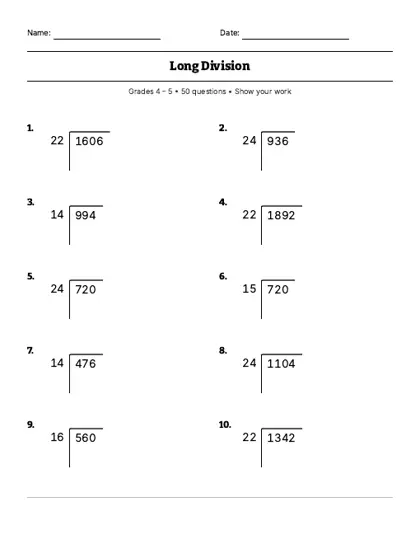
Long division worksheet: printable PDF with an answer key. · Make a fresh test
Division practice · division speed test · division chart · division for kids
Last reviewed
Questions parents ask
What is short division?
A quick written method for dividing by a 1-digit number. You divide each digit and carry any remainder, written small, to the next digit.
Why is it called the bus stop method?
Because the bracket looks like a bus shelter, with the divisor waiting outside it.
What is the difference between short and long division?
They use the same steps. Short division does the multiplying and subtracting in your head; long division writes them all down.
Can you use short division with 2-digit divisors?
It is possible, but hard to do in your head. Long division is usually better for 2-digit divisors.
What grade learns short division?
Grade 4 or 5, or class 4 to 5 in India, once times tables are secure.