
3rd grade measurement: elapsed time, mass and liters
3rd grade measurement (class 3): a quiz for kids, then every skill in order with lessons, a checklist and a plan.
🧒 Kids: answer 10 grade 3 measurement questions. Read each one, then tap Check ✓!
📏 Measurement practice 🏆 Measurement levels 🕒 Interactive clock
What children learn about measurement in 3rd grade
In grade 3, children tell time to the minute and solve elapsed time problems, measure and estimate mass and liquid volume in grams, kilograms and liters, and measure to the nearest quarter inch.
- 3.MD.A.1: tell and write time to the nearest minute, and measure time intervals in minutes.
- 3.MD.A.1: solve word problems about adding and subtracting time, for example on a number line.
- 3.MD.A.2: measure and estimate liquid volumes and masses in grams, kilograms and liters.
- 3.MD.A.2: solve one-step word problems about mass or volume with all four operations.
- 3.MD.B.4: measure lengths to the nearest half and quarter inch and show the data on a line plot.
The big idea in grade 3
Grade 3 adds precision and new kinds of measure. Children tell time to the nearest minute and solve elapsed time problems in minutes, often on a number line (3.MD.A.1).
They also meet mass and liquid volume for the first time as measurements: grams, kilograms and liters (3.MD.A.2). They estimate, read scales and measuring jugs, and solve one-step word problems with them.
On rulers, they measure to the nearest half and quarter inch and show the results on a line plot (3.MD.B.4). Area and perimeter also start this year; they live in the geometry section.
When your child gets stuck
Most grade 3 elapsed time trouble comes from treating time like ordinary numbers: 2:40 + 30 minutes becomes 2:70. Count on to the next o’clock first, then the rest.
If grams and kilograms are confusing, hold real things: a paper clip is about 1 gram, a bag of sugar about 1 kilogram.
For half and quarter inches, find the longest mark between two numbers first: that is the half.
3rd grade measurement skills, in order
Work down the list. Each lesson explains the idea for parents with pictures and has a quiz for your child.
By the end of grade 3, your child should be able to…
- Read any clock to the minute, such as 7:43.
- Find how long it is from 2:40 to 4:15 (1 hour 35 minutes).
- Find the end time 45 minutes after 3:35 (4:20).
- Choose grams or kilograms for an apple and for a dog.
- Read a measuring jug marked in 100s.
- Measure a line to the nearest quarter inch.
Unsure where your child is? The measurement levels page has a short test for every step from hours to word problems.
A 4-week plan for 3rd grade measurement
| When | Focus |
|---|---|
| Week 1 | Time to the minute and counting on in minutes |
| Week 2 | Elapsed time with number lines, start and end times |
| Week 3 | Grams, kilograms and liters: estimate, then measure |
| Week 4 | Half and quarter inches, line plots and word problems |
Add 5 minutes a day with the measurement practice tool, and use the interactive clock and unit converter to check answers.
More for grade 3
All 3rd grade math · CBSE class 3: Time Goes On · 3rd grade geometry · Measurement quiz for grades 1 to 5 · Measurement for kids
What to say to your child
A short script for teaching it the first time. Pause after each line and let your child do the next step.
- “The show starts at 3:40 and ends at 4:25. How long is it?”
- “Jump to 4:00 first. How many minutes?” (20.)
- “Then from 4:00 to 4:25?” (25.) “Add them.” (45 minutes.)
- “Is your school bag closer to 3 grams or 3 kilograms?” (3 kilograms.)
- “How much water is in the jug? What does each line stand for?”
More worked examples
Example 1: elapsed time
From 10:45 to 12:10: 15 minutes to 11:00, 1 hour to 12:00, 10 more: 1 hour 25 minutes.
Example 2: mass
4 bags of rice of 2 kg each weigh 4 × 2 = 8 kg.
Example 3: liquid volume
A jug holds 3 L. You pour in 2 L more into a bigger pot: 3 + 2 = 5 L.
Practice questions (answers below)
Ask these out loud or write them down. Check each answer, and ask “how did you get that?” for one or two.
- Long hand 2 marks past the 7, short hand between 11 and 12
- How long from 4:15 to 4:50?
- What time is 25 minutes after 6:50?
- How long from 1:45 to 3:00?
- Best unit for a paper clip: g or kg?
- Best unit for a bathtub: mL or L?
- 3 boxes of 5 kg each
- A bar ending halfway between 2 and 3 inches
- Minutes in 2 hours
- Stretch: a 1 hour 20 minute movie starts at 6:50 p.m. When does it end?
Show the answers
- 11:37
- 35 minutes
- 7:15
- 1 hour 15 minutes
- g
- L
- 15 kg
- 2 ½ in
- 120
- 8:10 p.m.
Common mistakes
How to teach it at home
Five minutes a day
Short daily practice beats long weekend sessions.
Measure real things
Clocks, coins, rulers, kitchen scales and measuring jugs make every skill concrete.
Estimate first
Ask for a guess before every measurement, then check. Good estimates catch silly answers.
By grade
- Before: 2nd grade measurement
- After: 4th grade measurement
Not sure where to start?
The free 3rd grade math check-up tests every grade 3 topic in 15–20 minutes. It shows which topics are solid and which lesson to start with.
Worksheets and practice
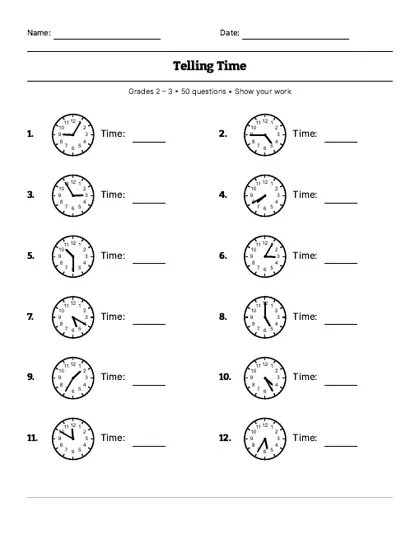
Telling time worksheet: printable PDF with an answer key.
Last reviewed
Questions parents ask
What do 3rd graders learn in measurement?
Time to the nearest minute and elapsed time, mass and liquid volume in grams, kilograms and liters, and measuring to the nearest quarter inch (3.MD.A and 3.MD.B).
How do you teach elapsed time in 3rd grade?
Use a number line. Mark the start, jump to the next o’clock, jump whole hours, then the last minutes, and add the jumps.
Is there a 3rd grade measurement quiz?
Yes. The quiz at the top of this page has 10 mixed grade 3 questions, each marked straight away. Play again for a fresh set, or try the measurement quiz for grades 1 to 5.
What is taught about measurement in class 3 in India?
NCERT class 3 covers weight and capacity in chapter 11, Filling and Lifting, and time in chapter 13, Time Goes On. This page lists the skills in order, starting with time to the minute, elapsed time.
How much practice does a 3rd grader need?
About 10 minutes a day: one short round with the practice tool and one real measuring job at home. Short daily practice works better than long weekly sessions.