
3rd grade geometry
3rd grade geometry (class 3): a picture quiz for kids, then every skill in order with lessons, a checklist and a plan.
🧒 Kids: answer 10 grade 3 geometry questions. Look at each picture and tap Check ✓!
What 3rd grader learn in geometry
In grade 3, children find area by counting unit squares and then by multiplying, find perimeter, tell the two apart, and sort quadrilaterals by their sides and angles.
- 3.G.A.1: understand that shapes in different groups share attributes, and that rhombuses, rectangles and squares are quadrilaterals.
- 3.G.A.2: split shapes into parts with equal areas.
- 3.MD.C.5–6: understand area and measure it by counting unit squares.
- 3.MD.C.7: find the area of rectangles by multiplying, and of L shapes by adding rectangles.
- 3.MD.D.8: solve problems with the perimeter of polygons.
The big idea in grade 3
Grade 3 is the year area arrives. Children learn that area is the number of unit squares that cover a shape, then that a rectangle’s squares come in rows, so length × width counts them fast (3.MD.C.5–7).
They also meet perimeter, the distance round a shape (3.MD.D.8), and learn to tell the two apart. Shapes are sorted by their properties: a square is a rectangle, and a rectangle is a quadrilateral (3.G.A.1).
Squared paper does most of the teaching. A child who has drawn and counted rectangles understands the formula; one who only memorised it mixes up area and perimeter.
When your child gets stuck
Most grade 3 trouble is mixing up area and perimeter. Ask: “Are we covering it or walking round it?” Covering is area, in square units. Walking round is perimeter.
If multiplying for area feels like magic, go back to drawing the rectangle on squared paper and counting one row, then the number of rows.
3rd grade geometry skills, in order
Work down the list. Each lesson explains the idea for parents with pictures and has a quiz for your child.
By the end of grade 3, your child should be able to…
- Say why a square is also a rectangle and a rhombus.
- Find the area of a rectangle drawn on squared paper by counting, then by multiplying.
- Find the perimeter of a 6 cm by 4 cm rectangle.
- Say whether a fence or a carpet needs area or perimeter.
- Find the area of an L shape by splitting it into two rectangles.
- Draw two rectangles with the same area but different perimeters.
Unsure where your child is? The geometry levels page has a short test for every step from naming shapes to the Pythagorean theorem.
A 4-week plan for 3rd grade geometry
| When | Focus |
|---|---|
| Week 1 | Quadrilaterals: sort shapes by sides and angles |
| Week 2 | Area by counting squares, then rows × columns |
| Week 3 | Perimeter, and area vs perimeter |
| Week 4 | L shapes and mixed problems |
Add 5 minutes a day with the geometry practice tool, and check any area or perimeter answer with the area and perimeter calculator.
More for grade 3
All 3rd grade math · CBSE class 3: Fun with Shapes · 3rd grade multiplication · Geometry quiz for grades 2 to 8 · Geometry for kids
What to say to your child
A short script for teaching it the first time. Pause after each line and let your child do the next step.
- “How many sides does a quadrilateral have?” (4.)
- “Is a square a rectangle?” (Yes: 4 right angles.)
- “How many squares in one row?”
- “How many rows? So how many squares altogether?”
- “How far is it all the way round?”
- “Carpet or fence: area or perimeter?”
More worked examples
Example 1: area
A 5 × 3 rectangle has 3 rows of 5 squares: 15 square units.
Example 2: perimeter
A 6 cm by 4 cm rectangle: 6 + 4 + 6 + 4 = 20 cm.
Example 3: L shape
Split it: 4 × 2 = 8 and 2 × 3 = 6, so 14 square units.
Practice questions (answers below)
Ask these out loud or write them down. Check each answer, and ask “how did you get that?” for one or two.
- Area of 4 × 3
- Area of a 7 × 2 rectangle
- Perimeter of 5 cm by 2 cm
- Perimeter of a square with 6 m sides
- Area of a square with 5 cm sides
- A rectangle has area 24 and width 4. Length?
- 4 equal sides and 4 right angles
- Exactly 1 pair of parallel sides
- Garden fence: area or perimeter?
- Stretch: two rectangles with area 12
Show the answers
- 12 sq units
- 14 sq units
- 14 cm
- 24 m
- 25 cm²
- 6
- square
- trapezoid
- perimeter
- 3 × 4 and 2 × 6
Common mistakes
How to teach it at home
Five minutes a day
Short daily practice beats long weekend sessions.
Draw it
Keep squared paper handy: most geometry is easier once it is drawn.
Shape spotting
Look for angles, parallel lines, symmetry and 3D shapes on walks and in the kitchen.
By grade
- Before: naming 2D and 3D shapes and splitting shapes into halves and quarters in grade 2
- After: 4th grade geometry
Not sure where to start?
The free 3rd grade math check-up tests every grade 3 topic in 15–20 minutes. It shows which topics are solid and which lesson to start with.
Worksheets and practice
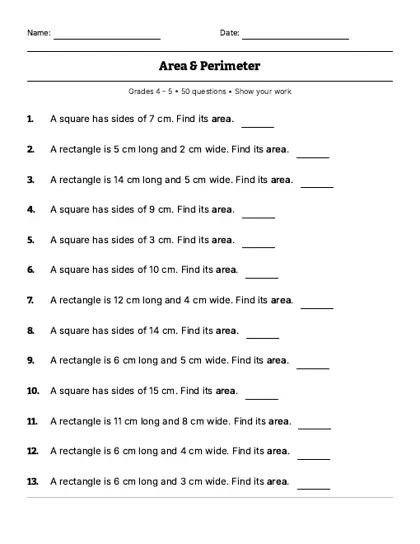
Area of rectangles worksheet: printable PDF with an answer key. · Make a fresh test
Last reviewed
Questions parents ask
What geometry do 3rd graders learn?
Quadrilaterals and their properties, area by counting squares and by multiplying, the area of L shapes, perimeter, and the difference between area and perimeter.
How do I explain area and perimeter to my 3rd grader?
Area is how many squares cover the shape, like tiles on a floor. Perimeter is the distance round the edge, like a fence. Draw both on squared paper.
Is there a 3rd grade geometry quiz?
Yes. The quiz at the top of this page has 10 mixed grade 3 questions, each with a picture. Every answer is marked straight away, and a wrong answer shows the working. Play again for a fresh set, or try the geometry quiz for grades 2 to 8.
What geometry is taught in class 3 in India?
The NCERT books spread geometry across every class: shapes and patterns early on, then perimeter, area, angles and symmetry, and later circles, constructions and the Pythagoras theorem. This page lists the skills in order, starting with shapes and their names, polygons, sides and vertices.
How much geometry practice does a 3rd grader need?
About 10 minutes a day during a geometry unit: 5 minutes on the current skill with the practice tool and 5 minutes of mixed review. Drawing on squared paper counts too.