
Learn geometry step by step
Learn geometry in 8 levels, from naming shapes to the Pythagorean theorem, with a 5-question picture test for each level.
🧒 Kids: tap Start level ▶ and get 4 of 5 right to pass. Can you reach level 8? 🏆
Which level for which grade?
There are 8 levels, from naming shapes to the Pythagorean theorem. Each level has short lessons and a 5-question picture test; get 4 right to pass. Progress is saved on this device, so your child can come back and carry on.
| Level | Skill | Grade |
|---|---|---|
| 1 | Shapes and sides | 1–2 |
| 2 | Lines and angles | 4 |
| 3 | Triangles and quadrilaterals | 3–5 |
| 4 | Area and perimeter | 3–4 |
| 5 | Measuring angles | 4–7 |
| 6 | Area formulas and circles | 6–7 |
| 7 | 3D shapes and volume | 5–8 |
| 8 | Symmetry, moves and Pythagoras | 4–8 |
How to use the levels
- Find the starting level. Take the tests from level 1 until your child scores under 4. That is the level to work on.
- Learn it. Open the Learn links for that level: each lesson has pictures, a parent script and practice.
- Practice for a few days. Use the quizzes on the lesson pages and the geometry practice tool.
- Retake the test. 4 out of 5 passes the level. Move on to the next one.
Level 4 is the one to take slowly. Area and perimeter come back in every later level, inside triangles, circles and boxes.
Why the levels are in this order
Levels 1 to 3 build the words: shape names, lines, rays, angle types, and the families of triangles and quadrilaterals. Without them, later questions are hard to even read.
Levels 4 to 6 measure. Area by counting leads to the rectangle formula, which leads to triangles, parallelograms and circles. Angles go from naming to measuring to finding missing ones.
Levels 7 and 8 go into 3D and onto the grid: volume and surface area, then symmetry, transformations and the Pythagorean theorem. A child stuck there usually has a gap in level 4.
Tools that help with every level
The area and perimeter calculator draws any rectangle, triangle, trapezoid, circle or L shape to scale and shows every step. It helps with levels 4 and 6 especially.
Real objects matter too. Squared paper, a protractor, a ruler, tracing paper and a few boxes and cans make every level easier than a screen alone.
More geometry practice
- Geometry quiz for grades 2 to 8.
- Geometry practice by skill.
- Area and perimeter calculator.
- Printable worksheets: naming 2D shapes, perimeter and volume.
For teachers
The levels work on a projector for a whole-class warm-up. Progress is saved only in each device’s browser, so no login or student data is needed. On shared computers, use Reset my progress at the end of the lesson.
Practice questions (answers below)
Ask these out loud or write them down. Check each answer, and ask “how did you get that?” for one or two.
- Level 1: sides on a pentagon
- Level 2: 95° is…
- Level 3: 3 equal sides
- Level 4: area of 8 × 3
- Level 4: perimeter of 8 × 3
- Level 5: 180° − 65°
- Level 6: triangle, base 12, height 5
- Level 7: volume of a 5 × 2 × 3 box
- Level 8: legs 3 and 4
- Stretch: lines of symmetry in a regular hexagon
Show the answers
- 5
- obtuse
- equilateral
- 24
- 22
- 115°
- 30
- 30
- 5
- 6
Common mistakes
How to teach it at home
Level chart
Print a chart of 8 boxes and colour one each time a level is passed.
Celebrate
A small reward at levels 4 and 8.
Shape of the day
Pick one shape each day and name its sides, angles and lines of symmetry.
By grade
Check every topic at once
The free math check-up tests every topic of one grade in 10 to 20 minutes. It shows which topics are solid and where to start practicing. Levels you pass here also appear on your progress page.
More for each grade: Grade 2 math and the CBSE class 2 maths guide; Grade 3 math and the CBSE class 3 maths guide; Grade 4 math and the CBSE class 4 maths guide; Grade 5 math and the CBSE class 5 maths guide; Grade 6 math and the CBSE class 6 maths guide; Grade 7 math and the CBSE class 7 maths guide; Grade 8 math and the CBSE class 8 maths guide.
Worksheets and practice
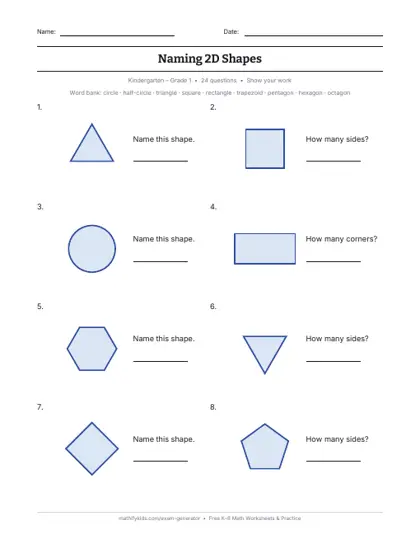
Naming 2D shapes worksheet: printable PDF with an answer key. · Make a fresh test
Last reviewed
Questions parents ask
How do you learn geometry step by step?
Start with shape names and lines, then angles and shape families. Next come area and perimeter, angle measuring, area formulas and circles, then 3D shapes, transformations and the Pythagorean theorem.
What is the hardest part of geometry for kids?
Usually area vs perimeter in grade 3, protractors in grade 4, and the height in area formulas in grade 6. Drawing each one fixes most mistakes.
How long does it take to learn geometry?
It is spread over grades 1 to 8. Most children move through one or two levels a year, with short practice during each geometry unit.
Is progress saved?
Yes, passed levels are saved in this browser on this device. Nothing is sent to us.
Does it include the Pythagorean theorem?
Yes. Level 8 has symmetry, transformations and right triangles with a hidden side.