
Learn measurement step by step
Learn measurement step by step in 8 levels, from telling time to the hour to unit conversions and word problems, with a 5-question test for each.
🧒 Kids: tap Start level ▶ and get 4 of 5 right to pass. Can you reach level 8? 🏆
Which level for which grade?
There are 8 levels, from time to the hour to measurement word problems. Each level has short lessons and a 5-question test; get 4 right to pass. Progress is saved on this device, so your child can come back and carry on.
| Level | Skill | Grade |
|---|---|---|
| 1 | Hours and half hours | 1 |
| 2 | Time to 5 minutes, a.m. and p.m. | 2 |
| 3 | Coins and change | 1–2 |
| 4 | Measuring length | 1–3 |
| 5 | Time to the minute and elapsed time | 3 |
| 6 | Weight and capacity | 3–4 |
| 7 | Unit conversions | 4–5 |
| 8 | Word problems | 3–5 |
How to use the levels
- Find the starting level. Take the tests from level 1 until your child scores under 4. That is the level to work on.
- Learn it. Open the Learn links for that level: each lesson has pictures, a parent script and a quiz.
- Practice for a few days. Use the practice tool on that skill, with a real clock, coins or ruler alongside.
- Retake the test. 4 out of 5 passes the level. Move on to the next one.
Levels 1 and 2 are the ones to take slowly. A child who reads a clock quickly finds elapsed time far easier later.
Why the levels are in this order
Time comes first, because children see clocks every day and the skill builds on counting by 5s. Coins come next, using counting by 25s, 10s and 5s.
Measuring length introduces rulers and units. Elapsed time needs secure clock reading, so it waits until level 5.
Weight and capacity bring new units, and conversions link them all with one rule: multiply to a smaller unit, divide to a bigger one. Word problems come last, because they mix every skill.
Tools that help with every level
The interactive clock has draggable hands, time in words and a quiz mode. The unit converter shows whether to multiply or divide for any unit.
Real objects matter most of all. A kitchen scale, a measuring jug, a tape measure and a jar of coins make every level easier to picture.
More measurement practice
- Measurement quiz for grades 1 to 5.
- Measurement practice by skill.
- Interactive clock.
- Printable worksheets: telling time, money, metric units and customary units.
For teachers
The levels work on a projector for a whole-class warm-up. Progress is saved only in each device’s browser, so no login or student data is needed. On shared computers, use Reset my progress at the end of the lesson.
Practice questions (answers below)
Ask these out loud or write them down. Check each answer, and ask “how did you get that?” for one or two.
- Level 1: long hand on 12, short hand on 7
- Level 2: long hand on 8, short hand past 3
- Level 3: 2 quarters and 2 dimes
- Level 3: change from $1 for 45¢
- Level 4: a bar from 2 to 9 cm
- Level 5: how long from 9:35 to 10:20?
- Level 6: which is more, 2 L or 1,500 mL?
- Level 7: 3 ft = ? in
- Level 7: 6,000 g = ? kg
- Level 8: 5 boxes weigh 3 kg each. Total?
Show the answers
- 7:00
- 3:40
- 70¢
- 55¢
- 7 cm
- 45 minutes
- 2 L
- 36
- 6
- 15 kg
Common mistakes
How to teach it at home
Level chart
Print a chart of 8 boxes and colour one each time a level is passed.
Celebrate
A small reward at levels 4 and 8.
Measure of the day
Each day, read one clock, count one handful of coins and measure one object.
By grade
Check every topic at once
The free math check-up tests every topic of one grade in 10 to 20 minutes. It shows which topics are solid and where to start practicing. Levels you pass here also appear on your progress page.
More for each grade: Grade 1 math and the CBSE class 1 maths guide; Grade 2 math and the CBSE class 2 maths guide; Grade 3 math and the CBSE class 3 maths guide; Grade 4 math and the CBSE class 4 maths guide; Grade 5 math and the CBSE class 5 maths guide.
Worksheets and practice
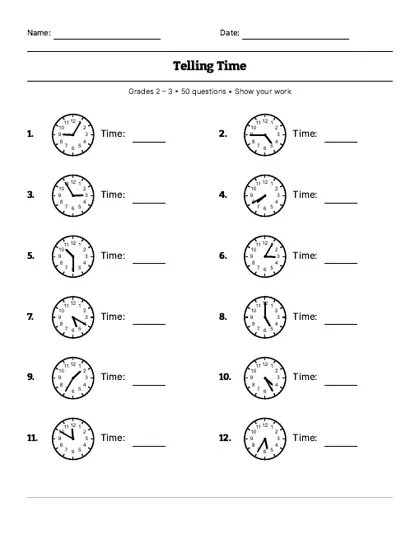
Telling time worksheet: printable PDF with an answer key. · Make a fresh test
Last reviewed
Questions parents ask
How do you learn measurement step by step?
Start with time to the hour and coins, then rulers and time to 5 minutes. Next come elapsed time, weight and capacity, then unit conversions and word problems.
What is the hardest part of measurement?
Usually elapsed time, because minutes stop at 60, and deciding whether to multiply or divide when converting units.
How long does it take to learn to tell time?
Most children learn o’clock and half past in grade 1, five-minute times in grade 2 and time to the minute in grade 3, with short daily practice.
Is progress saved?
Yes, passed levels are saved in this browser on this device. Nothing is sent to us.
Which level should a 4th grader start at?
Take the tests for levels 1 to 5 quickly. Most 4th graders should start at level 6 or 7, weight, capacity and conversions.