
4th grade measurement and unit conversions
4th grade measurement (class 4): a quiz for kids, then every skill in order with lessons, a checklist and a plan.
🧒 Kids: answer 10 grade 4 measurement questions. Read each one, then tap Check ✓!
📏 Measurement practice 🏆 Measurement levels 🕒 Interactive clock
What children learn about measurement in 4th grade
In grade 4, children learn the relative sizes of measurement units and convert from larger to smaller units within one system. They also solve word problems about distance, time, volume, mass and money.
- 4.MD.A.1: know the relative sizes of km, m, cm; kg, g; lb, oz; L, mL; hr, min, sec.
- 4.MD.A.1: express a larger unit in terms of a smaller one and record conversions in a two-column table.
- 4.MD.A.2: solve word problems about distance, time, liquid volume, mass and money with all four operations.
- 4.MD.A.2: use simple fractions and decimals in measurement problems, and show them on number lines.
- 4.MD.A.3: use the area and perimeter formulas for rectangles (see geometry).
The big idea in grade 4
Grade 4 is the conversion year (4.MD.A.1). Children learn the relative sizes of units within one system. These are km, m and cm; kg and g; L and mL; lb and oz; and hours, minutes and seconds. They convert from a bigger unit to a smaller one and record the results in two-column tables.
They then use all four operations in word problems about distance, time, liquid volume, mass and money, including simple fractions and decimals (4.MD.A.2). Area and perimeter formulas come this year too, in geometry.
The one rule that unlocks it all: to a smaller unit, multiply; to a bigger unit, divide.
When your child gets stuck
Most grade 4 conversion trouble is multiplying when it should divide, or the reverse. Ask: “Is the new unit bigger or smaller? So will the number get bigger or smaller?”
The other trap is base 10 thinking with customary units. 1 foot is 12 inches, not 10, and 1 hour is 60 minutes, so 1.5 hours is 90 minutes.
In word problems, change everything to one unit before adding or subtracting.
4th grade measurement skills, in order
Work down the list. Each lesson explains the idea for parents with pictures and has a quiz for your child.
By the end of grade 4, your child should be able to…
- Convert 3 km to meters and 5 lb to ounces.
- Fill in a feet-and-inches table for 1 to 5 feet.
- Explain why 1.5 hours is 90 minutes, not 150.
- Say which is more: 2 kg or 1,800 g.
- Solve 2 m − 45 cm by changing to centimeters.
- Find the change from $5 for $3.60.
Unsure where your child is? The measurement levels page has a short test for every step from hours to word problems.
A 4-week plan for 4th grade measurement
| When | Focus |
|---|---|
| Week 1 | Relative sizes of units, benchmarks, and the multiply rule |
| Week 2 | Metric conversions and two-column tables |
| Week 3 | Customary units and time: feet, pounds, quarts, hours |
| Week 4 | Word problems with all four operations, money and fractions |
Add 5 minutes a day with the measurement practice tool, and use the interactive clock and unit converter to check answers.
More for grade 4
All 4th grade math · CBSE class 4: Weigh It, Pour It · 4th grade geometry · Measurement quiz for grades 1 to 5 · Measurement for kids
What to say to your child
A short script for teaching it the first time. Pause after each line and let your child do the next step.
- “Is a meter bigger or smaller than a centimeter?” (Bigger.)
- “So how many centimeters in 3 meters? Will the number get bigger?” (Yes: 300.)
- “How many ounces in a pound?” (16.) “So 4 pounds is…?” (64 ounces.)
- “A ribbon is 2 m and we cut 45 cm. What do we do first?” (Change to centimeters.)
- “Check: does the answer make sense?”
More worked examples
Example 1: metric
4.5 kg = 4.5 × 1,000 = 4,500 g.
Example 2: customary
7 ft = 7 × 12 = 84 in; 3 gal = 3 × 4 = 12 qt.
Example 3: word problem
A 3 L jug, 750 mL poured out: 3,000 − 750 = 2,250 mL left.
Practice questions (answers below)
Ask these out loud or write them down. Check each answer, and ask “how did you get that?” for one or two.
- 6 m = ? cm
- 4 kg = ? g
- 3 L = ? mL
- 5 ft = ? in
- 3 lb = ? oz
- 2 gal = ? qt
- 4 hours = ? minutes
- Which is more, 3 yd or 100 in?
- 2 m − 45 cm
- Stretch: 6 bottles of 250 mL. How many liters?
Show the answers
- 600
- 4,000
- 3,000
- 60
- 48
- 8
- 240
- 3 yd (108 in)
- 155 cm
- 1.5 L
Common mistakes
How to teach it at home
Five minutes a day
Short daily practice beats long weekend sessions.
Measure real things
Clocks, coins, rulers, kitchen scales and measuring jugs make every skill concrete.
Estimate first
Ask for a guess before every measurement, then check. Good estimates catch silly answers.
By grade
- Before: 3rd grade measurement
- After: converting in both directions in grade 5, and volume
Not sure where to start?
The free 4th grade math check-up tests every grade 4 topic in 18–22 minutes. It shows which topics are solid and which lesson to start with.
Worksheets and practice
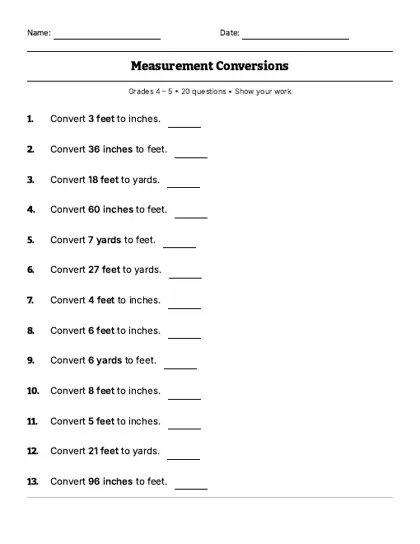
Customary units worksheet: printable PDF with an answer key.
Last reviewed
Questions parents ask
What do 4th graders learn in measurement?
The relative sizes of metric and customary units and converting from larger to smaller units. They also solve word problems about distance, time, liquid volume, mass and money (4.MD.A).
How do you teach unit conversions in 4th grade?
One rule: to a smaller unit, multiply; to a bigger unit, divide. Build two-column tables (1 ft = 12 in, 2 ft = 24 in…) so the pattern shows.
Is there a 4th grade measurement quiz?
Yes. The quiz at the top of this page has 10 mixed grade 4 questions, each marked straight away. Play again for a fresh set, or try the measurement quiz for grades 1 to 5.
What is taught about measurement in class 4 in India?
NCERT class 4 covers length in chapter 6 and weight and capacity in chapter 8, Weigh It, Pour It. Time is in chapter 12, Ticking Clocks and Turning Calendar. This page lists the skills in order, starting with metric conversions, customary conversions.
How much practice does a 4th grader need?
About 10 minutes a day: one short round with the practice tool and one real measuring job at home. Short daily practice works better than long weekly sessions.