
Capacity
Capacity is how much a container can hold. Small amounts are measured in milliliters or cups, big amounts in liters or gallons.
What capacity means
Capacity is the amount of liquid a container can hold when it is full. The amount of liquid actually in it is called liquid volume. A 1-liter bottle has a capacity of 1 liter even when it is half empty and holds 500 mL.
Grade 3 standards (3.MD.A.2) use the words liquid volume; many books just say capacity.
Children start by comparing: fill one container and pour it into another. If it overflows, the first holds more.
Milliliters and liters
The metric units of capacity are the milliliter (mL) and the liter (L). 1,000 milliliters make 1 liter.
- About 1 mL: a few drops of water.
- About 5 mL: a teaspoon.
- About 250 mL: a glass of milk or a juice box.
- About 1 L: a large water bottle.
- About 150 L: a bathtub.
Reading a measuring jug
- Read the numbers on the side: how much do they go up by?
- Count the marks between two numbers to find what each mark is worth.
- Look at the top of the water, at eye level, and read the mark it reaches.
- Say the unit.
Cups, pints, quarts and gallons
| 8 fluid ounces | 1 cup |
| 2 cups | 1 pint |
| 2 pints | 1 quart |
| 4 quarts | 1 gallon |
The Gallon Man drawing on the customary units page shows them all inside one gallon: 4 quarts, 8 pints and 16 cups.
Converting units of capacity
To a smaller unit, multiply: 3 L × 1,000 = 3,000 mL, and 2 qt × 4 = 8 cups. To a bigger unit, divide: 2,500 mL ÷ 1,000 = 2.5 L, and 12 cups ÷ 4 = 3 qt. Check with the unit converter.
Estimating capacity
Pick a benchmark container and compare. A juice box holds about 250 mL, so a bottle that looks four times bigger holds about 1 L. A gallon jug of milk is a good benchmark for big amounts.
Tall thin glasses often look as if they hold more than short wide ones, so estimate, then pour to check.
A fun test at home: line up four cups, mugs and bottles and ask your child to put them in order from holds least to holds most. Then fill each one with water from a measuring jug and read the amount.
Most children are surprised at least once. Write the results down and talk about why the tallest container was not the biggest.
Capacity word problems
A pitcher holds 2 quarts of lemonade. How many 1-cup glasses can it fill? 1 quart is 4 cups, so 2 × 4 = 8 glasses.
A jug holds 3 L and you pour out 750 mL. How much is left? 3 L = 3,000 mL, and 3,000 − 750 = 2,250 mL. Change to the smaller unit first.
More examples are in measurement word problems.
Capacity and volume
In grade 5, children meet volume measured in cubic units: a box 2 cm by 3 cm by 4 cm has a volume of 24 cubic centimeters. Capacity and volume are linked: 1 cubic centimeter holds exactly 1 milliliter, so 1,000 cubic centimeters hold 1 liter. For now, capacity is about liquids and containers, and volume is about the space a solid takes up.
Capacity quiz
Pick the best unit, compare amounts and convert. Wrong answers show the rule.
What to say to your child
A short script for teaching it the first time. Pause after each line and let your child do the next step.
- “Which holds more, the cup or the bucket?” (The bucket.) “That is capacity: how much it can hold.”
- “Look at the jug. What does each line stand for?” (100 mL.)
- “The water reaches the 600 line, so there are 600 mL.”
- “How many cups make a pint?” (2.) “And pints in a quart?” (2.)
- “So how many cups are in a quart?” (4.)
More worked examples
Example 1: Reading a jug
The water is at the third line on a jug marked in 100s: 300 mL.
Example 2: Liters to milliliters
2 L × 1,000 = 2,000 mL.
Example 3: Quarts to cups
3 qt × 4 = 12 cups.
Example 4: Compare
Which holds more, 1 gallon or 5 quarts? 1 gal = 4 qt, so 5 quarts.
Practice questions (answers below)
Ask these out loud or write them down. Check each answer, and ask “how did you get that?” for one or two.
- Best unit for a bathtub: cups or gallons?
- Best unit for a spoon of medicine: mL or L?
- 3 L = ? mL
- 2,500 mL = ? L
- 1 gallon = ? quarts
- 2 quarts = ? cups
- Which is more, 2 L or 1,800 mL?
- 4 pints = ? quarts
Show the answers
- gallons
- mL
- 3,000
- 2.5
- 4
- 8
- 2 L
- 2
Common mistakes
How to teach it at home
Bath time pouring
Count how many cups fill a jug, then a bottle.
Read labels
Find mL, L, quarts and gallons on bottles and cartons.
Cooking
Measure cups of water and milk for a recipe.
By grade
- Grade 2: compare which container holds more (many state standards).
- Grade 3 (3.MD.A.2): measure and estimate liquid volumes in liters; one-step word problems.
- Grade 4 (4.MD.A.1–2): know relative sizes of L, mL, cups, pints, quarts and gallons; convert and solve problems.
More for each grade: Grade 2 math and the CBSE class 2 maths guide; Grade 3 math and the CBSE class 3 maths guide; Grade 4 math and the CBSE class 4 maths guide.
Worksheets and practice
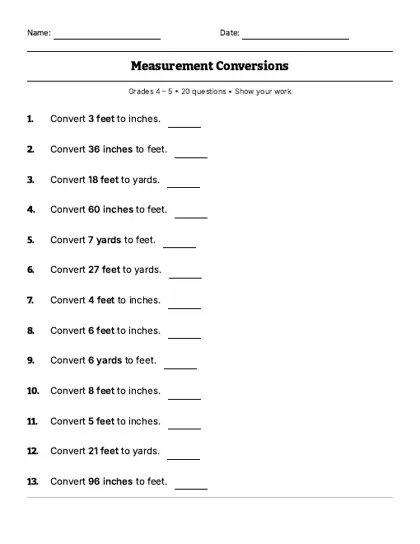
Customary units worksheet (cups to gallons): printable PDF with an answer key. · Make a fresh test
Practice capacity online · Unit converter · Measurement chart
Last reviewed
Questions parents ask
What is capacity in math?
The amount a container can hold, measured in units like milliliters, liters, cups and gallons.
How many milliliters are in a liter?
1,000. Half a liter is 500 mL.
How many cups are in a quart?
4. There are 2 cups in a pint and 2 pints in a quart.
What is the difference between capacity and volume?
Capacity is how much a container holds, usually liquid. Volume is the space an object takes up, in cubic units. 1 cubic centimeter equals 1 mL.
What grade learns capacity?
Grade 3 (3.MD.A.2) measures liquid volume in liters. Grade 4 converts between units like quarts and cups.