
Weight and mass
Weight and mass tell you how heavy something is. Small things are measured in grams or ounces, bigger things in kilograms or pounds.
Heavier and lighter
Young children start by comparing: hold two things and say which is heavier. A pan balance makes it fair. The heavier side goes down, and when both sides are level the objects weigh the same.
Size can fool you. A big balloon is lighter than a small rock. Ask children to guess first, then check.
Grams and kilograms
The metric units of mass are the gram (g) and the kilogram (kg). 1,000 grams make 1 kilogram. Grade 3 (3.MD.A.2) estimates and measures masses in grams and kilograms and solves one-step problems with them.
- About 1 gram: a paper clip, a raisin.
- About 100 grams: a small apple, a bar of soap.
- About 1 kilogram: a bag of sugar, a large bottle of water.
- About 30 kilograms: an 8-year-old child.
Ounces, pounds and tons
The US customary units of weight are the ounce (oz), the pound (lb) and the ton. 16 ounces make 1 pound, and 2,000 pounds make 1 ton.
- About 1 ounce: a slice of bread, a pencil.
- About 1 pound: a loaf of bread, a football.
- About 1 ton: a small car.
A pound is a little less than half a kilogram: 1 kg is about 2.2 lb.
Reading a scale
Kitchen and bathroom scales have a dial or a screen. On a dial, find what each small mark is worth before reading. If the numbers go up by 100 g and there are 4 marks between them, each mark is 25 g. Read where the pointer stops, and say the unit.
Converting units of weight
The rule is the same as for every measure. To a smaller unit, multiply: 3 kg × 1,000 = 3,000 g. To a bigger unit, divide: 48 oz ÷ 16 = 3 lb.
Mixed units are common: 2 lb 5 oz = 32 + 5 = 37 oz. Try it with the unit converter.
Estimating weight
Estimating means making a sensible guess using a benchmark.
Hold a 1 kg bag of sugar in one hand and a book in the other. Is the book lighter or heavier? If it feels about half as heavy, estimate 500 g. Then weigh it and see how close you were.
Good estimates come from good benchmarks. Use a paper clip for 1 gram, a slice of bread for 1 ounce, a loaf for 1 pound and a bag of sugar for 1 kilogram. Children who estimate before they weigh soon spot impossible answers, like a cat that weighs 4 grams.
Weight word problems
Grade 3 problems use one unit at a time. Four bags of flour weigh 2 kg each. How much do they weigh in all? 4 × 2 = 8 kg.
Grade 4 problems mix units: a puppy weighed 3 lb and gained 10 oz. How much does it weigh now? 3 lb = 48 oz, so 48 + 10 = 58 oz, or 3 lb 10 oz.
See measurement word problems for more.
Is weight the same as mass?
Not quite. Mass is how much stuff is in an object, and it stays the same everywhere. Weight is how hard gravity pulls on it, so an astronaut weighs less on the Moon but has the same mass.
In everyday life and in grades 2 to 5, the two words are used the same way. Grams and kilograms are units of mass, and ounces and pounds are used for weight.
Weight and mass quiz
Pick the best unit, compare weights and convert. Wrong answers show the rule.
What to say to your child
A short script for teaching it the first time. Pause after each line and let your child do the next step.
- “Hold the apple in one hand and the pencil in the other. Which is heavier?” (The apple.)
- “Now let’s check with the balance. The heavier side goes down.”
- “A paper clip is about 1 gram. A bag of sugar is about 1 kilogram.”
- “How many grams in a kilogram?” (1,000.) “So 2 kg is 2,000 g.”
- “Which is heavier: 1 kg of feathers or 1 kg of rocks?” (The same!)
More worked examples
Example 1: Heavier or lighter
On a balance, the pan with the heavier object goes down.
Example 2: Grams to kilograms
3,000 g ÷ 1,000 = 3 kg.
Example 3: Pounds to ounces
2 lb × 16 = 32 oz.
Example 4: Compare
Which is more, 2 kg or 1,500 g? 2 kg = 2,000 g, so 2 kg.
Practice questions (answers below)
Ask these out loud or write them down. Check each answer, and ask “how did you get that?” for one or two.
- Best unit for an apple: ounces or tons?
- Best unit for a car: pounds or tons?
- Best unit for a paper clip: grams or kilograms?
- 4 kg = ? g
- 5,000 g = ? kg
- 3 lb = ? oz
- 32 oz = ? lb
- Which is heavier, 1 kg or 900 g?
Show the answers
- ounces
- tons
- grams
- 4,000
- 5
- 48
- 2
- 1 kg
Common mistakes
How to teach it at home
Weigh the shopping
Read the weights on food packets, and find the heaviest and lightest.
Kitchen scale
Weigh fruit and guess before each one.
Balance with a hanger
Hang two bags from a coat hanger and see which side drops.
By grade
- Grade 2: compare heavier and lighter (many state standards).
- Grade 3 (3.MD.A.2): measure and estimate masses in grams and kilograms; one-step word problems.
- Grade 4 (4.MD.A.1–2): know relative sizes of kg, g, lb and oz; convert and solve word problems.
More for each grade: Grade 2 math and the CBSE class 2 maths guide; Grade 3 math and the CBSE class 3 maths guide; Grade 4 math and the CBSE class 4 maths guide.
Worksheets and practice
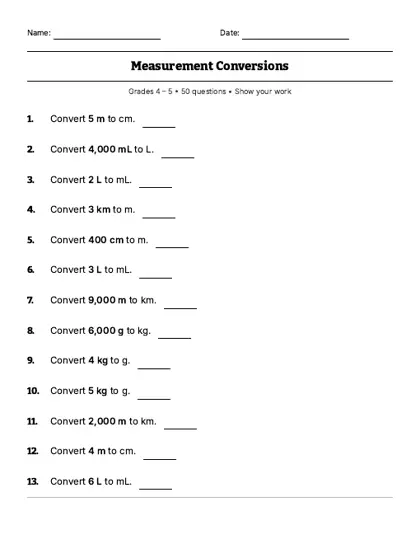
Metric units worksheet (grams and kilograms): printable PDF with an answer key. · Make a fresh test
Practice comparing weights online · Unit converter · Measurement chart
Last reviewed
Questions parents ask
What is the difference between weight and mass?
Mass is how much matter is in an object. Weight is the pull of gravity on it. On Earth, people use the words the same way.
How many grams are in a kilogram?
1,000. So 3 kg = 3,000 g, and 500 g is half a kilogram.
How many ounces are in a pound?
16. There are 2,000 pounds in a ton.
What weighs about 1 gram?
A paper clip or a raisin. A bag of sugar is about 1 kilogram.
What grade learns grams and kilograms?
Grade 3 (3.MD.A.2) measures and estimates in grams and kilograms. Grade 4 converts between units.