
Integer word problems
Integer word problems use temperatures, depths, money and scores. Find the zero point, write each amount as an integer, then choose the operation.
The idea: turn words into integers
Most integer word problems have a zero point and a change. First ask what zero means, then write each amount as a positive or negative integer.
Words like below, owe, lose, fall and down usually mean negative. Words like above, earn, gain, rise and up usually mean positive.
See it: pictures to draw with your child
Copy these onto paper or a whiteboard. A quick sketch makes the idea concrete before any written method.
A four-step plan
- Read the problem and find the zero point.
- Write each amount as an integer with a sign.
- Choose the operation: add for a change, subtract to compare, multiply for repeated changes, divide to share.
- Check that the answer makes sense in the story.
Common types of integer word problems
Temperature: −4°C rises 9 degrees: −4 + 9 = 5°C. Elevation: a diver at −20 m rises 8 m: −20 + 8 = −12 m.
Money: a balance of $15 after spending $40: 15 − 40 = −25, a debt of $25. Repeated change: losing 3 points in each of 5 rounds: 5 × (−3) = −15.
Comparing: how much warmer is 6°C than −3°C? 6 − (−3) = 9 degrees.
Check your answer
Type the integers from the story and pick the operation.
Does the answer make sense?
Picture the story. If a diver swims up, the new depth should be closer to 0. If the temperature falls, the new number should be smaller.
Also check the units and the sign in the answer sentence. “The temperature is −3°C” is clear; “the temperature fell −3 degrees” is confusing, so say “fell 3 degrees”.
Key words
- Zero point: what 0 means in the story.
- Gain / loss: an increase (positive) or a decrease (negative).
- Balance: the amount of money in an account after all changes.
- Rise / fall: a temperature or height going up (positive) or down (negative).
- Net change: the total of all the changes added together.
Two-step integer problems
Some problems have two changes. “It was −2°C at 6 a.m. It warmed 7 degrees by noon, then fell 9 degrees by midnight.” Work it in order: −2 + 7 = 5, then 5 − 9 = −4°C.
Or add the changes first: +7 and −9 make a net change of −2. Then −2 + (−2) = −4°C. Both ways give the same answer.
For money problems, list every deposit as positive and every withdrawal as negative. Then add the whole list to find the final balance.
Signal words
Words like “each”, “every” and “per” often mean multiply or divide. Words like “how much more” and “how much warmer” mean subtract.
Quiz: integer word problems
Write the answer with a minus sign for negatives.
Where this fits: integers step by step
- What are integers
- Integers on a number line
- Opposite numbers
- Absolute value
- Comparing integers
- Negative numbers in real life
- Zero pairs
- Adding integers
- Subtracting integers
- Distance between integers
- Multiplying integers
- Dividing integers
- Integer rules
- Order of operations with integers
- The coordinate plane
- Rational numbers
- Integer word problems (this page)
What to say to your child
A short script for teaching it the first time. Pause after each line and let your child do the next step.
- “A diver is 20 m below sea level. What integer is that?” (−20.)
- “She swims up 8 m. Add or subtract?” (Add 8.)
- “−20 + 8 = ?” (−12.)
- “Does that make sense? Is she closer to the top?” (Yes.)
- “Say the answer in a sentence.” (She is 12 m below sea level.)
More worked examples
Example 1: temperature drop
It is 3°C and the temperature falls 10 degrees: 3 − 10 = −7°C.
Example 2: lift
A lift goes from floor −2 up 7 floors: −2 + 7 = floor 5.
Example 3: repeated loss
A share price falls $4 a day for 3 days: 3 × (−4) = −12, a fall of $12.
Example 4: compare depths
A whale at −250 m and a seal at −90 m: −90 − (−250) = 160 m apart.
Practice questions (answers below)
Ask these out loud or write them down. Check each answer, and ask “how did you get that?” for one or two.
- It is −6°C and warms 4 degrees.
- It is 2°C and cools 9 degrees.
- A submarine at −60 m dives 25 m more.
- Ana has $10 and spends $18.
- A team loses 2 points in each of 6 rounds.
- A lift goes from floor 4 down 6 floors.
- How much warmer is 8°C than −5°C?
- Debt of $36 shared by 4 friends.
- A climber at 120 m and a cave at −30 m. Distance?
- Stretch: −3°C at 6 a.m., +2 degrees each hour. Temperature at 11 a.m.?
Show the answers
- −2°C
- −7°C
- −85 m
- −8 (owes $8)
- −12 points
- Floor −2
- 13 degrees
- −9 each
- 150 m
- 7°C
Common mistakes
How to teach it at home
Story swap
You give an integer sum, and your child makes up a story to match it.
Weather problems
Use real temperatures from a cold city to make up problems.
Pocket money ledger
Track pretend spending and earning, letting the balance go negative.
By grade
- Grade 6 (6.NS.C.5): integers to describe real-world quantities.
- Grade 7 (7.NS.A.3): solving real-world problems with the four operations on rational numbers.
- In India, integer word problems appear in class 6 and 7.
- Back to the start: integers for kids.
More for each grade: Grade 6 math and the CBSE class 6 maths guide; Grade 7 math and the CBSE class 7 maths guide.
Worksheets and practice
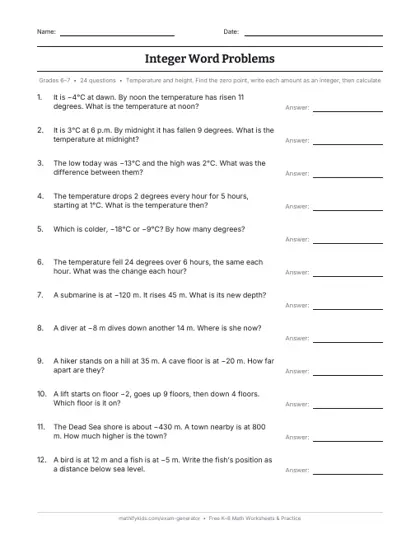
Integer word problems worksheet: printable PDF with an answer key. · Make a fresh test
Integer practice · integer calculator · integer number line · integers for kids · ratios
Last reviewed
Questions parents ask
How do you solve integer word problems?
Find the zero point, write each amount as an integer, choose the operation and check the answer makes sense.
What words mean negative in word problems?
Below, owe, lose, fall, down, withdraw and debt usually mean negative.
How do you find a temperature change?
Subtract the start from the end. From −4°C to 5°C is 5 − (−4) = 9 degrees warmer.
Which operation do I use?
Add for a change, subtract to compare, multiply for repeated changes and divide to share.
What grade learns integer word problems?
Grade 6 and grade 7 under Common Core 6.NS.C.5 and 7.NS.A.3. In India, class 6 and 7.