
Distance between integers
The distance between two integers is the absolute value of their difference: from −4 to 6 is |6 − (−4)| = 10. A quiz is included.
The idea: count the steps between
Distance is how many steps apart two numbers are on the number line. It doesn’t matter which one you start from, and it is never negative.
From −4 to 6, count 4 steps to reach 0 and 6 more to reach 6. That is 10 steps, so the distance is 10.
See it: pictures to draw with your child
Copy these onto paper or a whiteboard. A quick sketch makes the idea concrete before any written method.
Same side or opposite sides of zero
If the numbers are on opposite sides of 0, add their absolute values. From −7 to 5 is 7 + 5 = 12.
If they are on the same side, subtract their absolute values. From −9 to −3 is 9 − 3 = 6, and from 2 to 11 is 11 − 2 = 9.
Both cases fit one formula: distance = |a − b|. For example, |−9 − (−3)| = |−6| = 6.
Find the distance
Type two numbers separated by a comma. The tool marks both and measures the gap.
Change vs. distance
A change has a direction, so it can be negative. If the temperature goes from 3°C to −5°C, the change is −5 − 3 = −8 degrees.
A distance has no direction. The temperatures are |−8| = 8 degrees apart.
Word problems often ask “how much did it rise or fall?” Give the distance and say “rose” or “fell”, or give the signed change.
Distance on a grid
Points with the same x-coordinate sit on a vertical line. Their distance is the distance between their y-coordinates.
So (3, 4) and (3, −2) are |4 − (−2)| = 6 units apart. The coordinate plane guide uses this to find side lengths of shapes.
Key words
- Distance: how far apart two numbers are. Always 0 or positive.
- Absolute value: a number’s distance from 0, written |−5| = 5.
- Difference: the result of subtracting one number from another.
- Change: a difference with a direction, like a fall of 8 degrees or −8.
- Elevation: height above or below sea level.
Distance in real life
Temperature range: a desert might be 45°C by day and −5°C at night. The range is 45 − (−5) = 50 degrees.
Heights: a mountain peak at 2,000 m and a valley floor at −100 m are 2,100 m apart.
Time: on a timeline with −300 for 300 BC, the time from 300 BC to AD 200 is 200 − (−300) = 500 years.
Golf: a score of −4 and a score of +3 are 7 shots apart.
In each case, the question is “how far apart?”, so the answer is positive.
Using the number line tool
The number line tool above marks both numbers and shows the gap. Try pairs on the same side of 0 and pairs on opposite sides.
Ask your child to predict the distance first, then check. After a few tries, most children see the add-or-subtract pattern for themselves.
A common slip: subtracting across zero
When two numbers are on opposite sides of 0, children often subtract their sizes. From −4 to 6, they say 6 − 4 = 2.
Ask them to count to 0 first: 4 steps from −4 to 0, then 6 more to 6. Ten steps in all. After a few tries with a number line, the rule “opposite sides, add” sticks.
Quiz: distance between integers
How far apart are the numbers? Distances are never negative.
Where this fits: integers step by step
- What are integers
- Integers on a number line
- Opposite numbers
- Absolute value
- Comparing integers
- Negative numbers in real life
- Zero pairs
- Adding integers
- Subtracting integers
- Distance between integers (this page)
- Multiplying integers
- Dividing integers
- Integer rules
- Order of operations with integers
- The coordinate plane
- Rational numbers
- Integer word problems
What to say to your child
A short script for teaching it the first time. Pause after each line and let your child do the next step.
- “Put one finger on −4 and one on 6. How many steps from −4 to 0?” (4.)
- “And from 0 to 6?” (6.) “So the distance is…?” (10.)
- “Now −9 and −3. Are they on the same side of 0?” (Yes.)
- “Then subtract: 9 − 3.” (6.)
- “Can a distance be negative?” (No.)
More worked examples
Example 1: opposite sides
From −15 to 8: 15 + 8 = 23.
Example 2: same side
From −20 to −6: 20 − 6 = 14.
Example 3: with the formula
|−2 − 13| = |−15| = 15.
Example 4: elevation
A bird at 25 m and a fish at −10 m are 25 + 10 = 35 m apart.
Practice questions (answers below)
Ask these out loud or write them down. Check each answer, and ask “how did you get that?” for one or two.
- From −3 to 5
- From −12 to −2
- From 4 to 19
- From −8 to 0
- |−6 − 9|
- |−1 − (−11)|
- From −4°C to 7°C
- A diver at −18 m and a boat at 0 m
- (2, 5) and (2, −3)
- Stretch: a number is 6 away from −2. What could it be?
Show the answers
- 8
- 10
- 15
- 8
- 15
- 10
- 11 degrees
- 18 m
- 8 units
- 4 or −8
Common mistakes
How to teach it at home
Thermometer gaps
Compare today’s high and low and find how far apart they are.
Lift distance
Floor −2 to floor 5: how many floors does the lift travel?
Two-finger line
On a drawn number line, place two fingers and count the gap.
By grade
- Grade 6 (6.NS.C.8): distances between points with the same first or second coordinate.
- Grade 7 (7.NS.A.1c): distance between two rational numbers is the absolute value of their difference.
- In India, this appears in class 6 and 7 integers.
- Next: multiplying integers.
More for each grade: Grade 6 math and the CBSE class 6 maths guide; Grade 7 math and the CBSE class 7 maths guide.
Worksheets and practice
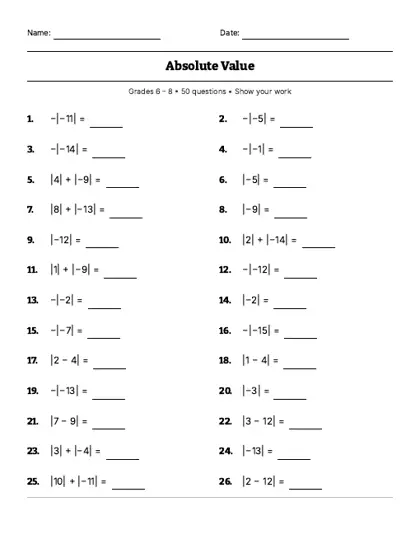
Absolute value worksheet: printable PDF with an answer key. · Make a fresh test
Integer practice · integer calculator · integer number line · integers for kids · ratios
Last reviewed
Questions parents ask
How do you find the distance between two integers?
Subtract them and take the absolute value: |a − b|.
What is the distance from −4 to 6?
10, because |6 − (−4)| = 10.
Can distance be negative?
No. Distance is always 0 or positive.
How is distance different from change?
Change has a direction and can be negative. Distance is the size of the change.
What grade learns distance between integers?
Grade 6 (6.NS.C.8) and grade 7 (7.NS.A.1c). In India, class 6 and 7.