
What are integers?
Integers are the whole numbers, their negatives and zero: …, −2, −1, 0, 1, 2, … Pictures and a quiz for kids, parent help below.
🧒 Kids: meet the negative numbers!
Zero sits in the middle. Numbers to the right are positive. Numbers to the left are negative and wear a minus sign. Then try the quiz!
💡 Trick: Below zero, owing, losing or going down? Use a minus sign: 5 below zero is −5!
More integers: What are integers · Opposite numbers · Absolute value · Comparing integers · Integers on a number line · Zero pairs
This part is for grown-ups: the key idea, pictures to draw, what to say, common mistakes, questions with answers and a free worksheet.
The trick: ask “above or below zero?”
Every integer story has a zero point: freezing, sea level, the ground floor or an empty wallet. Above or more than zero is positive. Below or less than zero is negative, written with a minus sign.
- 5 degrees below zero: −5
- A deposit of $20: 20 (or +20)
- 30 feet below sea level: −30
- Owing a friend $8: −8
Patterns to spot
- Every positive integer has a negative partner the same distance from 0.
- Zero is neither positive nor negative.
- There is no biggest integer and no smallest one: the number line goes on both ways.
- Positive numbers can be written with or without a + sign: 7 and +7 are the same.
- Negative numbers get smaller as their digits get bigger: −9 is less than −2.
- Between any two integers next to each other, like 2 and 3, there is no other integer.
Key words
- Integer: a whole number, its negative or zero, like −4, 0 or 9.
- Positive number: a number greater than 0, to the right of 0 on the number line.
- Negative number: a number less than 0, written with a minus sign, like −3.
- Zero: the starting point. It is neither positive nor negative.
- Sign: the + or − that shows which side of 0 a number is on.
Why it matters: Integers are the first numbers children meet that go below zero. They are the base for every later topic: adding and subtracting negatives, the coordinate plane, equations and graphs. A child who is calm with −5 now will find algebra much easier later.
See it: pictures to draw with your child
Draw these on paper or a whiteboard. A quick sketch makes the idea concrete before any rules.
What your child already knows
Children already count, add and subtract with whole numbers from 0 upwards. Many have seen a thermometer drop below zero or a lift button marked B1. Integers simply extend the number line to the left of zero.
In real life: Temperatures, bank balances, golf scores, floors below ground and heights below sea level all use negative numbers. Point them out when you see them, and ask your child which way from zero they go.
Integers, whole numbers and natural numbers
Counting numbers (also called natural numbers) are 1, 2, 3 and so on. Whole numbers are the counting numbers plus 0.
Integers are the whole numbers plus their negatives: …, −3, −2, −1, 0, 1, 2, 3, … So every whole number is an integer, but −4 is an integer that is not a whole number.
Fractions and decimals like ½, 2.5 and −0.75 are not integers. They sit between the integers on the number line. Together with the integers, they make the rational numbers.
Worked examples
Example 1: Write the integer
- A submarine is 250 feet below sea level.
- Below sea level is negative, so the integer is −250.
Example 2: Pick the integers
- Which of these are integers: 4, −9, 2.5, 0, −½?
- The integers are 4, −9 and 0. 2.5 and −½ are not, because they are not whole.
Example 3: Two meanings of zero
- In a bank account, 0 means no money at all.
- On a thermometer, 0°C means water freezes.
- Zero is the starting point, not always “nothing”.
Common mistakes
What to say to your child
A short script for your first session. Pause after each line and let your child answer.
- “Where is zero on this thermometer?”
- “The red line is 4 marks below zero. What temperature is that?” (−4°C.)
- “If you owe me $3, is that positive or negative?” (Negative, −3.)
- “Which is warmer, −4°C or 2°C?” (2°C.)
- “Integers are whole numbers, their negatives and zero.”
Questions to try (answers below)
Ask these out loud or write them down. The last one is a stretch.
- Write an integer for 12 degrees below zero
- Write an integer for a gain of 7 yards
- Write an integer for 80 m below sea level
- Is 0 positive or negative?
- Is −15 an integer?
- Is 3.5 an integer?
- Name the integer just left of −6
- Name three integers between −2 and 2
- Stretch: a lift goes from floor 3 to floor −2. How many floors down?
Show the answers
- −12
- 7
- −80
- Neither
- Yes
- No
- −7
- −1, 0 and 1
- 5 floors
Games to play at home
Weather watch
Check a weather app for a cold city and say its temperature as an integer.
Lift game
In a lift or on paper, call ground 0 and say each floor as an integer.
Plus or minus cards
Write money stories on cards (“spent $4”, “got $10”) and sort them into positive and negative.
A 5-day plan for what are integers
Ten minutes a day is enough. Short, regular practice works far better than one long session.
- Day 1: Learn it with real things: a thermometer, coins, a lift or a taped number line, like the pictures above.
- Day 2: Read the script together, then ask the first four questions.
- Day 3: Do the quiz at the top of the page and read the hints for anything missed.
- Day 4: Play one of the games at home for ten minutes.
- Day 5: Ask the rest of the questions, then do a round of the matching integer practice skill.
By grade
Grade 6 (Common Core 6.NS.C.5 and 6.NS.C.6) uses positive and negative numbers for real situations and places them on a number line. Grade 7 adds, subtracts, multiplies and divides them. In India, integers start in class 6 and continue in class 7.
More for each grade: Grade 6 math and the CBSE class 6 maths guide.
What comes next
Next, learn opposite numbers, absolute value and comparing integers. Explore on the integer number line.
Worksheet and more practice
Print a free worksheet with an answer key, or keep practicing online with integer practice.
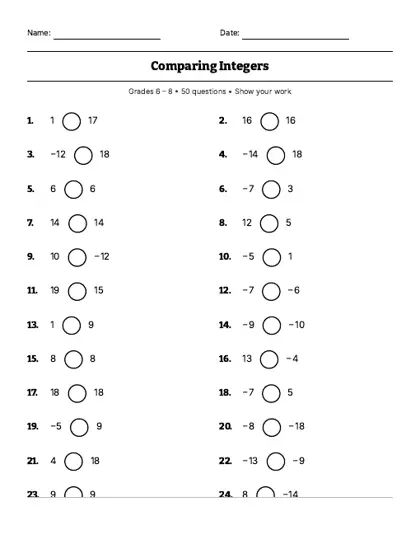 Comparing integers
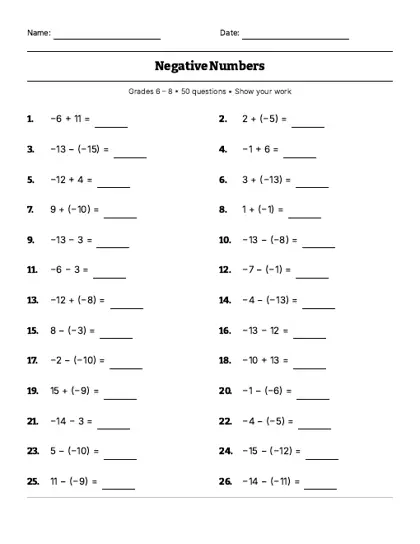 Adding and subtracting integers
Printable PDFs: comparing integers · absolute value · adding and subtracting integers · make a fresh integers test
More: integers for kids · integer calculator · integer number line · integer practice · multiplying integers · ratios for kids
Last reviewed
Questions parents ask
What are integers?
Integers are the whole numbers, their negatives and zero: …, −3, −2, −1, 0, 1, 2, 3, …
Is zero an integer?
Yes. Zero is an integer, but it is neither positive nor negative.
Are fractions integers?
No. Fractions and decimals like ½ or −2.5 are not integers, because integers are whole.
What are some real-life examples of integers?
Temperatures below zero, heights below sea level, money owed, floors below ground and points lost in a game.
What grade learns integers?
Grade 6 under Common Core 6.NS.C.5. In India, class 6.