
Multiplying integers
To multiply integers, multiply the numbers, then choose the sign. Same signs give a positive answer, different signs a negative one: −4 × 3 = −12.
The sign rules
| Signs | Answer | Example |
|---|---|---|
| positive × positive | positive | 4 × 3 = 12 |
| negative × positive | negative | −4 × 3 = −12 |
| positive × negative | negative | 4 × (−3) = −12 |
| negative × negative | positive | −4 × (−3) = 12 |
Short version: same signs, positive; different signs, negative. The rules are the same for dividing integers.
With more than two numbers, count the negatives: an even number of negatives gives a positive answer, an odd number gives a negative answer. (−2) × (−3) × (−1) has three negatives, so it is −6.
See it: pictures to draw with your child
Copy these onto paper or a whiteboard. A quick sketch makes the idea concrete before any written method.
Positive × negative on a number line
4 × (−3) means 4 jumps of −3. Start at 0 and jump left 3, four times. You land on −12.
And 3 × (−4) is three jumps of −4, also −12. The turn-around rule still works with negatives.
Why is a negative times a negative positive?
Follow the pattern. In the first table, each answer goes down by 3, so after 0 the answers become negative. In the second table, each answer goes up by 3, so after 0 the answers become positive. That is why −3 × (−2) = 6.
| Multiplication | Answer |
|---|---|
| 3 × 3 | 9 |
| 3 × 2 | 6 |
| 3 × 1 | 3 |
| 3 × 0 | 0 |
| 3 × (−1) | −3 |
| 3 × (−2) | −6 |
| 3 × (−3) | −9 |
| Multiplication | Answer |
|---|---|
| −3 × 3 | −9 |
| −3 × 2 | −6 |
| −3 × 1 | −3 |
| −3 × 0 | 0 |
| −3 × (−1) | 3 |
| −3 × (−2) | 6 |
| −3 × (−3) | 9 |
Another way: a negative sign means “the opposite of”. −3 × (−2) is the opposite of 3 × (−2). 3 × (−2) = −6, and the opposite of −6 is 6.
Multiplying integers quiz
Type each answer. Use a minus sign (−) for negative answers.
Multiplying integers in real life
- Temperature: it drops 2 °C every hour for 5 hours: 5 × (−2) = −10 °C change.
- Money: you spend 30 a week for 4 weeks: 4 × (−30) = −120.
- Going back in time: a tank fills 6 litres a minute. 3 minutes ago it had (−3) × 6 = 18 litres less than now.
Key words
- Product: the answer to a multiplication.
- Factor: each number being multiplied. In −4 × 3, the factors are −4 and 3.
- Sign rule: the rule that decides whether a product is positive or negative.
- Opposite: the number the same distance from 0 on the other side, like 6 and −6.
- Even and odd: used to count the negative factors in a longer product.
Squares and powers of negative numbers
A negative number squared is always positive, because it has two negative factors: (−5)² = (−5) × (−5) = 25.
A negative number cubed is negative, because three negative factors is odd: (−2)³ = −8. In general, an even power of a negative number is positive and an odd power is negative.
Watch the brackets. −5² means the opposite of 5², which is −25. Only (−5)² is 25. The order of operations with integers lesson practices this.
For more on powers, see what is an exponent and the exponent calculator, which works with negative bases.
Dividing integers uses the same rules
Division undoes multiplication, so the signs work the same way. Since −4 × 3 = −12, it follows that −12 ÷ 3 = −4 and −12 ÷ (−4) = 3.
A quick check for any division is to multiply back. If −35 ÷ (−7) = 5, then 5 × (−7) should be −35, and it is. See dividing integers for more.
Teaching tips
Ask for the sign first, then the size. “Same or different signs?” takes two seconds and stops most mistakes. Then the size is just a times table fact.
Keep the adding rules separate. “Two negatives make a positive” is true for × and ÷, but −3 + (−4) is −7. If your child mixes them up, practice a few of each side by side with the integer rules page.
If the times tables are slow, work on those first with multiplication practice. Every question here is a times table fact with a sign added. For quick daily practice, try the multiplying integers practice or Integer Race.
Where this fits: integers step by step
- What are integers
- Integers on a number line
- Opposite numbers
- Absolute value
- Comparing integers
- Negative numbers in real life
- Zero pairs
- Adding integers
- Subtracting integers
- Distance between integers
- Multiplying integers (this page)
- Dividing integers
- Integer rules
- Order of operations with integers
- The coordinate plane
- Rational numbers
- Integer word problems
What to say to your child
A short script for teaching it the first time. Pause after each line and let your child do the next step.
- “First ignore the signs. What is 6 × 4?” (24.)
- “Now look at the signs. 6 is positive and −4 is negative. Same or different?” (Different.)
- “Different signs give a negative. So 6 × (−4) = −24.”
- “What about −6 × (−4)?” (Same signs: 24.)
- “Count the negatives in (−1) × (−1) × (−1). Odd or even?” (Odd: −1.)
More worked examples
Example 1: −7 × 5
Different signs: −35.
Example 2: −8 × (−6)
Same signs: 48.
Example 3: (−2) × 3 × (−5)
Two negatives (even): 30.
Example 4: (−1) × (−1) × (−1) × (−1) × (−1)
Five negatives (odd): −1.
Practice questions (answers below)
Ask these out loud or write them down. Check each answer, and ask “how did you get that?” for one or two.
- −5 × 4
- 6 × (−7)
- −9 × (−3)
- −12 × 0
- (−2) × (−2) × (−2)
- (−4)²
- A temperature falls 3 °C each hour for 6 hours. Change?
- −11 × (−11)
- (−3)³
- Stretch: (−1) × (−2) × (−3) × (−4)
Show the answers
- −20
- −42
- 27
- 0
- −8
- 16
- −18 °C
- 121
- −27
- 24
Common mistakes
How to teach it at home
Temperature talk
Use weather forecasts: “It drops 2 degrees an hour for 3 hours.”
Sign game
Call out two signs; your child shouts “positive” or “negative” as fast as possible.
Pattern tables
Write 4 × 3, 4 × 2 … 4 × (−3) and let your child continue the pattern.
By grade
- Grade 6: understand positive and negative numbers on a number line.
- Grade 7 (7.NS.A.2): multiply and divide integers and rational numbers, and explain the sign rules.
- Grade 8: use the rules with exponents and in algebra.
More for each grade: Grade 7 math and the CBSE class 7 maths guide.
Worksheets and practice
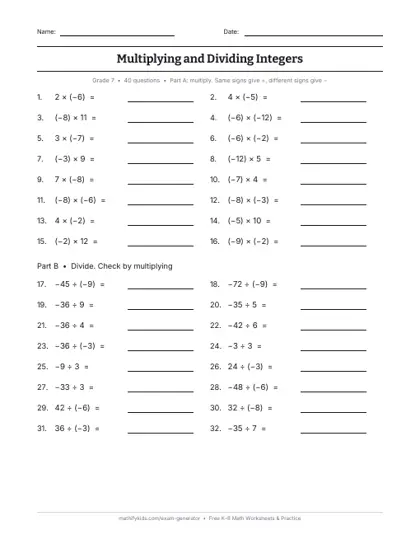
Multiplying and dividing integers worksheet: printable PDF with an answer key. · Make a fresh test
Integer practice · integer calculator · integers for kids · exponents · multiplication properties · times tables · multiplication strategies
Last reviewed
Questions parents ask
What are the rules for multiplying integers?
Multiply the numbers, then choose the sign: the same signs give a positive answer, different signs give a negative answer.
Why is a negative times a negative a positive?
Patterns show it: 3 × (−2) = −6, and each step of −3 × 2, −3 × 1, −3 × 0, −3 × (−1) goes up by 3, so −3 × (−2) = 6. A negative also means “the opposite of”, and the opposite of a negative is positive.
What is a negative times a positive?
Always negative. For example −7 × 4 = −28.
How do you multiply three negative numbers?
Count the negatives. Three is odd, so the answer is negative: (−2) × (−3) × (−4) = −24.
Are the rules for dividing integers the same?
Yes. Same signs give a positive quotient and different signs give a negative quotient: −24 ÷ (−6) = 4.