
Comparing and ordering integers
To compare integers, picture the number line: the number further right is greater, so −3 > −8. A quiz for kids, parent help below.
🧒 Kids: further right wins!
Find both numbers on the number line. The one on the right is bigger. The open mouth of < or > eats the bigger number! Then try the quiz.
💡 Trick: −3 is to the right of −8, so −3 > −8. Any positive beats any negative!
More integers: What are integers · Opposite numbers · Absolute value · Comparing integers · Integers on a number line · Zero pairs
This part is for grown-ups: the key idea, pictures to draw, what to say, common mistakes, questions with answers and a free worksheet.
The trick: further right is greater
On a number line, numbers grow from left to right. So of two integers, the one further right is greater. For two negatives, the one closer to 0 is greater.
- −3 ○ −8: −3 > −8
- −1 ○ 1: −1 < 1
- 0 ○ −5: 0 > −5
- −12 ○ −12: −12 = −12
Patterns to spot
- Every positive number is greater than every negative number.
- Zero is greater than every negative number and less than every positive one.
- For negatives, the bigger the digits, the smaller the number.
- To order least to greatest, read the dots from left to right.
- If a < b, then −a > −b: 3 < 5 but −3 > −5.
- The least number in a list is the one furthest left.
Key words
- Greater than (>): the left number is bigger: 2 > −5.
- Less than (<): the left number is smaller: −9 < −1.
- Equal to (=): both sides are the same number.
- Least: the smallest number in a list, furthest left on the number line.
- Greatest: the biggest number in a list, furthest right on the number line.
Why it matters: Comparing integers trains children to trust the number line instead of the digits. That habit stops errors later with negative fractions and decimals, with inequalities in algebra and with reading graphs.
See it: pictures to draw with your child
Draw these on paper or a whiteboard. A quick sketch makes the idea concrete before any rules.
What your child already knows
Children already compare whole numbers and use the symbols <, > and =. They also know a number line goes up from left to right. With negatives, the same rule holds, even when it looks backwards at first.
In real life: Which day was colder, −4°C or −9°C? Who is deeper, a diver at −15 m or one at −8 m? Which golf score is better, −3 or 2? Each is a comparison of integers.
Inequality statements in real life
Grade 6 writes and explains comparisons in context. “−3°C > −7°C” means −3°C is warmer than −7°C.
“−50 m < −20 m” means a depth of 50 m is lower than a depth of 20 m. The word matters: lower, colder or less money all mean further left.
Ask your child to say each statement in words. For example, “−12 < −5 because −12 is further left on the number line.”
Golf is a fun example. A score of −4 beats a score of −1, because lower is better in golf. But −4 is still less than −1. The number comparison stays the same; only the meaning of “better” changes.
Worked examples
Example 1: Two negatives
- Compare −6 and −11. −6 is closer to 0, so it is further right. −6 > −11.
Example 2: Order a list
- Order 4, −2, −9, 0 and −5 from least to greatest.
- Place them on a line and read left to right: −9, −5, −2, 0, 4.
Example 3: In context
- At 6 a.m. it was −5°C.
- At midnight it was −10°C. −10 < −5, so midnight was colder.
Common mistakes
What to say to your child
A short script for your first session. Pause after each line and let your child answer.
- “Find −3 and −8 on the number line.”
- “Which one is further right?” (−3.)
- “So which is greater?” (−3.)
- “Which is colder, −3°C or −8°C?” (−8°C.)
- “Order −1, −6 and 2 from least to greatest.” (−6, −1, 2.)
Questions to try (answers below)
Ask these out loud or write them down. The last one is a stretch.
- −7 ○ −2
- 0 ○ −4
- −10 ○ 3
- −15 ○ −51
- Order: 3, −8, −1, 0
- Order greatest to least: −4, −12, 6, −7
- Which is colder: −13°C or −6°C?
- Least of −20, −2, −200
- Stretch: a number is less than −5 and greater than −8. Name one.
Show the answers
- −7 < −2
- 0 > −4
- −10 < 3
- −15 > −51
- −8, −1, 0, 3
- 6, −4, −7, −12
- −13°C
- −200
- −6 or −7
Games to play at home
Integer war
Play the card game War with red cards negative and black cards positive.
Temperature line-up
Look up five cold cities and order their temperatures.
Human number line
Give family members integer cards and ask them to line up in order.
A 5-day plan for comparing integers
Ten minutes a day is enough. Short, regular practice works far better than one long session.
- Day 1: Learn it with real things: a thermometer, coins, a lift or a taped number line, like the pictures above.
- Day 2: Read the script together, then ask the first four questions.
- Day 3: Do the quiz at the top of the page and read the hints for anything missed.
- Day 4: Play one of the games at home for ten minutes.
- Day 5: Ask the rest of the questions, then do a round of the matching integer practice skill.
By grade
Grade 6 (Common Core 6.NS.C.7a and 7b) compares and orders integers using the number line, and writes and explains inequality statements in context. Grade 7 compares rational numbers, like −2.5 and −2¼. In India, comparing integers is part of class 6.
More for each grade: Grade 6 math and the CBSE class 6 maths guide.
What comes next
Next, practice reading and plotting on integers on a number line. Compare any two numbers with the integer number line.
Worksheet and more practice
Print a free worksheet with an answer key, or keep practicing online with integer practice.
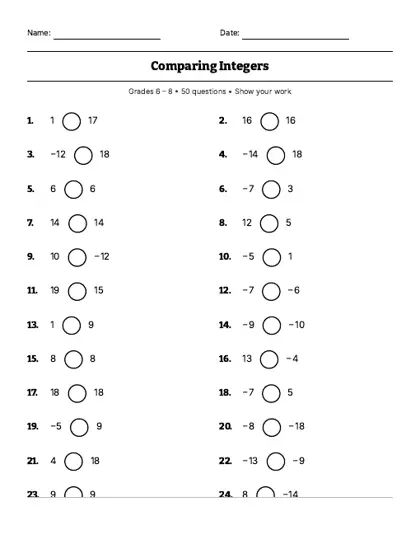 Comparing integers
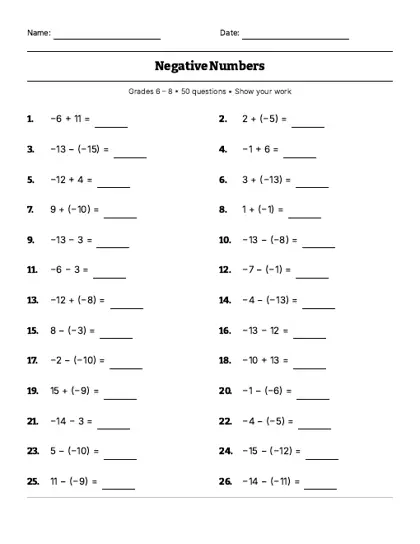 Adding and subtracting integers
Printable PDFs: comparing integers · absolute value · adding and subtracting integers · make a fresh integers test
More: integers for kids · integer calculator · integer number line · integer practice · multiplying integers · ratios for kids
Last reviewed
Questions parents ask
How do you compare integers?
Picture the number line. The integer further right is greater, so −3 > −8.
Which is greater, −5 or −10?
−5, because it is closer to 0 and further right.
Is a negative number always less than a positive one?
Yes. Every negative number is less than 0, and 0 is less than every positive number.
How do you order integers from least to greatest?
Place them on a number line and read from left to right.
What grade learns comparing integers?
Grade 6 under Common Core 6.NS.C.7. In India, class 6.