
Opposite numbers
Opposite numbers are the same distance from 0 on opposite sides, like 6 and −6. Pictures and a quiz for kids, parent help below.
🧒 Kids: flip over zero!
Find the number. Count its steps to 0. Now take the same steps on the other side. That is its opposite! Then try the quiz.
💡 Trick: To find the opposite, just change the sign: 7 → −7 and −7 → 7. Zero stays 0!
More integers: What are integers · Opposite numbers · Absolute value · Comparing integers · Integers on a number line · Zero pairs
This part is for grown-ups: the key idea, pictures to draw, what to say, common mistakes, questions with answers and a free worksheet.
The trick: change the sign
The opposite of a number is the same distance from 0, but on the other side. So to find it, keep the digits and change the sign. A number and its opposite always add to 0.
- Opposite of 9: −9
- Opposite of −14: 14
- Opposite of 0: 0
- Opposite of the opposite of 3: 3
Patterns to spot
- A number and its opposite add to 0: 6 + (−6) = 0.
- The opposite of a positive number is negative, and the opposite of a negative number is positive.
- Zero is its own opposite.
- Taking the opposite twice brings you back to the number you started with.
- Opposites have the same absolute value: |6| = |−6| = 6.
- On a number line, opposites are mirror images with 0 as the mirror.
Key words
- Opposite numbers: two numbers the same distance from 0 on opposite sides, like 8 and −8.
- Additive inverse: another name for the opposite. A number plus its additive inverse is 0.
- Sign: the + or − in front of a number. Changing it gives the opposite.
- Mirror image: opposites look like reflections of each other with 0 as the mirror.
- −(−a): the opposite of the opposite, which is a again.
Why it matters: Opposites are the key to subtracting integers, because subtracting a number means adding its opposite. They also lead to the idea that a number plus its opposite is 0, which children use when solving equations later.
See it: pictures to draw with your child
Draw these on paper or a whiteboard. A quick sketch makes the idea concrete before any rules.
What your child already knows
Children already know the number line and that negatives sit to the left of zero. They also know words that come in pairs, like up and down or gain and loss. Opposite numbers turn those word pairs into maths.
In real life: Going up 5 floors and down 5 floors, earning $10 and spending $10, or gaining and losing 3 points are opposites. Each pair cancels out back to where you started.
The minus sign means “the opposite of”
A minus sign in front of a number can be read as “the opposite of”. So −5 is the opposite of 5, and −(−5) is the opposite of −5, which is 5.
This idea matters later. In algebra, −x is not always negative: if x is −3, then −x is 3.
Opposites also explain subtraction of integers. Subtracting a number is the same as adding its opposite: 4 − 6 = 4 + (−6).
Try it with your child on a number line. Start at 4 and jump 6 to the left: you land on −2. Now start at 4 and add −6: you land on the same spot.
Worked examples
Example 1: Find the opposite
- What is the opposite of −23?
- It is 23 steps left of 0.
- The same distance on the right is 23.
- So the opposite is 23.
Example 2: Opposite of the opposite
- Simplify −(−8).
- The opposite of −8 is 8.
- So −(−8) = 8.
Example 3: In a story
- A plane climbs 400 m.
- What is the opposite move?
- Falling 400 m, written −400.
Common mistakes
What to say to your child
A short script for your first session. Pause after each line and let your child answer.
- “Put your finger on 5. How many steps is it to 0?” (5.)
- “Keep going 5 steps past 0. Where are you?” (−5.)
- “So 5 and −5 are opposites. What is 5 + (−5)?” (0.)
- “What is the opposite of −9?” (9.)
- “And the opposite of that?” (−9 again.)
Questions to try (answers below)
Ask these out loud or write them down. The last one is a stretch.
- Opposite of 12
- Opposite of −31
- Opposite of 0
- Simplify −(−6)
- Simplify −(4)
- Which number is 9 steps from 0 on the negative side?
- What is 15 + (−15)?
- Opposite of “10 m below sea level”
- Stretch: if −x = 7, what is x?
Show the answers
- −12
- 31
- 0
- 6
- −4
- −9
- 0
- 10 m above sea level, or 10
- −7
Games to play at home
Mirror walk
Chalk a number line outside. Stand on a number and have your child stand on its opposite.
Opposite snap
Write integers on cards. Snap any two cards that are opposites.
Story flip
Say a move (“up 6 stairs”) and ask for the opposite move and its integer.
A 5-day plan for opposite numbers
Ten minutes a day is enough. Short, regular practice works far better than one long session.
- Day 1: Learn it with real things: a thermometer, coins, a lift or a taped number line, like the pictures above.
- Day 2: Read the script together, then ask the first four questions.
- Day 3: Do the quiz at the top of the page and read the hints for anything missed.
- Day 4: Play one of the games at home for ten minutes.
- Day 5: Ask the rest of the questions, then do a round of the matching integer practice skill.
By grade
Grade 6 (Common Core 6.NS.C.6a) learns that opposite signs show locations on opposite sides of 0. It also learns that the opposite of the opposite is the number itself. Grade 7 uses opposites to subtract integers. In India, this is part of the class 6 integers chapter.
More for each grade: Grade 6 math and the CBSE class 6 maths guide.
What comes next
Next, learn absolute value, the distance from 0 that opposites share. Try opposites on the integer number line.
Worksheet and more practice
Print a free worksheet with an answer key, or keep practicing online with integer practice.
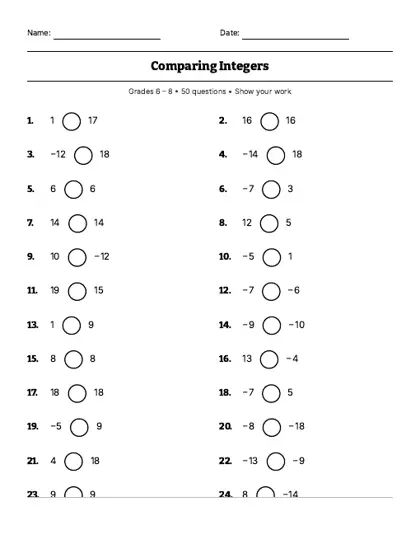 Comparing integers
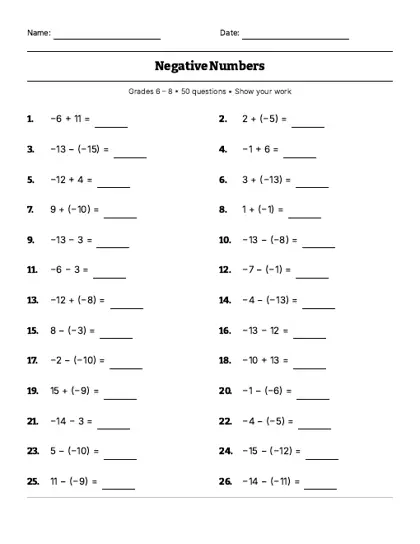 Adding and subtracting integers
Printable PDFs: comparing integers · absolute value · adding and subtracting integers · make a fresh integers test
More: integers for kids · integer calculator · integer number line · integer practice · multiplying integers · ratios for kids
Last reviewed
Questions parents ask
What are opposite numbers?
Two numbers the same distance from 0 on opposite sides of the number line, like 4 and −4.
What is the opposite of a negative number?
A positive number. The opposite of −8 is 8.
What is the opposite of 0?
0. Zero is its own opposite.
What do a number and its opposite add up to?
Always 0. For example, 9 + (−9) = 0.
What grade learns opposite numbers?
Grade 6 under Common Core 6.NS.C.6a. In India, class 6.