
What is an exponent?
An exponent is the small raised number in a power. It says how many times to multiply the base by itself. Quiz for kids, parent help below.
🧒 Kids: the small number tells you how many!
In 3⁴, the big 3 is the base and the small 4 is the exponent. It means four 3s multiplied: 3 × 3 × 3 × 3 = 81. Then try the quiz!
▶ Quiz 🔢 More practice 🧮 Calculator
💡 Trick: Write it out! 2⁵ is five 2s: 2 × 2 × 2 × 2 × 2 = 32. Not 2 × 5!
More on exponents: What are exponents · Square numbers · Square roots · Cube numbers and cube roots · Powers of 10
This part is for grown-ups: the key idea, pictures to draw, what to say, common mistakes, questions with answers and a free worksheet.
The trick: count the factors
Ask your child to write the power out in full before working it out. The exponent tells you how many copies of the base to write, with × signs between them. Then multiply from left to right, one step at a time.
- 2⁵: 2 × 2 × 2 × 2 × 2 = 32
- 3⁴: 3 × 3 × 3 × 3 = 81
- 10³: 10 × 10 × 10 = 1,000
- 7¹: just 7, one factor
Patterns to spot
- A power gets big fast: 2¹ = 2, 2² = 4, 2³ = 8, 2⁴ = 16, doubling each time.
- Each time the exponent goes up by 1, you multiply by the base once more.
- Any number to the power of 1 is itself: 9¹ = 9.
- 1 to any power is still 1: 1⁵ = 1 × 1 × 1 × 1 × 1 = 1.
- Powers of 10 are 1 followed by zeros: 10⁴ = 10,000.
- Powers of an even number are always even, and powers of an odd number are always odd.
Key words
- Exponent: the small raised number in a power. It says how many times the base is used as a factor.
- Base: the number being multiplied. In 3⁴ the base is 3.
- Power: a number written with an exponent, like 3⁴, or the answer, 81.
- Squared: to the power of 2, like 5² = 25.
- Cubed: to the power of 3, like 2³ = 8.
- Factor: a number that is multiplied. In 3 × 3 × 3 × 3, there are four factors of 3.
Why it matters: Exponents are a short way to write repeated multiplication. They are used for areas and volumes, powers of 10 in place value, very big and small numbers in science, and later in algebra.
See it: pictures to draw with your child
Draw these on paper, or build them with tiles and blocks. Seeing the shape makes the numbers easy to remember.
What your child already knows
Children already know that multiplication is repeated addition: 4 × 3 is 3 + 3 + 3 + 3. An exponent is the next step: repeated multiplication. They also know their times tables, which is all the arithmetic small powers need.
In real life: A phone with 2⁸ = 256 GB of storage, a hundred is 10², and a cube box 3 blocks wide holds 3³ = 27 blocks. Scientists write the distance to the Sun as about 1.5 × 10⁸ km.
How fast powers grow
Doubling again and again grows faster than children expect. 2¹⁰ = 1,024, so ten doublings turn 1 into more than a thousand.
Try the old story of rice on a chessboard: 1 grain on the first square, 2 on the next, then 4, then 8. By square 21, there are more than a million grains on that one square.
That is why exponents matter in real life. Savings with interest, viruses and phone storage all grow by multiplying, not adding.
Worked examples
Example 1: Write it as a power
- Write 6 × 6 × 6 × 6 as a power.
- The base is the number repeated: 6.
- It appears 4 times, so the exponent is 4.
- The answer is 6⁴.
Example 2: Work out a power
- Work out 4³.
- Write it out: 4 × 4 × 4.
- Multiply step by step: 4 × 4 = 16, then 16 × 4 = 64.
- So 4³ = 64.
Example 3: Compare two powers
- Which is bigger, 2⁵ or 5²?
- 2⁵ = 32 and 5² = 25.
- So 2⁵ is bigger, even though the numbers are the same.
Common mistakes
What to say to your child
A short script for your first session. Pause after each line and let your child answer.
- “What does the small number in 2³ tell us?” (How many 2s to multiply.)
- “So what do we write?” (2 × 2 × 2.)
- “What is the answer?” (8.)
- “Is 2³ the same as 2 × 3?” (No. 2 × 3 = 6, but 2³ = 8.)
- “What is 5 squared?” (25.)
Questions to try (answers below)
Ask these out loud or write them down. The last one is a stretch.
- 2⁴
- 3³
- 10²
- 5²
- 1⁶
- Write 7 × 7 × 7 as a power.
- Which is bigger, 3⁴ or 4³?
- What is the exponent in 9⁵?
- Stretch: 2¹⁰
Show the answers
- 16
- 27
- 100
- 25
- 1
- 7³
- 3⁴ = 81 is bigger than 4³ = 64.
- 5
- 1,024
Games to play at home
Doubling chain
Start at 1 and keep doubling: 2, 4, 8, 16. Ask which power of 2 each number is. How far can you go?
Fold a paper
Fold a sheet in half again and again. Count the layers each time: 2, 4, 8, 16. That is 2¹, 2², 2³, 2⁴.
Power snap
Write powers like 3² and their values like 9 on cards. Turn two over and keep them if they match.
A 5-day plan for what are exponents
Ten minutes a day is enough. Short, regular practice works far better than one long session.
- Day 1: Learn it with the pictures above: draw them on paper and talk them through.
- Day 2: Read the script together, then ask the first four questions.
- Day 3: Do the quiz at the top of the page and read the working for anything missed.
- Day 4: Play one of the games at home for ten minutes.
- Day 5: Ask the rest of the questions, then do a round of the matching practice skill.
By grade
Grade 6 (Common Core 6.EE.A.1) writes and works out numbers with whole-number exponents. Grade 5 meets exponents first with powers of 10. In India, exponents are taught in the class 8 chapter “Power Play”.
CBSE families: see the class 8 parent guides for A Square and a Cube and Power Play.
What comes next
Next, learn square numbers and cube numbers, the two powers with special names. Grade 8 learns the exponent rules. Check any power with the exponent calculator.
Worksheet and more practice
Print a free worksheet with an answer key, or keep practicing online with exponents practice.
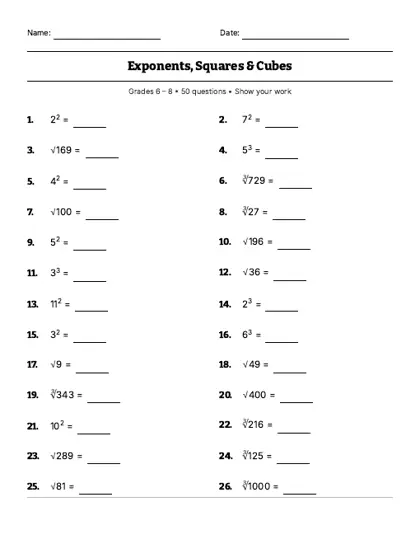 Exponents
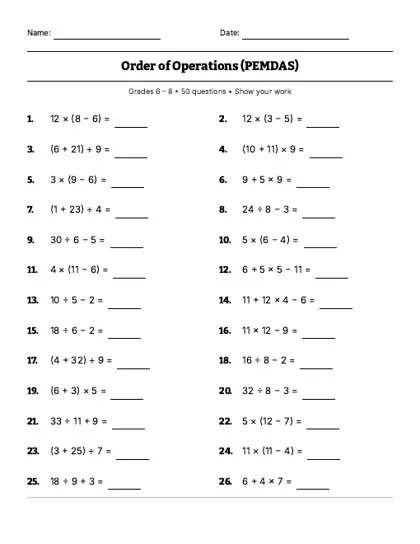 Order of operations with exponents
Printable worksheets: exponents worksheet · square roots worksheet · exponent rules worksheet · make a fresh exponents test
More: exponents for kids · exponent calculator · practice · order of operations with exponents · negative numbers and powers
Last reviewed
Questions parents ask
What is an exponent in math?
The small raised number in a power, like the 4 in 3⁴. It says how many times to use the base as a factor: 3⁴ = 3 × 3 × 3 × 3 = 81.
What is the base?
The number being multiplied. In 3⁴, the base is 3.
Is 2³ the same as 2 × 3?
No. 2³ = 2 × 2 × 2 = 8, but 2 × 3 = 6.
What is a number to the power of 1?
The number itself. 7¹ = 7, because there is only one factor of 7.
What grade learns exponents?
Grade 6 under Common Core 6.EE.A.1. Grade 5 uses exponents for powers of 10, and grade 8 learns the exponent rules.