
Cube numbers and cube roots
A cube number is a number used three times in a multiplication, like 3 × 3 × 3 = 27. The blocks make a cube. Quiz for kids, parent help below.
🧒 Kids: build a cube of blocks!
Stack 3 layers of 3 by 3 blocks and you get a cube. That is 27 blocks, so 27 is a cube number: 3³ = 27. Then try the quiz!
▶ Quiz 🔢 More practice 🧮 Calculator
💡 Trick: For 4³, work out 4 × 4 = 16 first, then 16 × 4 = 64!
More on exponents: What are exponents · Square numbers · Square roots · Cube numbers and cube roots · Powers of 10
This part is for grown-ups: the key idea, pictures to draw, what to say, common mistakes, questions with answers and a free worksheet.
The trick: square it, then times it once more
Work a cube out in two steps: square the number, then multiply by it once more. 5³ is 5 × 5 = 25, then 25 × 5 = 125. For cube roots, go backwards: ask which number, used three times, makes the cube.
- 2³: 4 × 2 = 8
- 4³: 16 × 4 = 64
- 5³: 25 × 5 = 125
- ∛1,000: 10, because 10 × 10 × 10 = 1,000
Patterns to spot
- Cube numbers grow very fast: 1, 8, 27, 64, 125, 216.
- Each last digit 0 to 9 gives a different last digit for the cube, so 2 → 8, 3 → 7, 7 → 3 and 8 → 2.
- Even numbers have even cubes, and odd numbers have odd cubes.
- Multiples of 10 have cubes ending in 000: 20³ = 8,000.
- A negative number has a negative cube: (−2)³ = −8.
- 1 and 64 are both square numbers and cube numbers.
Key words
- Cube number: a whole number multiplied by itself three times, like 4 × 4 × 4 = 64.
- Cubed: to the power of 3. “4 cubed” is 4³ = 64.
- Cube root: the number that was cubed: ∛64 = 4.
- Volume: the space inside a solid, counted in unit cubes.
- Perfect cube: another name for a cube number.
Why it matters: Cube numbers count the blocks in a cube, so they are used for volume. Cube roots work backwards from a volume to the side length, and they appear in grade 8 equations like x³ = 27.
See it: pictures to draw with your child
Draw these on paper, or build them with tiles and blocks. Seeing the shape makes the numbers easy to remember.
What your child already knows
Children already know square numbers, and a cube number is just one more multiplication. They may also have built towers of blocks, which is volume in a picture.
In real life: A box that holds 4 layers of 4 by 4 sugar cubes holds 4³ = 64 cubes. A cube-shaped tank 10 cm on each side holds 10³ = 1,000 cm³, which is exactly 1 litre.
Cube numbers from 1³ to 10³
| n | n³ | Cube root |
|---|---|---|
| 1 | 1 | ∛1 = 1 |
| 2 | 8 | ∛8 = 2 |
| 3 | 27 | ∛27 = 3 |
| 4 | 64 | ∛64 = 4 |
| 5 | 125 | ∛125 = 5 |
| 6 | 216 | ∛216 = 6 |
| 7 | 343 | ∛343 = 7 |
| 8 | 512 | ∛512 = 8 |
| 9 | 729 | ∛729 = 9 |
| 10 | 1,000 | ∛1,000 = 10 |
Unlike square roots, cube roots work for negative numbers too. (−3) × (−3) × (−3) = −27, so ∛(−27) = −3.
Worked examples
Example 1: Work out a cube
- Work out 6³.
- Square first: 6 × 6 = 36.
- Then multiply by 6 again: 36 × 6 = 216.
- So 6³ = 216.
Example 2: Find a cube root
- Find ∛343.
- Which number used three times makes 343?
- Try 7: 7 × 7 = 49, and 49 × 7 = 343.
- So ∛343 = 7.
Example 3: A negative cube root
- Find ∛(−8). (−2) × (−2) = 4, and 4 × (−2) = −8.
- So ∛(−8) = −2.
Common mistakes
What to say to your child
A short script for your first session. Pause after each line and let your child answer.
- “What does 2 cubed mean?” (2 × 2 × 2.)
- “What is it?” (8.)
- “Why is it called cubed?” (8 blocks make a 2 by 2 by 2 cube.)
- “What is the cube root of 27?” (3.)
- “Is 4³ the same as 4 × 3?” (No, 4³ = 64.)
Questions to try (answers below)
Ask these out loud or write them down. The last one is a stretch.
- 3³
- 10³
- 6³
- 1³
- ∛8
- ∛125
- ∛(−64)
- A cube box has sides of 7 cm. How many 1 cm cubes fit inside?
- Stretch: which number is both a square and a cube, between 2 and 100?
Show the answers
- 27
- 1,000
- 216
- 1
- 2
- 5
- −4
- 343
- 64 (8² and 4³)
Games to play at home
Sugar cube build
Build cubes with sugar cubes or Lego, 1, 2 and 3 blocks wide. Count the blocks each time.
Cube or not?
Say a number. Your child decides if it is a cube number, using the table.
Last digit trick
Give a cube like 2,744. Its last digit, 4, says the cube root ends in 4. It is 14.
Square or cube race
Write the squares and cubes up to 100 on cards. Take turns sorting them into a square pile, a cube pile, or both. The only card in both piles is 64.
A 5-day plan for cube numbers and cube roots
Ten minutes a day is enough. Short, regular practice works far better than one long session.
- Day 1: Learn it with the pictures above: draw them on paper and talk them through.
- Day 2: Read the script together, then ask the first four questions.
- Day 3: Do the quiz at the top of the page and read the working for anything missed.
- Day 4: Play one of the games at home for ten minutes.
- Day 5: Ask the rest of the questions, then do a round of the matching practice skill.
By grade
Grade 5 counts unit cubes for volume. Grade 6 writes cubes with exponents (Common Core 6.EE.A.1), and grade 8 uses cube roots to solve x³ = p (8.EE.A.2). In India, cube numbers and cube roots are in the class 8 chapter “A Square and a Cube”.
CBSE families: see the class 8 parent guides for A Square and a Cube and Power Play.
What comes next
Next, learn powers of 10. Practice with the cube numbers practice and cube roots practice.
Worksheet and more practice
Print a free worksheet with an answer key, or keep practicing online with exponents practice.
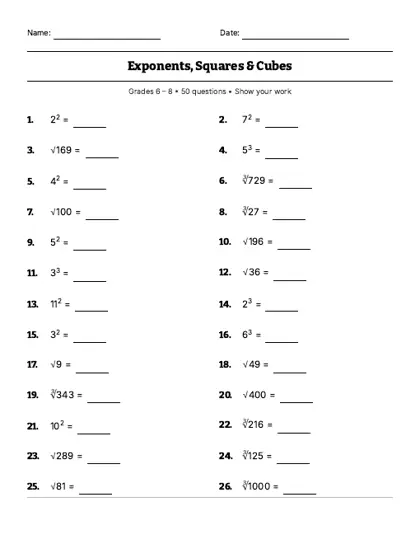 Exponents
Printable worksheets: square and cube roots worksheet · exponents worksheet · exponent rules worksheet · make a fresh exponents test
More: exponents for kids · exponent calculator · practice · order of operations with exponents · negative numbers and powers
Last reviewed
Questions parents ask
What are cube numbers?
Numbers you get by using a whole number three times in a multiplication: 1, 8, 27, 64, 125 and so on. 27 is a cube number because 3 × 3 × 3 = 27.
Why are they called cube numbers?
That many blocks can be stacked into a perfect cube. 8 blocks make a 2 by 2 by 2 cube.
What is a cube root?
The number that was cubed. ∛64 = 4 because 4 × 4 × 4 = 64.
Can you find the cube root of a negative number?
Yes. ∛(−27) = −3, because (−3) × (−3) × (−3) = −27.
What are the cube numbers up to 1,000?
1, 8, 27, 64, 125, 216, 343, 512, 729 and 1,000.