
Square roots
A square root is the number you multiply by itself to get another number. √36 = 6, because 6 × 6 = 36. Quiz for kids, parent help below.
🧒 Kids: find the side of the square!
If a square has 36 tiles, how long is each side? 6, because 6 × 6 = 36. So the square root of 36 is 6. Then try the quiz!
▶ Quiz 🔢 More practice 🧮 Calculator
💡 Trick: For √81, ask: what number times itself makes 81? 9 × 9 = 81, so √81 = 9.
More on exponents: What are exponents · Square numbers · Square roots · Cube numbers and cube roots · Powers of 10
This part is for grown-ups: the key idea, pictures to draw, what to say, common mistakes, questions with answers and a free worksheet.
The trick: ask “what times itself?”
Turn every square root into a question: “what number times itself makes this?” Then use the square numbers your child already knows. If no whole number works, find the two square numbers on each side to estimate it.
- √25: 5 × 5 = 25, so 5
- √100: 10 × 10 = 100, so 10
- √144: 12 × 12 = 144, so 12
- √50: between 7 and 8, about 7.1
Patterns to spot
- The square root of a square number is a whole number: √1 = 1, √4 = 2, √9 = 3.
- Squaring and square-rooting undo each other: √(7²) = 7.
- Bigger numbers have bigger square roots, but they grow slowly: √100 = 10 and √400 = 20.
- √1 = 1 and √0 = 0.
- If a number ends in 2, 3, 7 or 8, its square root is not a whole number.
- Multiply the number by 100 and the square root gets 10 times bigger: √9 = 3 and √900 = 30.
Key words
- Square root: the number that, multiplied by itself, makes the given number: √49 = 7 because 7 × 7 = 49.
- Radical sign: the √ symbol. The number under it is the radicand.
- Perfect square: a number with a whole-number square root, like 64.
- Inverse: an operation that undoes another. Square root undoes squaring.
- Estimate: a close answer, like √50 ≈ 7.1.
Why it matters: Square roots find the side of a square from its area, and they are used in the Pythagorean theorem to find lengths. They are also the first numbers many children meet that are not whole numbers or simple fractions.
See it: pictures to draw with your child
Draw these on paper, or build them with tiles and blocks. Seeing the shape makes the numbers easy to remember.
What your child already knows
Children already know their square numbers, or can work them out from times tables. A square root just runs a square number backwards, the way division runs multiplication backwards.
In real life: A square room with an area of 16 square metres has walls 4 metres long. Builders and gardeners use square roots to find the side of a square space from its area.
Two square roots, and roots that don’t end
Both 4 × 4 and (−4) × (−4) make 16, so 16 has two square roots: 4 and −4. The √ sign always means the positive one, so √16 = 4.
Most numbers are not perfect squares, so their square roots are long decimals that never end or repeat. √2 = 1.41421…, for example. These are called irrational numbers, and grade 8 estimates them on a number line.
There is no ordinary number that squares to a negative number, so √(−9) is not worked out in school maths before high school.
Worked examples
Example 1: A perfect square
- Find √121.
- Ask what times itself makes 121.
- 11 × 11 = 121, so √121 = 11.
Example 2: Estimate
- Estimate √30.
- 5² = 25 and 6² = 36, so √30 is between 5 and 6.
- It is a little closer to 5, about 5.5.
Example 3: Add square roots
- Work out √16 + √9.
- Find each root first: √16 = 4 and √9 = 3.
- Then 4 + 3 = 7.
- It is not √25 = 5!
Common mistakes
What to say to your child
A short script for your first session. Pause after each line and let your child answer.
- “What is the square root of 49?” (7.)
- “How do you know?” (7 × 7 = 49.)
- “Is the square root of 36 equal to 18?” (No, it is 6.)
- “What about √50?” (Between 7 and 8.)
- “What is √100?” (10.)
Questions to try (answers below)
Ask these out loud or write them down. The last one is a stretch.
- √64
- √9
- √169
- √400
- √1
- √25 + √4
- √20 is between which two whole numbers?
- A square has an area of 81 cm². How long is each side?
- Stretch: √(12²)
Show the answers
- 8
- 3
- 13
- 20
- 1
- 7
- 4 and 5
- 9 cm
- 12
Games to play at home
Tile hunt
Lay out 36 tiles or coins. Can your child make a square? How long is each side?
Root race
Call out a square number. Your child says the root before you count to three.
Guess and check
Pick a number that is not a square, like 40. Estimate its root, then check on a calculator.
A 5-day plan for square roots
Ten minutes a day is enough. Short, regular practice works far better than one long session.
- Day 1: Learn it with the pictures above: draw them on paper and talk them through.
- Day 2: Read the script together, then ask the first four questions.
- Day 3: Do the quiz at the top of the page and read the working for anything missed.
- Day 4: Play one of the games at home for ten minutes.
- Day 5: Ask the rest of the questions, then do a round of the matching practice skill.
By grade
Grade 6 meets square roots informally with area. Grade 8 (Common Core 8.EE.A.2) uses √ to solve x² = p and estimates roots that are not whole numbers (8.NS.A.2). In India, square roots are in the class 8 chapter “A Square and a Cube”.
CBSE families: see the class 8 parent guides for A Square and a Cube and Power Play.
What comes next
Next, learn cube numbers and cube roots. Grade 8 goes on to estimating square roots and uses them in the Pythagorean theorem to find the sides of right triangles. Practice with the square roots practice.
Worksheet and more practice
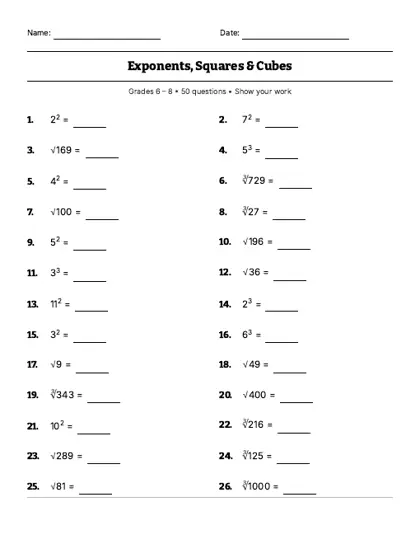
Print a free worksheet with an answer key, or keep practicing online with exponents practice.
 Exponents
Printable worksheets: square roots worksheet · exponents worksheet · exponent rules worksheet · make a fresh exponents test
More: exponents for kids · exponent calculator · practice · order of operations with exponents · negative numbers and powers
Last reviewed
Questions parents ask
What is a square root?
The number you multiply by itself to get another number. √49 = 7 because 7 × 7 = 49.
What does the √ symbol mean?
Take the square root. It always means the positive root, so √16 = 4, not −4.
What is the square root of 2?
About 1.414. It is not a whole number or a fraction: its decimals go on forever without repeating.
How do you estimate a square root?
Find the two square numbers on either side. √30 is between √25 = 5 and √36 = 6, so it is between 5 and 6.
What grade learns square roots?
Grade 8 under Common Core 8.EE.A.2 and 8.NS.A.2, though many children meet them in grade 6 or 7.