
Rational numbers
Rational numbers are integers, fractions and decimals, positive or negative, like −3, −½ and 2.75. The integer sign rules work for all of them.
The idea: filling the gaps between integers
Between −1 and 0 there are no integers, but there are lots of numbers: −0.5, −¼, −0.9 and more. These are negative fractions and decimals.
A rational number is any number that can be written as one integer over another (not zero). So −3 = −3/1, −0.5 = −1/2 and 2.75 = 11/4 are all rational.
See it: pictures to draw with your child
Copy these onto paper or a whiteboard. A quick sketch makes the idea concrete before any written method.
Rational numbers on the number line
−2.5 sits halfway between −3 and −2. −¾ sits three quarters of the way from 0 to −1.
The mirror rule still works: −2.5 is the opposite of 2.5, the same distance from 0 on the other side.
See decimals on a number line and fractions on a number line for the positive side.
Comparing negative fractions and decimals
The rule is the same as for integers: further right is greater. So −0.3 > −0.8, because −0.3 is closer to 0.
For fractions, change them to decimals or to a common denominator. −1/2 = −0.5 and −3/4 = −0.75, so −1/2 > −3/4.
Adding, subtracting, multiplying and dividing
Use the same sign rules as integers. −2.5 + 1.2: different signs, so 2.5 − 1.2 = 1.3, and the bigger size is negative: −1.3.
−0.5 × 6 = −3, because the signs are different. −1/2 ÷ (−1/4) = 2, because the signs are the same.
The integer rules page has the full chart.
Every rational number is a decimal that ends or repeats
Dividing turns a fraction into a decimal. −3/8 = −0.375 ends, and −1/3 = −0.333… repeats.
That is a test for rational numbers. Numbers like π, whose decimals never end or repeat, are not rational.
Key words
- Rational number: a number that can be written as a fraction of two integers, like −3/4.
- Integer: a whole number, its negative or zero.
- Terminating decimal: a decimal that ends, like −0.375.
- Repeating decimal: a decimal with a pattern that repeats forever, like −0.333…
- Irrational number: a number like π whose decimal never ends or repeats.
How the number families fit together
Counting numbers (1, 2, 3, …) sit inside the whole numbers (0, 1, 2, …). Whole numbers sit inside the integers (…, −1, 0, 1, …). Integers sit inside the rational numbers.
So 5 is a counting number, a whole number, an integer and a rational number. −5 is an integer and rational, but not a whole number. −5.5 is rational, but not an integer.
A Venn diagram of nested circles shows this well. Draw it with your child and place a few numbers in the right ring.
A tip for negative fractions
Put the minus sign in front of the whole fraction: −3/4. This is the same as (−3)/4 and 3/(−4), but it is clearer to read.
When adding negative fractions, find a common denominator first, then use the integer rules on the numerators.
Money is the best model
Amounts of money with cents are rational numbers. Owing $2.50 is −2.50, and earning $1.25 is +1.25.
Ask your child to track a pretend balance through a few spends and earnings. The sign rules for decimals feel natural when the numbers are dollars and cents.
Quiz: rational numbers
Add, multiply and compare negative decimals and fractions.
Where this fits: integers step by step
- What are integers
- Integers on a number line
- Opposite numbers
- Absolute value
- Comparing integers
- Negative numbers in real life
- Zero pairs
- Adding integers
- Subtracting integers
- Distance between integers
- Multiplying integers
- Dividing integers
- Integer rules
- Order of operations with integers
- The coordinate plane
- Rational numbers (this page)
- Integer word problems
What to say to your child
A short script for teaching it the first time. Pause after each line and let your child do the next step.
- “Is there an integer between −1 and 0?” (No.)
- “Is there any number between them?” (Yes, like −0.5.)
- “Which is greater, −0.3 or −0.8?” (−0.3, closer to 0.)
- “What is −0.5 × 4?” (−2.)
- “Same rules as integers?” (Yes.)
More worked examples
Example 1: compare
−2/3 and −0.7: −2/3 ≈ −0.67, which is further right, so −2/3 > −0.7.
Example 2: add
−1.6 + (−2.3) = −3.9.
Example 3: subtract
1.5 − 4.25 = 1.5 + (−4.25) = −2.75.
Example 4: divide
−3/4 ÷ 3 = −1/4.
Practice questions (answers below)
Ask these out loud or write them down. Check each answer, and ask “how did you get that?” for one or two.
- −0.4 + 1
- −0.4 − 1
- −2.5 × 2
- −1.2 × (−3)
- −4.8 ÷ 4
- Which is greater, −1/3 or −1/2?
- Write −0.25 as a fraction
- Write −5/8 as a decimal
- Is −7 rational?
- Stretch: −1/2 + 3/4 − 1
Show the answers
- 0.6
- −1.4
- −5
- 3.6
- −1.2
- −1/3
- −1/4
- −0.625
- Yes, −7/1
- −3/4
Common mistakes
How to teach it at home
Money with cents
Use pretend money: owe $2.50, then earn $1.25. What is the balance?
Ruler number line
Mark 0 in the middle of a ruler and place halves and quarters on both sides.
Weather decimals
Some weather apps show −0.5°C. Order a week of readings.
By grade
- Grade 6 (6.NS.C.6c, 6.NS.C.7): rational numbers on the number line and comparing them.
- Grade 7 (7.NS.A.1–3): all four operations with rational numbers.
- Grade 8: rational vs. irrational numbers.
- In India, rational numbers are a full chapter in class 8 (and class 7 in older books).
- Next: integer word problems.
More for each grade: Grade 7 math and the CBSE class 7 maths guide.
Worksheets and practice
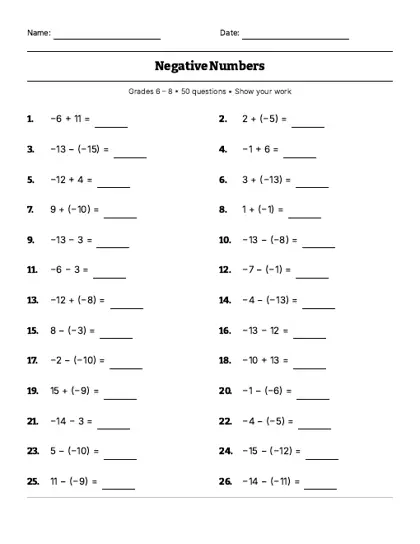
Integers worksheet: printable PDF with an answer key. · Make a fresh test
Integer practice · integer calculator · integer number line · integers for kids · ratios
Last reviewed
Questions parents ask
What is a rational number?
Any number that can be written as one integer over another non-zero integer, like −3/4, 0.5 or −7.
Are integers rational numbers?
Yes. Every integer can be written over 1, so −5 = −5/1.
How do you compare negative fractions?
Change them to decimals or a common denominator. The one closer to 0 is greater.
Do integer rules work for decimals and fractions?
Yes. The same sign rules apply to all rational numbers.
What grade learns rational numbers?
Grades 6 and 7 under Common Core 6.NS.C and 7.NS.A. In India, class 7 and 8.