
Area of composite shapes worksheet
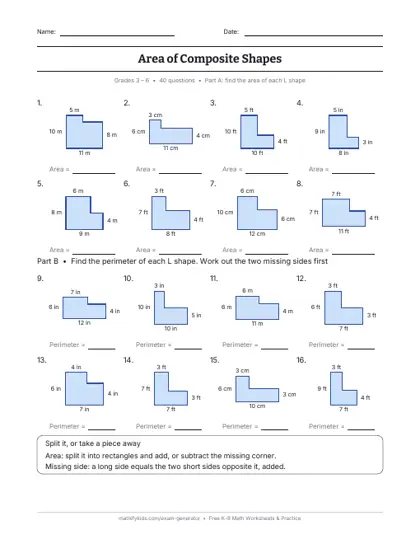
Forty questions on composite shapes: L shapes, missing sides and perimeter, T and U shapes, rectangles with a hole, word problems and quick areas.
Download the free area of composite shapes worksheet (PDF)
Area of composite shapes worksheet
What’s on the worksheet
- 40 questions on area of composite shapes, sized for US Letter paper
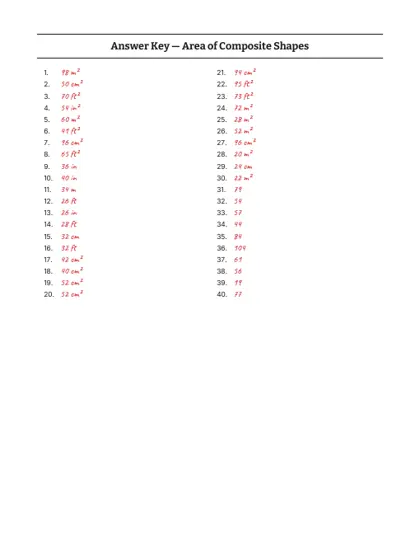
- 2 pages of questions plus an answer key on the last page
- Written for grades 3–6, matching Common Core 3.MD.C.7d, 6.G.A.1
- Name and date lines at the top, and room to show the work
Sample questions from this worksheet
- Find the area of the L shape (picture with sides).
- Find the perimeter of the L shape. Work out the two missing sides first.
- Find the area of the T shape.
- Find the shaded area of a rectangle with a hole.
- A 6 m by 5 m room has a 2 m by 1 m cupboard in a corner. Floor area outside it?
- 10 × 8 rectangle, 3 × 3 corner cut off:
Preview the worksheet and answer key
Practice area of composite shapes online
Between worksheets, a few minutes of online practice keeps the skill fresh. The composite shapes practice draws a new L shape every time and asks for its area or perimeter. The area and perimeter calculator draws any L shape to scale and shows every step, so your child can check their own answers.
Make a new area of composite shapes worksheet
Need another page for extra practice, a retake or a second group in class? The free Mathify Kids test maker builds a fresh area of composite shapes worksheet with different numbers every time. Choose how many questions, print it with its own answer key, or let your child take it on screen and see the score straight away.
Area of composite shapes: a worked example (An L shape 10 m wide and 8 m tall with a 4 m by 3 m corner missing)
- Draw the whole rectangle around the shape: 10 × 8 = 80 m².
- Find the missing corner: 4 × 3 = 12 m².
- Subtract: 80 − 12 = 68 m².
- Check by splitting into two rectangles instead: you should get the same answer.
How to use it at home and in class
At home
Colour each rectangle in a different colour before multiplying, so your child can see the parts. Let them try both methods, splitting and subtracting, on one shape: getting the same answer twice builds confidence. For perimeter, trace the outline with a finger and say each side aloud. The composite shapes lesson walks through both methods. Ten problems a day works better than a whole sheet at once. Mark them together with the answer key, then ask your child to explain one they got wrong: finding the mistake themselves is where the learning happens.
In class
Use the first row as a warm-up, a full page for independent practice, or five questions as an exit ticket. For a retake or a second group, make a new version with the test maker so every child gets different numbers.
Mistakes to watch for
- Adding a side twice, or missing one, when splitting the shape.
- Using a total side length for a part of the shape.
- Forgetting a missing side in the perimeter.
- Writing cm instead of cm² for area.
What to practice before and after area of composite shapes
- Before: area of rectangles. If this sheet is a struggle, go back a step.
- After: area of triangles, once this one is mostly right.
- Learn it first: the area of composite shapes lesson and the perimeter and area chart.
More geometry worksheets
Last reviewed
Questions parents ask
How do you find the area of a composite shape?
Split it into rectangles, find the area of each and add. Or draw the whole rectangle around it and subtract the missing part. Both give the same answer.
What grade is this area of composite shapes worksheet for?
It is written for grades 3–6 and matches Common Core standards 3.MD.C.7d, 6.G.A.1.
Can I get a different version of this area of composite shapes worksheet?
Yes. Use the free Mathify Kids test maker to make a new area of composite shapes worksheet with different numbers every time. You choose how many questions, and every version comes with its own answer key.