
Surface area
Surface area is the total area of all the faces of a 3D shape. Unfold it into a net, find each face’s area and add them.
The idea: wrapping paper
Surface area is how much wrapping paper you would need to cover a shape exactly. It is measured in square units, like cm².
The easy way to find it is to unfold the shape into a flat net. Every face becomes a rectangle, triangle or circle whose area you already know (6.G.A.4).
See it: pictures to draw with your child
Copy these onto paper or a whiteboard. A quick sketch makes the idea concrete before any written method.
Surface area of a box
A box has 6 faces in 3 matching pairs: top and bottom, front and back, left and right.
SA = 2 × (l × w) + 2 × (l × h) + 2 × (w × h). A box 5 × 3 × 2 cm has SA = 2 × 15 + 2 × 10 + 2 × 6 = 62 cm².
Surface area of a cube
A cube has 6 equal square faces. If each edge is s, each face is s × s, so SA = 6 × s².
A cube with 4 cm edges has 6 × 16 = 96 cm². Doubling the edge makes the surface area 4 times as big.
Box explorer
The explorer shows the volume. Work out the surface area from the six faces too, and compare the two numbers.
Triangular prisms and pyramids
A triangular prism has 2 triangle ends and 3 rectangles. Find the area of each and add all five. The triangles use ½ × base × height.
A square pyramid has a square base and 4 matching triangles. SA = base area + 4 × triangle area.
Surface area of a cylinder
A cylinder’s net is two circles and one rectangle. The rectangle is as long as the circle’s circumference, 2πr, and as tall as the cylinder.
SA = 2πr² + 2πrh. A can with r = 3 cm and h = 10 cm has 2 × 3.14 × 9 + 2 × 3.14 × 3 × 10 = 56.52 + 188.4 = 244.92 cm².
Surface area or volume?
Surface area is the outside: paint, paper or material. Volume is the inside: how much it holds. They use different units, cm² and cm³.
Ask “am I covering it or filling it?” Covering means surface area; filling means volume.
Key words
- Surface area: the total area of all faces, in square units.
- Net: a flat shape that folds into a 3D shape.
- Face: a flat surface of a 3D shape.
- Prism: a shape with two matching ends joined by rectangles.
- Lateral area: the area of the sides only, without the ends.
A week of practice
Ten minutes a day is plenty. Short, regular practice beats one long session at the weekend.
- Day 1: unfold a real box into a net and label the faces.
- Day 2: surface area of boxes with the 2 × (lw + lh + wh) rule.
- Day 3: cubes: 6 × s².
- Day 4: triangular prisms and cylinders from their nets.
- Day 5: the quiz on this page, then a round of surface area practice.
If one day goes badly, repeat it rather than moving on. Each day builds on the one before.
Quiz: surface area
Picture the net. Add every face.
Where this fits: geometry step by step
- Lines, rays and line segments
- Types of angles
- Measuring angles with a protractor
- Angle relationships
- Polygons
- Types of triangles
- Angles in a triangle
- Quadrilaterals
- Symmetry
- Perimeter
- Area
- Area of composite shapes
- Area of triangles
- Area of parallelograms and trapezoids
- Parts of a circle
- Circumference and area of a circle
- Faces, edges and vertices
- Volume
- Surface area (this page)
- Volume of cylinders, cones and spheres
- The coordinate plane
- Transformations
- Pythagorean theorem
What to say to your child
A short script for teaching it the first time. Pause after each line and let your child do the next step.
- “How many faces does a box have?” (6.)
- “Which faces match?” (Top and bottom, front and back, the two sides.)
- “What is the area of the top?”
- “And the front? And the side?”
- “Add them, then double. What do you get?”
- “Is that how much paint we need, or how much it holds?” (Paint.)
More worked examples
Example 1: Box 4 × 3 × 2 m
2 × 12 + 2 × 8 + 2 × 6 = 52 m².
Example 2: Cube, edge 5 in
6 × 25 = 150 in².
Example 3: Triangular prism
Two triangles of 6 cm² and rectangles of 20, 15 and 25 cm²: 12 + 60 = 72 cm².
Example 4: Cylinder r = 2, h = 5
2π × 4 + 2π × 2 × 5 = 8π + 20π = 28π ≈ 87.92.
Practice questions (answers below)
Ask these out loud or write them down. Check each answer, and ask “how did you get that?” for one or two.
- Box 2 × 2 × 2
- Box 3 × 2 × 1
- Box 6 × 4 × 3
- Cube, edge 3
- Cube, edge 10
- Box 5 × 5 × 2
- Cube with SA 96. Edge?
- Cylinder r = 1, h = 4 (in terms of π)
- Box 10 × 2 × 1
- Stretch: 8 cubes of edge 1 make a 2 × 2 × 2 cube. SA?
Show the answers
- 24
- 22
- 108
- 54
- 600
- 90
- 4
- 10π
- 64
- 24
Common mistakes
How to teach it at home
Unfold a box
Open a cereal box flat and measure each panel. Add them up.
Wrap it
Estimate how much paper wraps a gift box, then check.
Cube builds
Build shapes from cubes and count the visible square faces.
By grade
- Grade 6 (6.G.A.4): nets made of rectangles and triangles, and surface area of prisms and pyramids.
- Grade 7 (7.G.B.6): surface area of objects made of cubes and right prisms.
- In India, Surface Area and Volume (class 9) and Surface Areas and Volumes (class 10) go further.
- Next: volume of cylinders, cones and spheres.
More for each grade: Grade 6 math and the CBSE class 6 maths guide; Grade 7 math and the CBSE class 7 maths guide; Grade 8 math and the CBSE class 8 maths guide.
Worksheets and practice
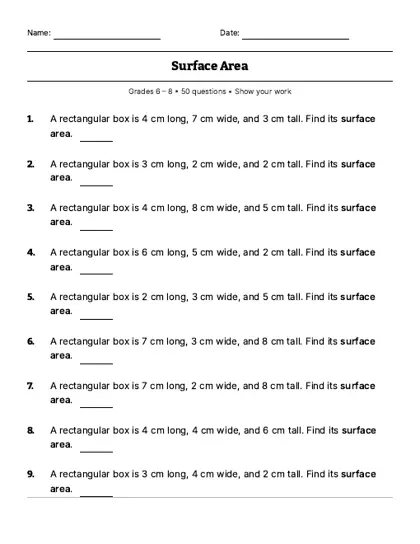
Surface area worksheet: printable PDF with an answer key. · Make a fresh test
Geometry practice · area and perimeter calculator · geometry for kids · area and perimeter chart · 3D shapes worksheet · faces, edges and vertices
Last reviewed
Questions parents ask
What is surface area?
The total area of all the faces of a 3D shape, measured in square units.
How do you find the surface area of a box?
SA = 2(lw + lh + wh): find the area of three different faces, add them and double.
What is the surface area of a cube?
6 × s², where s is the length of an edge.
How do you find the surface area of a cylinder?
Add the two circles and the curved side: 2πr² + 2πrh.
What is the difference between surface area and volume?
Surface area covers the outside (cm²); volume fills the inside (cm³).