
Lines, rays and line segments
A line goes on forever both ways, a ray goes one way, and a segment stops at two end points. Quiz for kids, parent help below.
🧒 Kids: line, ray or segment?
Look at the ends! Two arrows: a line. One arrow: a ray. Two dots: a line segment.
▶ Quiz 🔷 More practice 📐 Area and perimeter
💡 Trick: Arrows mean it keeps going. Dots mean it stops.
More on shapes and lines: Lines, rays and segments · Polygons · Types of triangles · Quadrilaterals · Parts of a circle · Faces, edges and vertices
This part is for grown-ups: the key idea, pictures to draw, what to say, common mistakes, questions with answers and free printables.
The trick: look at the two ends
Ask your child to point at each end in turn and say “keeps going” or “stops”. Two “keeps going” ends make a line, one makes a ray, and none makes a segment.
- Arrow and arrow: a line
- Dot and arrow: a ray
- Dot and dot: a line segment
- Two lines with a small square where they meet: perpendicular lines
Patterns to spot
- Every side of a polygon is a line segment.
- Every angle is made of two rays that start at the same point.
- Parallel lines are always the same distance apart.
- Perpendicular lines make four right angles where they cross.
- Two lines that cross meet at exactly one point.
- Only a line segment can be measured with a ruler.
Key words
- Point: an exact spot, drawn as a dot and named with a capital letter, like A.
- Line: a straight path that goes on forever in both directions.
- Ray: part of a line that starts at a point and goes on forever in one direction.
- Line segment: part of a line between two end points. It has a length.
- Parallel lines: lines that go the same way and never meet, like train tracks.
- Perpendicular lines: lines that meet at a right angle, like the corner of a page.
Why it matters: Lines, rays and segments are the building blocks of every shape and angle. An angle is two rays from one point, and a polygon is made of line segments.
See it: pictures to draw with your child
Draw these on paper, or build them with straws, paper and boxes. Holding and turning real shapes makes the words stick.
What your child already knows
Your child already draws straight lines with a ruler and knows the corner of a book is a “square corner”. This topic gives names to those ideas, and the small marks that show them in pictures.
In real life: Look for them around you. The edge of a table is a line segment, a torch beam is like a ray, and the lines on a road are parallel. A window frame has perpendicular sides.
Naming lines, rays and segments
Each one is named by two points on it, with a small mark on top. The mark shows what kind it is.
| What | Written | Ends | Has a length? |
|---|---|---|---|
| Line AB | AB with a double arrow on top | None: goes on both ways | No |
| Ray AB | AB with a one-way arrow on top | Starts at A | No |
| Line segment AB | AB with a bar on top | A and B | Yes |
For a ray, the starting point always comes first. Ray AB starts at A and goes through B; ray BA starts at B and goes the other way.
Worked examples
Example 1: Name a figure
- The picture has a dot at A and an arrow past B.
- One end stops and one goes on, so it is ray AB.
Example 2: Parallel or not?
- Two lines on squared paper both go 3 squares across for every 1 square up.
- They go the same way and never meet.
- They are parallel.
Example 3: Find perpendicular lines
- Look at a capital letter T.
- The top bar and the stem meet at a right angle.
- They are perpendicular.
Common mistakes
What to say to your child
A short script for your first session. Pause after each line and let your child answer.
- “Put your finger on one end. Does it stop or keep going?”
- “And the other end?”
- “So is it a line, a ray or a segment?”
- “Can we measure it with a ruler?” (Only if it is a segment.)
- “Do these two lines ever meet?” (Parallel lines never do.)
- “Do they make a square corner?” (Then they are perpendicular.)
Questions to try (answers below)
Ask these out loud, with pictures or real objects to hand. The last one is a stretch.
- Arrows at both ends
- A dot at one end and an arrow at the other
- Dots at both ends
- Which one has a length you can measure?
- Train tracks are…
- The corner of a page shows lines that are…
- How many end points does a ray have?
- Two lines cross but not at a right angle. They are…
- Stretch: how many line segments make a hexagon?
Show the answers
- a line
- a ray
- a line segment
- a line segment
- parallel
- perpendicular
- 1
- intersecting
- 6
Games to play at home
Line hunt
Walk round the house and find parallel lines (shelves), perpendicular lines (door frames) and segments (table edges).
Letter sort
Write the capital letters. Which have parallel lines (H, N, Z)? Which have perpendicular lines (E, F, H, L, T)?
Draw and name
One person draws a line, ray or segment with points A and B. The other names it, then swaps.
A 5-day plan for lines, rays and segments
Ten minutes a day is enough. Short, regular practice works far better than one long session.
- Day 1: Learn it with the pictures above: draw them on paper or build them with real objects, and talk them through.
- Day 2: Read the script together, then ask the first four questions.
- Day 3: Do the quiz at the top of the page and read the working for anything missed.
- Day 4: Play one of the games at home for ten minutes.
- Day 5: Ask the rest of the questions, then do a round of the matching practice skill.
By grade
Grade 4 (Common Core 4.G.A.1) draws and identifies points, lines, rays, segments, angles, and parallel and perpendicular lines. Grade 4 (4.G.A.2) then sorts shapes by their parallel and perpendicular sides.
CBSE families: Playing with Lines (class 2), Lines and Angles (class 6) and Parallel and Intersecting Lines (class 7) use the same ideas.
More for each grade: Grade 3 math and the CBSE class 3 maths guide; Grade 4 math and the CBSE class 4 maths guide.
What comes next
Next, see types of angles and how to measure angles with a protractor. Then use parallel and perpendicular sides to sort quadrilaterals.
Worksheets and more practice
Print a free worksheet with an answer key, or keep practicing online with geometry practice.
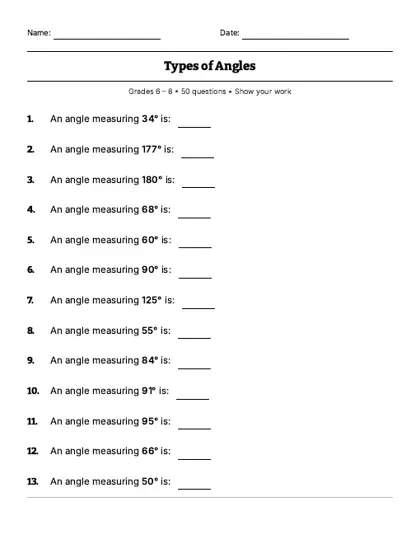 Types of angles
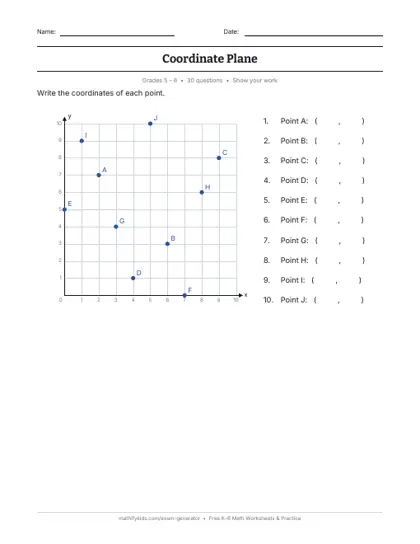 Coordinate plane
More printables: lines, rays and line segments worksheet · types of angles worksheet · make a fresh test
More: geometry for kids · shapes for kids · practice · 2D shapes chart · 3D shapes chart
Last reviewed
Questions parents ask
What is the difference between a line, a ray and a line segment?
A line goes on forever in both directions, a ray starts at a point and goes on forever in one direction, and a line segment has two end points.
How do you name a ray?
With two points, starting point first. Ray AB starts at A and passes through B.
What are parallel lines?
Lines that go in the same direction, stay the same distance apart and never meet.
What are perpendicular lines?
Lines that meet or cross at a right angle, 90°. A small square at the corner shows a right angle.
What grade learns lines, rays and line segments?
Grade 4, under Common Core 4.G.A.1.