
Types of angles
Angles are named by size: acute is smaller than a right angle, obtuse is bigger, and straight is a flat line. Compare with a square corner.
The idea: an angle is a turn
An angle is made by two rays that start at the same point, called the vertex. The size of the angle is how far one ray turns to reach the other.
Angles are measured in degrees (°). A full turn is 360°, a half turn is 180° and a quarter turn is 90°. The length of the arms doesn’t change the angle.
See it: pictures to draw with your child
Copy these onto paper or a whiteboard. A quick sketch makes the idea concrete before any written method.
The six types of angles
| Type | Size | Looks like |
|---|---|---|
| Acute | Less than 90° | A sharp point, like a slice of pizza |
| Right | Exactly 90° | The corner of a book, shown with a small square |
| Obtuse | Between 90° and 180° | An open book lying back |
| Straight | Exactly 180° | A flat line |
| Reflex | Between 180° and 360° | The outside of a pizza slice |
| Full turn | 360° | All the way round, back to the start |
Every angle except a right, straight or full turn falls into one of three ranges: acute, obtuse or reflex.
The trick: compare with a right angle
Children don’t need a protractor to name an angle. Fold a piece of paper into a square corner and hold it in the angle.
If the angle is smaller than the paper corner, it is acute. If it is bigger, but not yet a flat line, it is obtuse. If it matches exactly, it is a right angle.
Angle explorer
Slide to change the angle. Watch its name change as it passes 90° and 180°.
Angles on a clock
A clock is full of angles. At 3 o’clock the hands make a right angle. At 4 o’clock the angle is obtuse, and at 1 o’clock it is acute.
Each hour mark is 30° apart, because 360 ÷ 12 = 30. So at 2 o’clock the hands are 2 × 30 = 60° apart, and at 5 o’clock they are 150° apart.
Angles in shapes
Every corner of a polygon is an angle. A rectangle has 4 right angles, and an equilateral triangle has 3 acute angles of 60°.
A triangle can have at most one right angle or one obtuse angle. See types of triangles for how triangles are named by their angles.
Angles in real life
Look for angles around the house. Door hinges open from an acute angle to a right angle and beyond, and scissors make acute angles.
A ramp, a slide or a ladder against a wall all make angles with the ground. Ask whether each one is smaller or bigger than a right angle.
Key words
- Vertex: the point where the two arms of an angle meet.
- Degree (°): the unit for measuring angles; a full turn is 360°.
- Acute: less than 90°.
- Obtuse: more than 90° but less than 180°.
- Reflex: more than 180° but less than 360°.
A week of practice
Ten minutes a day is plenty. Short, regular practice beats one long session at the weekend.
- Day 1: make a paper right-angle tester and find right angles in the room.
- Day 2: sort angles into acute, right and obtuse with the tester.
- Day 3: angles on a clock at each hour.
- Day 4: straight and reflex angles with the angle explorer above.
- Day 5: the quiz on this page, then a round of types of angles practice.
If one day goes badly, repeat it rather than moving on. Each day builds on the one before.
Quiz: name the angle
Is it smaller or bigger than a right angle? Then name it.
Where this fits: geometry step by step
- Lines, rays and line segments
- Types of angles (this page)
- Measuring angles with a protractor
- Angle relationships
- Polygons
- Types of triangles
- Angles in a triangle
- Quadrilaterals
- Symmetry
- Perimeter
- Area
- Area of composite shapes
- Area of triangles
- Area of parallelograms and trapezoids
- Parts of a circle
- Circumference and area of a circle
- Faces, edges and vertices
- Volume
- Surface area
- Volume of cylinders, cones and spheres
- The coordinate plane
- Transformations
- Pythagorean theorem
What to say to your child
A short script for teaching it the first time. Pause after each line and let your child do the next step.
- “Show me a right angle with your arms.” (One arm up, one out.)
- “Close your arms a little. Is it bigger or smaller now?” (Smaller: acute.)
- “Open them wider than a right angle.” (Obtuse.)
- “Now make a straight line.” (180°, a straight angle.)
- “What angle do the hands make at 3 o’clock?” (A right angle.)
- “And at 1 o’clock?” (Acute.)
More worked examples
Example 1: Name an angle of 65°
65° is less than 90°, so it is acute.
Example 2: Name an angle of 140°
It is more than 90° and less than 180°, so it is obtuse.
Example 3: Name an angle of 200°
It is more than a straight line, so it is reflex.
Example 4: 2 o’clock
2 × 30° = 60°, an acute angle.
Practice questions (answers below)
Ask these out loud or write them down. Check each answer, and ask “how did you get that?” for one or two.
- 35°
- 90°
- 120°
- 180°
- 300°
- 89°
- 91°
- The angle at 3 o’clock
- The angle at 4 o’clock
- Stretch: the angle at 6 o’clock
Show the answers
- acute
- right
- obtuse
- straight
- reflex
- acute
- obtuse
- right, 90°
- obtuse, 120°
- straight, 180°
Common mistakes
How to teach it at home
Arm angles
Call out acute, right, obtuse or straight. Everyone makes the angle with their arms.
Angle hunt
Use a folded paper corner to test angles round the house: smaller, the same or bigger?
Clock quiz
Ask what kind of angle the clock hands make at different times of day.
By grade
- Grade 4 (4.G.A.1, 4.MD.C.5): angles as turns measured in degrees; acute, right and obtuse angles.
- Grade 3 children meet right angles when they sort shapes (3.G.A.1).
- In India, Angles as Turns (class 5) and Lines and Angles (class 6) cover the same ideas.
- Next: measure angles with a protractor, then types of triangles.
More for each grade: Grade 3 math and the CBSE class 3 maths guide; Grade 4 math and the CBSE class 4 maths guide; Grade 5 math and the CBSE class 5 maths guide.
Worksheets and practice
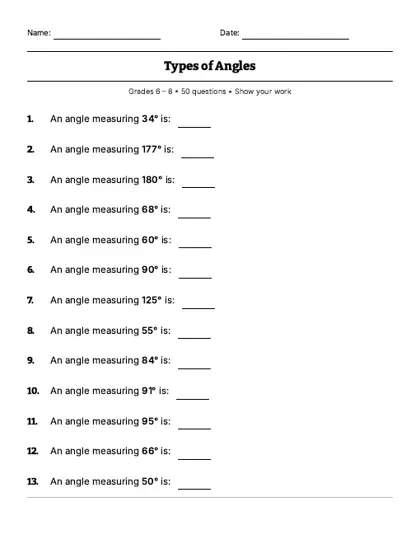
Types of angles worksheet: printable PDF with an answer key. · Make a fresh test
Geometry practice · area and perimeter calculator · geometry for kids · area and perimeter chart · types of angles chart
Last reviewed
Questions parents ask
What are the types of angles?
Acute (less than 90°), right (exactly 90°), obtuse (between 90° and 180°), straight (180°), reflex (between 180° and 360°) and a full turn (360°).
What is an acute angle?
An angle smaller than a right angle, so less than 90°. The angles of an equilateral triangle are acute.
What is an obtuse angle?
An angle bigger than a right angle but smaller than a straight line: between 90° and 180°.
What is a reflex angle?
An angle bigger than a straight line, between 180° and 360°. It is the outside of an ordinary angle.
How can I tell the type of angle without a protractor?
Compare it with a square corner, like the corner of a page. Smaller is acute, the same is right, and bigger is obtuse.