
Transformations in math: translation, reflection, rotation and dilation
A transformation moves or resizes a shape. Translations slide, reflections flip, rotations turn, and dilations make it bigger or smaller.
The idea: four ways to move a shape
A transformation takes a shape, called the pre-image, to a new position, called the image. The image’s corners are named with a dash: A becomes A′ (“A prime”).
Translations, reflections and rotations keep the size and shape the same. Only a dilation changes the size (8.G.A.1).
See it: pictures to draw with your child
Copy these onto paper or a whiteboard. A quick sketch makes the idea concrete before any written method.
Translation: a slide
Every point moves the same distance in the same direction. The shape doesn’t turn or flip.
On a grid, describe it with steps: “6 left and 2 up”. In coordinates, (x, y) becomes (x − 6, y + 2).
Reflection: a flip
The shape is flipped over a mirror line. Each point ends up the same distance from the line, on the other side.
Reflecting in the y-axis changes (x, y) to (−x, y). Reflecting in the x-axis changes it to (x, −y). The image faces the other way, like a mirror.
Coordinate grid
Plot a point, then find where it goes after a reflection or a translation.
Rotation: a turn
The shape turns about a fixed point, the centre of rotation, by an angle such as 90° or 180°.
A 90° turn anticlockwise about the origin takes (x, y) to (−y, x). A 180° turn takes it to (−x, −y). The shape is turned, but not flipped.
Tracing paper helps. Trace the shape, hold the centre with a pencil point and turn the paper a quarter turn.
Dilation: bigger or smaller
A dilation multiplies every distance from a centre by a scale factor. A scale factor of 2 doubles the size; ½ halves it.
From the origin, (x, y) becomes (kx, ky). The image is similar to the original: same shape and angles, different size (8.G.A.4).
Congruent or similar?
After a translation, reflection or rotation, the image is congruent: exactly the same size and shape (8.G.A.2).
After a dilation it is similar: the same shape, but a different size. Every angle stays the same.
Key words
- Image: the shape after the transformation; corners are marked A′, B′.
- Translation: a slide.
- Reflection: a flip over a mirror line.
- Rotation: a turn about a point.
- Dilation: a resize by a scale factor.
A week of practice
Ten minutes a day is plenty. Short, regular practice beats one long session at the weekend.
- Day 1: slide a paper shape on squared paper and describe the move.
- Day 2: reflect shapes in a mirror line and the axes.
- Day 3: rotate shapes 90° and 180° with tracing paper.
- Day 4: dilations and scale factors.
- Day 5: the quiz on this page, then a round of transformations practice.
If one day goes badly, repeat it rather than moving on. Each day builds on the one before.
Quiz: which transformation?
Is it the same way round? Flipped? Turned?
Where this fits: geometry step by step
- Lines, rays and line segments
- Types of angles
- Measuring angles with a protractor
- Angle relationships
- Polygons
- Types of triangles
- Angles in a triangle
- Quadrilaterals
- Symmetry
- Perimeter
- Area
- Area of composite shapes
- Area of triangles
- Area of parallelograms and trapezoids
- Parts of a circle
- Circumference and area of a circle
- Faces, edges and vertices
- Volume
- Surface area
- Volume of cylinders, cones and spheres
- The coordinate plane
- Transformations (this page)
- Pythagorean theorem
What to say to your child
A short script for teaching it the first time. Pause after each line and let your child do the next step.
- “Is the new shape the same size?”
- “Is it facing the same way?” (Then it slid: a translation.)
- “Is it a mirror image?” (A reflection.)
- “Is it turned round but not flipped?” (A rotation.)
- “Is it bigger or smaller?” (A dilation.)
- “Where does the point (2, 3) go if we reflect it in the y-axis?” ((−2, 3).)
More worked examples
Example 1: Translate (3, 1) 4 right, 2 down
(7, −1).
Example 2: Reflect (5, 2) in the x-axis
(5, −2).
Example 3: Rotate (2, 4) by 180° about the origin
(−2, −4).
Example 4: Dilate (3, 1) by 2
(6, 2).
Practice questions (answers below)
Ask these out loud or write them down. Check each answer, and ask “how did you get that?” for one or two.
- Slide with no turning
- Mirror image
- Turn about a point
- Make twice as big
- Reflect (4, 3) in the y-axis
- Translate (0, 0) 3 up
- Rotate (1, 0) 90° anticlockwise
- Dilate (2, 5) by 3
- Does a reflection change size?
- Stretch: rotate (3, 2) by 90° anticlockwise about the origin
Show the answers
- translation
- reflection
- rotation
- dilation
- (−4, 3)
- (0, 3)
- (0, 1)
- (6, 15)
- No
- (−2, 3)
Common mistakes
How to teach it at home
Paper moves
Cut out an L shape and slide, flip and turn it on squared paper.
Mirror drawings
Draw half a shape next to a line; your child draws the reflection.
Tracing paper turns
Trace a shape, pin the centre with a pencil and turn it 90°.
By grade
- Grade 4 (4.G.A.3) meets line symmetry, the start of reflections.
- Grade 8 (8.G.A.1–4): properties of rotations, reflections and translations, coordinates after transformations, congruence and similarity.
- In India, Symmetry (class 6) and Constructions and Tilings (class 7) use reflections and rotations.
- Next: the coordinate plane and the Pythagorean theorem.
More for each grade: Grade 4 math and the CBSE class 4 maths guide; Grade 5 math and the CBSE class 5 maths guide; Grade 6 math and the CBSE class 6 maths guide; Grade 7 math and the CBSE class 7 maths guide; Grade 8 math and the CBSE class 8 maths guide.
Worksheets and practice
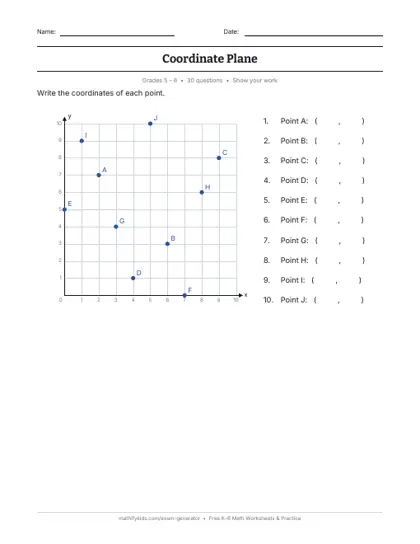
Coordinate plane worksheet: printable PDF with an answer key.
Geometry practice · area and perimeter calculator · geometry for kids · area and perimeter chart · symmetry worksheet · lines of symmetry
Last reviewed
Questions parents ask
What are the four transformations?
Translation (slide), reflection (flip), rotation (turn) and dilation (resize).
What is the difference between a reflection and a rotation?
A reflection flips the shape into a mirror image. A rotation turns it without flipping.
What happens to coordinates in a reflection in the y-axis?
The x-coordinate changes sign: (x, y) becomes (−x, y).
Which transformations keep the same size?
Translations, reflections and rotations. The image is congruent to the original.
What grade learns transformations?
Grade 8 (8.G.A.1–4), building on symmetry in grade 4.