
Volume of cylinders, cones and spheres
A cylinder holds πr²h. A cone holds a third of that, and a sphere holds 4/3 × π × r³. Each starts from the area of a circle.
The idea: base area times height
A cylinder is a stack of circles. Each circle has area πr², and the stack is h high, so V = πr²h.
It is the same idea as a box: area of the base × height. Only the base has changed from a rectangle to a circle (8.G.C.9).
See it: pictures to draw with your child
Copy these onto paper or a whiteboard. A quick sketch makes the idea concrete before any written method.
Cones: one third of a cylinder
Fill a cone with water or rice and pour it into a cylinder with the same radius and height. It takes exactly 3 cones to fill it.
So V = ⅓ × πr²h. A cone with r = 3 cm and h = 6 cm holds ⅓ × 3.14 × 9 × 6 = 56.52 cm³.
Spheres
A sphere’s volume is V = 4/3 × πr³. The r is cubed, because a sphere is round in every direction.
A ball with radius 3 cm holds 4/3 × 3.14 × 27 = 113.04 cm³. Double the radius and the volume becomes 8 times as big.
The three formulas side by side
| Shape | Volume | r = 3, h = 6 |
|---|---|---|
| Cylinder | πr²h | 169.56 |
| Cone | ⅓πr²h | 56.52 |
| Sphere | 4/3 πr³ | 113.04 |
A sphere fits snugly inside a cylinder of the same radius whose height is 2r. Its volume is two thirds of that cylinder: Archimedes’ favourite result.
Radius or diameter?
Every formula uses the radius. If a question gives the diameter, halve it first: a diameter of 10 cm means r = 5 cm.
Using the diameter by mistake makes a cylinder’s volume 4 times too big, and a sphere’s 8 times too big. Always check before you square or cube.
In real life
Drink cans are cylinders, ice-cream cones are cones and balls are spheres. Companies use these formulas to choose packaging sizes.
Ask your child to measure a can, work out its volume in cm³, and compare it with the millilitres printed on it. 1 cm³ is 1 millilitre.
Key words
- Volume: the space inside a 3D shape, in cubic units.
- Cylinder: two equal circles joined by a curved side.
- Cone: a circle base and a curved side meeting at a point.
- Sphere: a perfectly round ball.
- r³: the radius × radius × radius.
A week of practice
Ten minutes a day is plenty. Short, regular practice beats one long session at the weekend.
- Day 1: cylinders: base area times height.
- Day 2: fill a paper cone with rice and pour it into a cylinder.
- Day 3: cones: a third of the cylinder.
- Day 4: spheres: 4/3 πr³, and halving diameters first.
- Day 5: the quiz on this page, then a round of volume practice.
If one day goes badly, repeat it rather than moving on. Each day builds on the one before.
Quiz: cylinders, cones and spheres
Find r first. Then pick the right formula.
Where this fits: geometry step by step
- Lines, rays and line segments
- Types of angles
- Measuring angles with a protractor
- Angle relationships
- Polygons
- Types of triangles
- Angles in a triangle
- Quadrilaterals
- Symmetry
- Perimeter
- Area
- Area of composite shapes
- Area of triangles
- Area of parallelograms and trapezoids
- Parts of a circle
- Circumference and area of a circle
- Faces, edges and vertices
- Volume
- Surface area
- Volume of cylinders, cones and spheres (this page)
- The coordinate plane
- Transformations
- Pythagorean theorem
What to say to your child
A short script for teaching it the first time. Pause after each line and let your child do the next step.
- “What shape is the bottom of a can?” (A circle.)
- “What is its area?” (π × r × r.)
- “How tall is the stack?” (h.)
- “So the volume is…?” (πr²h.)
- “How many cones fill the cylinder?” (3.)
- “The ball is 10 cm across. What is r?” (5 cm.)
More worked examples
Example 1: Cylinder r = 2, h = 10
3.14 × 4 × 10 = 125.6.
Example 2: Cone r = 3, h = 4
⅓ × 3.14 × 9 × 4 = 37.68.
Example 3: Sphere r = 6
4/3 × 3.14 × 216 = 904.32.
Example 4: Sphere d = 4
r = 2: 4/3 × 3.14 × 8 ≈ 33.49.
Practice questions (answers below)
Ask these out loud or write them down. Check each answer, and ask “how did you get that?” for one or two.
- Cylinder r = 1, h = 10
- Cylinder r = 3, h = 2
- Cone r = 3, h = 3
- Cone r = 6, h = 5
- Sphere r = 3
- Sphere r = 1 (in terms of π)
- Cylinder r = 5, h = 4 (in terms of π)
- Cone with the same r and h as a 90 cm³ cylinder
- Sphere d = 10. r?
- Stretch: a cylinder and a cone have the same r and h. The cone holds 50 ml. The cylinder?
Show the answers
- 31.4
- 56.52
- 28.26
- 188.4
- 113.04
- 4/3π
- 100π
- 30 cm³
- 5
- 150 ml
Common mistakes
How to teach it at home
Rice test
Make a paper cone and cylinder with the same base and height. How many cones fill the cylinder?
Can check
Measure a drink can and compare your volume with the ml on the label.
Ball sizes
Compare two balls: if one has twice the radius, how many times the volume?
By grade
- Grade 8 (8.G.C.9): the formulas for the volumes of cones, cylinders and spheres, used to solve real problems.
- Grade 5 builds the idea with cubes and boxes: see how to find volume.
- In India, Surface Area and Volume (class 9) and Surface Areas and Volumes (class 10) use these formulas.
- Next: the Pythagorean theorem.
More for each grade: Grade 8 math and the CBSE class 8 maths guide.
Worksheets and practice
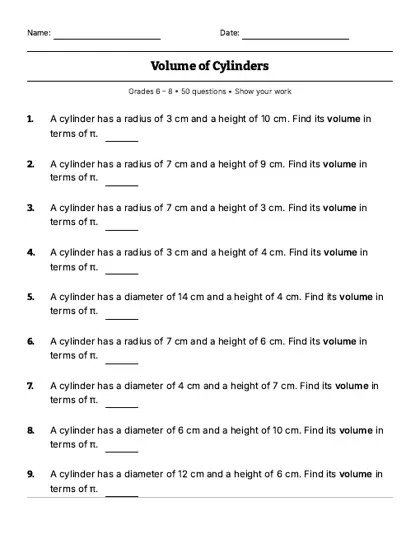
Volume of cylinders worksheet: printable PDF with an answer key. · Make a fresh test
Geometry practice · area and perimeter calculator · geometry for kids · area and perimeter chart · volume of cones and spheres worksheet
Last reviewed
Questions parents ask
What is the volume of a cylinder?
V = πr²h: the area of the circle base times the height.
What is the volume of a cone?
V = ⅓πr²h, one third of a cylinder with the same radius and height.
What is the volume of a sphere?
V = 4/3 × π × r³.
Why is a cone one third of a cylinder?
Three cones of water exactly fill a cylinder with the same base and height. It can be proved with calculus, but the pouring test shows it.
What grade learns the volume of cylinders, cones and spheres?
Grade 8, under Common Core 8.G.C.9.