
Lines of symmetry
A line of symmetry splits a shape into two halves that match exactly when folded. Some shapes have one line, some many, some none.
The idea: two matching halves
A line of symmetry is a fold line. If you fold a shape along it, the two halves land exactly on top of each other.
Each half is a mirror image of the other. Put a small mirror on the line, and the reflection completes the shape. That is why it is also called mirror symmetry.
See it: pictures to draw with your child
Copy these onto paper or a whiteboard. A quick sketch makes the idea concrete before any written method.
The fold test
The surest way to check a line of symmetry is to fold. Cut the shape out of paper and fold it along the line you are testing.
If every edge and corner matches, it is a line of symmetry. If anything sticks out, it isn’t. A rectangle’s diagonal fails this test, even though it cuts the rectangle into two equal triangles.
How many lines of symmetry?
| Shape | Lines of symmetry |
|---|---|
| Scalene triangle, parallelogram | 0 |
| Isosceles triangle, kite, isosceles trapezoid | 1 |
| Rectangle, rhombus | 2 |
| Equilateral triangle | 3 |
| Square | 4 |
| Regular pentagon, hexagon, octagon | 5, 6, 8 |
| Circle | Infinitely many |
A regular polygon has as many lines of symmetry as it has sides. A circle has a line of symmetry through every diameter, so it has more than you can count.
Symmetry in letters and pictures
Capital letters make a great test. A, M, T and V have a vertical line of symmetry. B, C, D and E have a horizontal one, and H, I, O and X have both.
F, G, J, N and S have none. S and N do look the same upside down, but that is rotational symmetry, not a line.
Rotational symmetry
Some shapes look the same after a turn of less than a full circle. A square looks the same after a quarter turn, so it has rotational symmetry of order 4.
A parallelogram has no lines of symmetry, but it looks the same after a half turn. That gives it rotational symmetry of order 2.
Symmetry in real life
Butterflies, leaves, faces and buildings are often symmetrical. Snowflakes have 6 lines of symmetry, like a regular hexagon.
Look at logos and road signs together. Many are designed to be symmetrical because people find symmetry calm and easy to recognise.
Key words
- Line of symmetry: a fold line that makes two matching halves.
- Symmetrical: having at least one line of symmetry.
- Mirror image: a reflection, flipped like in a mirror.
- Regular polygon: all sides and angles equal.
- Rotational symmetry: looking the same after a turn of less than 360°.
A week of practice
Ten minutes a day is plenty. Short, regular practice beats one long session at the weekend.
- Day 1: fold paper shapes: square, rectangle and triangle.
- Day 2: find symmetrical letters in your name.
- Day 3: count lines on regular polygons.
- Day 4: finish half-drawn pictures on squared paper.
- Day 5: the quiz on this page, then a round of symmetry practice.
If one day goes badly, repeat it rather than moving on. Each day builds on the one before.
Quiz: how many lines of symmetry?
Imagine folding the shape. How many ways do the halves match?
Where this fits: geometry step by step
- Lines, rays and line segments
- Types of angles
- Measuring angles with a protractor
- Angle relationships
- Polygons
- Types of triangles
- Angles in a triangle
- Quadrilaterals
- Symmetry (this page)
- Perimeter
- Area
- Area of composite shapes
- Area of triangles
- Area of parallelograms and trapezoids
- Parts of a circle
- Circumference and area of a circle
- Faces, edges and vertices
- Volume
- Surface area
- Volume of cylinders, cones and spheres
- The coordinate plane
- Transformations
- Pythagorean theorem
What to say to your child
A short script for teaching it the first time. Pause after each line and let your child do the next step.
- “Fold this paper square so the halves match.” (Edge to edge.)
- “Can you find another way?” (Corner to corner.)
- “How many ways altogether?” (4.)
- “Now try the rectangle. Does corner to corner work?” (No.)
- “Which letters in your name fold in half?”
- “Is your face symmetrical?”
More worked examples
Example 1: Square
Fold top to bottom, side to side and along both diagonals: 4 lines.
Example 2: Isosceles triangle
Fold from the top corner to the middle of the base: 1 line.
Example 3: Regular octagon
A regular polygon has as many lines as sides: 8.
Example 4: Letter H
A vertical and a horizontal line: 2 lines.
Practice questions (answers below)
Ask these out loud or write them down. Check each answer, and ask “how did you get that?” for one or two.
- Square
- Rectangle
- Equilateral triangle
- Scalene triangle
- Kite
- Regular pentagon
- Letter A
- Letter X
- Parallelogram
- Stretch: a circle
Show the answers
- 4
- 2
- 3
- 0
- 1
- 5
- 1
- 2
- 0
- infinitely many
Common mistakes
How to teach it at home
Paper folding
Cut out shapes and fold them every way you can. Count the folds that work.
Mirror game
Draw half a picture next to a line. Your child draws the mirror half.
Ink blots
Drop paint on one half of a page, fold and press. The picture is symmetrical.
By grade
- Grade 4 (4.G.A.3): recognise lines of symmetry and draw them.
- Grades 2 and 3 fold and match shapes informally.
- In India, Fun with Symmetry (class 4), Symmetrical Designs (class 5) and Symmetry (class 6) teach the same ideas.
- Next: quadrilaterals and their lines of symmetry, then the coordinate plane.
More for each grade: Grade 2 math and the CBSE class 2 maths guide; Grade 3 math and the CBSE class 3 maths guide; Grade 4 math and the CBSE class 4 maths guide.
Worksheets and practice
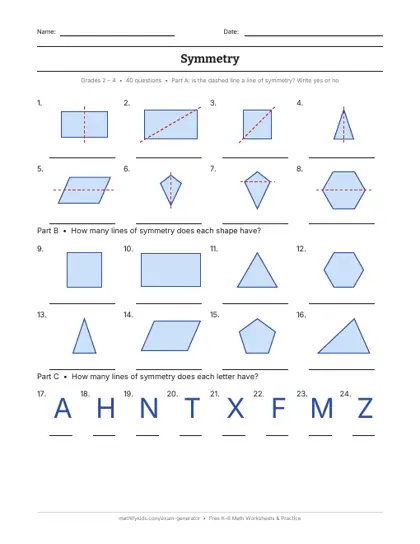
Symmetry worksheet: printable PDF with an answer key.
Geometry practice · area and perimeter calculator · geometry for kids · area and perimeter chart · symmetry chart · symmetrical shapes chart
Last reviewed
Questions parents ask
What is a line of symmetry?
A line that splits a shape into two halves that match exactly when the shape is folded along it.
How many lines of symmetry does a square have?
4: one up and down, one across, and one along each diagonal.
How many lines of symmetry does a rectangle have?
2. The diagonals are not lines of symmetry, because the halves don’t match when folded.
Does a circle have lines of symmetry?
Yes, infinitely many. Every line through the centre is a line of symmetry.
What is the difference between line and rotational symmetry?
Line symmetry is about folding to match. Rotational symmetry is about turning: the shape looks the same after part of a turn.