
Circumference and area of a circle
The circumference of a circle is π × diameter. The area is π × radius × radius. π is about 3.14.
The idea: π links a circle to its diameter
Wrap a string around any circle, then lay it straight. It is always a little more than 3 diameters long: about 3.14 diameters.
That number is called pi, written π. It never ends: 3.14159… Most schools use 3.14 or 22/7 (7.G.B.4).
See it: pictures to draw with your child
Copy these onto paper or a whiteboard. A quick sketch makes the idea concrete before any written method.
Circumference: the distance round
C = π × d, or C = 2 × π × r, because the diameter is 2 radii. Both give the same answer.
A circle with radius 5 cm has diameter 10 cm, so C = 3.14 × 10 = 31.4 cm. Circumference is a length, so the units are cm, not cm².
Area: the space inside
A = π × r × r, written πr². Use the radius, not the diameter. The area is about 3.14 squares of r by r.
A circle with radius 5 cm has area 3.14 × 5 × 5 = 78.5 cm². If the question gives the diameter, halve it first.
Circle calculator
Type a radius to see the circumference and area, worked out step by step.
Which formula do I need?
| The question asks for… | Use | Units |
|---|---|---|
| Distance round, fence, edge, wheel turns | C = πd or 2πr | cm, m, in |
| Space inside, paint, grass, pizza size | A = πr² | cm², m², in² |
Answers in terms of π leave π as a letter: a circle of radius 4 has area 16π cm². That is exact, and it is what many tests ask for.
Semicircles and quarter circles
A semicircle is half a circle, so its area is ½πr². Its perimeter is half the circumference plus the straight diameter.
A quarter circle has area ¼πr². For its perimeter, add a quarter of the circumference and two radii.
Circles in real life
A bike wheel moves forward one circumference with every turn. A wheel 70 cm across travels about 220 cm per turn.
Pizza sizes are diameters, but area grows with the square of the radius. A 12-inch pizza has more than twice the area of an 8-inch one.
Key words
- Pi (π): the circumference divided by the diameter, about 3.14.
- Circumference: the distance round a circle.
- Radius: centre to edge; half the diameter.
- Diameter: across the circle through the centre.
- r²: the radius times itself.
A week of practice
Ten minutes a day is plenty. Short, regular practice beats one long session at the weekend.
- Day 1: measure round and across plates and cans; divide to find about 3.14.
- Day 2: circumference from a diameter and from a radius.
- Day 3: area with πr², halving diameters first.
- Day 4: semicircles and answers in terms of π.
- Day 5: the quiz on this page, then a round of circles practice.
If one day goes badly, repeat it rather than moving on. Each day builds on the one before.
Quiz: circles
Check: is it the radius or the diameter? Do they want the distance round or the space inside?
Where this fits: geometry step by step
- Lines, rays and line segments
- Types of angles
- Measuring angles with a protractor
- Angle relationships
- Polygons
- Types of triangles
- Angles in a triangle
- Quadrilaterals
- Symmetry
- Perimeter
- Area
- Area of composite shapes
- Area of triangles
- Area of parallelograms and trapezoids
- Parts of a circle
- Circumference and area of a circle (this page)
- Faces, edges and vertices
- Volume
- Surface area
- Volume of cylinders, cones and spheres
- The coordinate plane
- Transformations
- Pythagorean theorem
What to say to your child
A short script for teaching it the first time. Pause after each line and let your child do the next step.
- “What is the radius of this circle?”
- “So what is the diameter?” (Double it.)
- “Circumference is π times the diameter. Roughly, 3 times what?”
- “For area, which do we use, radius or diameter?” (Radius.)
- “What is 5 squared?” (25.)
- “So the area is about 3.14 × 25. What is that?” (78.5.)
More worked examples
Example 1: Circumference, d = 10 cm
3.14 × 10 = 31.4 cm.
Example 2: Circumference, r = 7 m
2 × 3.14 × 7 = 43.96 m.
Example 3: Area, r = 3 in
3.14 × 3 × 3 = 28.26 in².
Example 4: Area, d = 20 cm
r = 10, so 3.14 × 100 = 314 cm².
Practice questions (answers below)
Ask these out loud or write them down. Check each answer, and ask “how did you get that?” for one or two.
- C, d = 4
- C, r = 10
- A, r = 2
- A, r = 10
- A, d = 6
- r, if d = 18
- A in terms of π, r = 5
- C in terms of π, d = 9
- Area of a semicircle, r = 2
- Stretch: C = 31.4 cm. Find d.
Show the answers
- 12.56
- 62.8
- 12.56
- 314
- 28.26
- 9
- 25π
- 9π
- 6.28
- 10 cm
Common mistakes
How to teach it at home
Measure π
Wrap string round cans and plates, then divide by the diameter. How close to 3.14?
Wheel walk
Roll a bike wheel one turn and measure how far it went. Compare with π × d.
Pizza maths
Compare the areas of two pizza sizes. Which is better value?
By grade
- Grade 7 (7.G.B.4): the formulas for the area and circumference of a circle, and how they are related.
- Grade 8 uses πr² inside the volume of cylinders, cones and spheres.
- In India, Areas Related to Circles (class 10) and Circles (class 9) use these formulas.
- Next: surface area and volume of cylinders, cones and spheres.
More for each grade: Grade 7 math and the CBSE class 7 maths guide.
Worksheets and practice
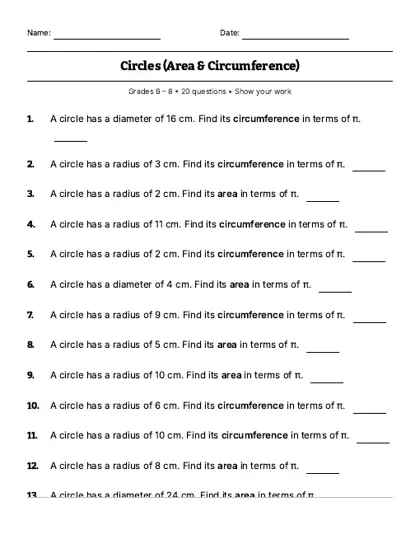
Area and circumference of circles worksheet: printable PDF with an answer key. · Make a fresh test
Geometry practice · area and perimeter calculator · geometry for kids · area and perimeter chart · parts of a circle
Last reviewed
Questions parents ask
What is the formula for the circumference of a circle?
C = π × d, or C = 2 × π × r. With π ≈ 3.14, a circle with diameter 10 cm has a circumference of 31.4 cm.
What is the formula for the area of a circle?
A = π × r × r (πr²). A circle with radius 5 cm has area 3.14 × 25 = 78.5 cm².
What is pi?
Pi (π) is the circumference of any circle divided by its diameter. It is about 3.14, or 22/7, and its digits never end.
How do you find the area from the diameter?
Halve the diameter to get the radius, then use πr².
What does “in terms of π” mean?
Leave π as a symbol instead of multiplying by 3.14. A circle with radius 4 has area 16π.