
Angle relationships
Some angle pairs always add to 90° or 180°, and some are always equal. Spot the pair, and the missing angle follows.
The idea: angles that belong together
When lines meet or cross, the angles they make are linked. If you know one angle, you can often find all the others without a protractor.
There are only a few rules to learn. Each one comes from a right angle (90°), a straight line (180°) or a full turn (360°) (7.G.B.5).
See it: pictures to draw with your child
Copy these onto paper or a whiteboard. A quick sketch makes the idea concrete before any written method.
The main angle pairs
| Pair | Rule | Example |
|---|---|---|
| Complementary | Add to 90° | 35° and 55° |
| Supplementary | Add to 180° | 60° and 120° |
| Adjacent on a straight line | Add to 180° | A ray splits a straight line into 70° and 110° |
| Vertical (vertically opposite) | Equal | Two crossing lines: opposite angles are both 120° |
| Around a point | Add to 360° | 100°, 130° and 130° |
A memory trick: C comes before S in the alphabet, and 90 comes before 180. Complementary is 90, supplementary is 180.
Parallel lines cut by a transversal
A transversal is a line that crosses two parallel lines. It makes eight angles, but only two different sizes. Every angle is either the small one or its partner that makes 180°.
- Corresponding angles sit in the same position at each crossing. They are equal: look for an F shape.
- Alternate interior angles are between the parallel lines, on opposite sides of the transversal. They are equal: look for a Z shape.
- Co-interior angles are between the lines, on the same side. They add to 180°: look for a C or U shape.
Angle explorer
Slide to make an angle. What angle would make it up to 90° or to 180°?
Solving for x
Many questions give the angles as expressions. Write the rule as an equation, then solve it.
Two supplementary angles are x and 2x + 30. So x + 2x + 30 = 180, which gives 3x = 150 and x = 50. The angles are 50° and 130°. See equations for more on solving.
Angle relationships in real life
Railway tracks, road markings and the rungs of a ladder are parallel lines. A road that crosses them is a transversal, and the angles repeat at each crossing.
Carpenters use the same rules to cut matching angles for picture frames. Two 45° cuts make a 90° corner.
Key words
- Complementary: two angles that add up to 90°.
- Supplementary: two angles that add up to 180°.
- Vertical angles: opposite angles where two lines cross; they are equal.
- Transversal: a line that crosses two or more other lines.
- Corresponding angles: angles in matching positions at each crossing.
A week of practice
Ten minutes a day is plenty. Short, regular practice beats one long session at the weekend.
- Day 1: complementary and supplementary pairs with the angle explorer.
- Day 2: vertical angles: draw two crossing lines and measure all four.
- Day 3: parallel lines and a transversal: find F, Z and C shapes.
- Day 4: solve for x in angle equations.
- Day 5: the quiz on this page, then a round of missing angles practice.
If one day goes badly, repeat it rather than moving on. Each day builds on the one before.
Quiz: find the missing angle
Which rule fits? 90, 180, or equal?
Where this fits: geometry step by step
- Lines, rays and line segments
- Types of angles
- Measuring angles with a protractor
- Angle relationships (this page)
- Polygons
- Types of triangles
- Angles in a triangle
- Quadrilaterals
- Symmetry
- Perimeter
- Area
- Area of composite shapes
- Area of triangles
- Area of parallelograms and trapezoids
- Parts of a circle
- Circumference and area of a circle
- Faces, edges and vertices
- Volume
- Surface area
- Volume of cylinders, cones and spheres
- The coordinate plane
- Transformations
- Pythagorean theorem
What to say to your child
A short script for teaching it the first time. Pause after each line and let your child do the next step.
- “What does a right angle measure?” (90°.)
- “So what goes with 30° to make a right angle?” (60°.)
- “What does a straight line measure?” (180°.)
- “What goes with 110° on a straight line?” (70°.)
- “Two lines cross. What do you notice about the opposite angles?” (They are equal.)
- “Can you see an F shape here? What does that tell you?” (The angles are equal.)
More worked examples
Example 1: Complement of 28°
90 − 28 = 62°.
Example 2: Supplement of 135°
180 − 135 = 45°.
Example 3: Vertical angles
One angle is 72°, so the opposite angle is 72°.
Example 4: Co-interior angles
One is 65°, so the other is 180 − 65 = 115°.
Practice questions (answers below)
Ask these out loud or write them down. Check each answer, and ask “how did you get that?” for one or two.
- Complement of 40°
- Supplement of 40°
- Complement of 75°
- Supplement of 99°
- Vertical angle to 58°
- Angles around a point: 120°, 150° and ?
- Corresponding angle to 70°
- Co-interior angle to 70°
- x + 3x = 180. Find x.
- Stretch: x and x + 20 are complementary. Find both angles.
Show the answers
- 50°
- 140°
- 15°
- 81°
- 58°
- 90°
- 70°
- 110°
- 45
- 35° and 55°
Common mistakes
How to teach it at home
Arm angles
Make a right angle with your arms, then split it with a pencil. Name both parts.
Street spotting
Look for parallel lines and a road crossing them. Point out matching angles.
Scissor angles
Open scissors and look at the four angles. Which are equal?
By grade
- Grade 7 (7.G.B.5): supplementary, complementary, vertical and adjacent angles, and solving simple equations for an unknown angle.
- Grade 8 (8.G.A.5): angles made when parallel lines are cut by a transversal, and angle facts about triangles.
- In India, Parallel and Intersecting Lines (class 7) and Lines and Angles (class 6) cover these rules.
- Next: angles in a triangle.
More for each grade: Grade 7 math and the CBSE class 7 maths guide; Grade 8 math and the CBSE class 8 maths guide.
Worksheets and practice
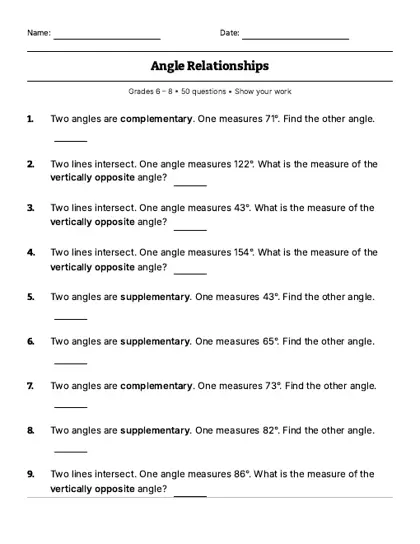
Angle relationships worksheet: printable PDF with an answer key. · Make a fresh test
Geometry practice · area and perimeter calculator · geometry for kids · area and perimeter chart · angles in a triangle worksheet
Last reviewed
Questions parents ask
What are complementary angles?
Two angles that add up to 90°, like 30° and 60°.
What are supplementary angles?
Two angles that add up to 180°, like 70° and 110°. Angles on a straight line are supplementary.
What are vertical angles?
The opposite angles made when two lines cross. They are always equal.
What are corresponding angles?
When a line crosses two parallel lines, corresponding angles are in the same position at each crossing. They are equal.
What grade learns angle relationships?
Grade 7 (7.G.B.5) for complementary, supplementary and vertical angles, and grade 8 (8.G.A.5) for parallel lines.