
Angles in a triangle
The three angles inside any triangle add up to 180°. Use it to find a missing angle, then the exterior angle and polygon rules follow.
The idea: always 180°
Draw any triangle, tear off its three corners and line them up. They always make a straight line, which is 180°.
So if you know two angles, subtract them from 180 to find the third. A triangle with 50° and 60° has a third angle of 180 − 50 − 60 = 70°.
See it: pictures to draw with your child
Copy these onto paper or a whiteboard. A quick sketch makes the idea concrete before any written method.
Why the angles make 180°
Draw a line through the top corner, parallel to the base. The two angles at the bottom appear again at the top as alternate angles.
Together with the top angle, they make a straight line. That is the proof grade 8 children meet (8.G.A.5), and it uses the angle relationships for parallel lines.
Isosceles and equilateral triangles
An isosceles triangle has two equal sides, and the two angles opposite them are equal too. If the top angle is 40°, each base angle is (180 − 40) ÷ 2 = 70°.
An equilateral triangle has three equal angles. 180 ÷ 3 = 60, so every angle is 60°. A right triangle’s two other angles always add to 90°.
Angle explorer
Set the slider to 50°. If a triangle has angles of 50° and 70°, what must the third angle be?
Exterior angles
Extend one side of a triangle past a corner. The angle outside is an exterior angle. It equals the two inside angles that are not next to it, added together.
A triangle with angles 50°, 70° and 60° has an exterior angle of 50 + 60 = 110° at the 70° corner. Check: 180 − 70 = 110°.
Angles in other polygons
Any polygon can be cut into triangles from one corner. A polygon with n sides makes n − 2 triangles, so its angles add up to (n − 2) × 180°.
| Shape | Triangles | Angle sum |
|---|---|---|
| Quadrilateral | 2 | 360° |
| Pentagon | 3 | 540° |
| Hexagon | 4 | 720° |
| Octagon | 6 | 1,080° |
In real life
Roof trusses, bridges and bike frames use triangles because they don’t change shape. Builders check the angles so the pieces fit.
Ask your child to measure the angles of a triangle cut from a cereal box. Do they add to 180°, give or take a degree?
Key words
- Interior angle: an angle inside the shape.
- Exterior angle: the angle between one side and the next side extended.
- Isosceles: two equal sides and two equal angles.
- Equilateral: three equal sides and three 60° angles.
- Angle sum: what the angles add up to: 180° in a triangle.
A week of practice
Ten minutes a day is plenty. Short, regular practice beats one long session at the weekend.
- Day 1: tear off the corners of a paper triangle and line them up.
- Day 2: missing angles: subtract two angles from 180.
- Day 3: isosceles and equilateral triangles.
- Day 4: exterior angles: add the two opposite inside angles.
- Day 5: the quiz on this page, then a round of missing angles practice.
If one day goes badly, repeat it rather than moving on. Each day builds on the one before.
Quiz: angles in triangles and polygons
Start from 180°. Look for equal sides and straight lines.
Where this fits: geometry step by step
- Lines, rays and line segments
- Types of angles
- Measuring angles with a protractor
- Angle relationships
- Polygons
- Types of triangles
- Angles in a triangle (this page)
- Quadrilaterals
- Symmetry
- Perimeter
- Area
- Area of composite shapes
- Area of triangles
- Area of parallelograms and trapezoids
- Parts of a circle
- Circumference and area of a circle
- Faces, edges and vertices
- Volume
- Surface area
- Volume of cylinders, cones and spheres
- The coordinate plane
- Transformations
- Pythagorean theorem
What to say to your child
A short script for teaching it the first time. Pause after each line and let your child do the next step.
- “What do the angles in a triangle add up to?” (180°.)
- “Two angles are 40° and 80°. What is the third?” (60°.)
- “This triangle has two equal sides. What else is equal?” (Two angles.)
- “What is each angle of an equilateral triangle?” (60°.)
- “Extend this side. What is the outside angle?”
- “How many triangles fit in a pentagon from one corner?” (3.)
More worked examples
Example 1: Missing angle
Angles 35° and 85°: 180 − 35 − 85 = 60°.
Example 2: Isosceles
Top angle 50°: base angles (180 − 50) ÷ 2 = 65° each.
Example 3: Exterior angle
Opposite inside angles 45° and 75°: exterior angle 120°.
Example 4: Pentagon
(5 − 2) × 180 = 540°.
Practice questions (answers below)
Ask these out loud or write them down. Check each answer, and ask “how did you get that?” for one or two.
- Angles 60° and 70°. Third?
- Angles 90° and 25°. Third?
- Isosceles, top 80°. Base angles?
- Equilateral angle
- Isosceles, base angle 40°. Top?
- Exterior angle: inside angles 30° and 90°
- Quadrilateral angle sum
- Hexagon angle sum
- Right triangle with one 37° angle. Third angle?
- Stretch: each angle of a regular hexagon
Show the answers
- 50°
- 65°
- 50° each
- 60°
- 100°
- 120°
- 360°
- 720°
- 53°
- 120°
Common mistakes
How to teach it at home
Tear and test
Cut paper triangles, tear off the corners and fit them on a straight line.
Triangle detectives
Give two angles; your child finds the third. Swap roles.
Polygon puzzle
Draw polygons and count the triangles from one corner. Predict the angle sum.
By grade
- Grades 4 and 5 measure angles in triangles and notice they make 180°.
- Grade 8 (8.G.A.5): an informal proof of the angle sum and exterior angle facts.
- In India, A Tale of Three Intersecting Lines (class 7) and Triangles (class 10) use these facts.
- Next: circumference and area of a circle and the Pythagorean theorem.
More for each grade: Grade 5 math and the CBSE class 5 maths guide; Grade 6 math and the CBSE class 6 maths guide; Grade 7 math and the CBSE class 7 maths guide; Grade 8 math and the CBSE class 8 maths guide.
Worksheets and practice
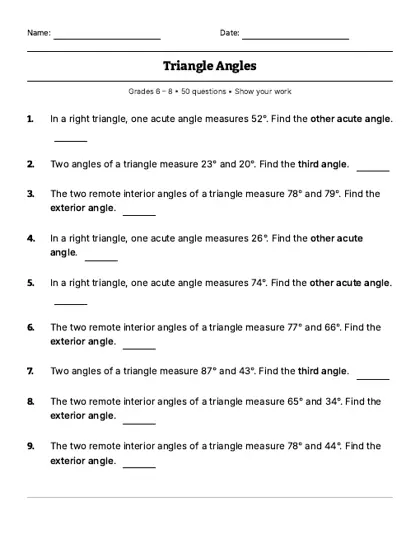
Angles in a triangle worksheet: printable PDF with an answer key. · Make a fresh test
Geometry practice · area and perimeter calculator · geometry for kids · area and perimeter chart · classifying triangles worksheet · types of triangles
Last reviewed
Questions parents ask
What do the angles in a triangle add up to?
180°, in every triangle.
How do you find a missing angle in a triangle?
Add the two angles you know and subtract the total from 180.
What are the angles of an equilateral triangle?
All three are 60°.
What is an exterior angle of a triangle?
The angle between one side and the extension of the next side. It equals the two opposite inside angles added together.
What do the angles of a polygon add up to?
(n − 2) × 180°, where n is the number of sides. A pentagon’s angles add to 540°.