
Equations with variables on both sides
When x is on both sides, like 5x + 4 = 2x + 19, first move the x terms to one side. Then solve as usual.
The idea: gather the x terms
In 5x + 4 = 2x + 19, there are x terms on both sides. Subtract 2x from both sides so all the x terms are on the left: 3x + 4 = 19.
Now it is a two-step equation. Subtract 4 and divide by 3: x = 5. Moving the smaller x term keeps the coefficient positive, which avoids sign slips.
See it: pictures to draw with your child
Copy these onto paper or a whiteboard. A quick sketch makes the idea concrete before any written method.
One solution, none or infinitely many
Usually there is one solution, like x = 5. But sometimes the x terms cancel completely.
If they cancel and leave something false, like 4 = 9, there is no solution. If they cancel and leave something true, like 4 = 4, every number works: infinitely many solutions.
For example, 2x + 1 = 2x + 5 has no solution, but 3(x + 1) = 3x + 3 is true for every x.
Try both sides
Try 2x + 1 = 2x + 5 and 3(x + 1) = 3x + 3 to see the special cases.
Seeing it on a balance
With small numbers, x on both sides is easy to picture. In 4x + 1 = 2x + 9, there are 4 bags on the left and 2 on the right. Take 2 bags off both sides: 2x + 1 = 9.
Then take 1 block off both sides and share the rest: x = 4. Try it on the balance scale.
Key words
- Variables on both sides: an equation like 5x + 2 = 3x + 10, with x on each side.
- Collect: move all the variable terms to one side.
- Identity: an equation true for every value, like x + 2 = x + 2.
- No solution: an equation that can never be true, like x + 2 = x + 5.
- Break-even point: where two costs or amounts are equal.
Tip: move the smaller x term
In 5x + 2 = 3x + 10, you could subtract 5x or 3x from both sides. Subtracting 3x leaves 2x on the left, which stays positive.
Moving the smaller x term avoids negative coefficients. Fewer negatives means fewer sign slips.
Both choices give the same answer, so this is about comfort, not rules. Let children try both ways once to see it for themselves.
Real-life comparisons
Equations with x on both sides answer “when are two things equal?” Two phone plans, two gym memberships, or two savers with different starts.
Sam has $30 and saves $5 a week. Lee has $50 and saves $3 a week. 30 + 5w = 50 + 3w gives 2w = 20, so after 10 weeks they have the same.
Ask your child who is ahead before and after week 10. That question makes the answer mean something.
Special cases: no solution and every number
Sometimes the x terms cancel completely. In 2x + 5 = 2x + 9, subtracting 2x leaves 5 = 9, which is false, so there is no solution.
In 3(x + 2) = 3x + 6, subtracting 3x leaves 6 = 6, which is always true. Every number is a solution.
These cases are part of grade 8 (8.EE.C.7a). The equation solver reports them clearly.
Quiz: variables on both sides
Move the x terms to one side, then solve.
Where this fits: equations step by step
- What is an equation
- Variables
- Algebraic expressions
- Evaluating expressions
- Writing expressions
- Inverse operations
- One-step equations
- Combining like terms
- Distributive property with variables
- Two-step equations
- Equations with fractions and decimals
- Solving inequalities
- Multi-step equations
- Variables on both sides (this page)
- Systems of equations
- Equation word problems
What to say to your child
A short script for teaching it the first time. Pause after each line and let your child do the next step.
- “Where are the x terms in 5x + 4 = 2x + 19?” (On both sides.)
- “Which is smaller, 5x or 2x?” (2x.)
- “Subtract 2x from both sides.” (3x + 4 = 19.)
- “Now solve.” (x = 5.)
- “Check: 5 × 5 + 4 and 2 × 5 + 19?” (Both 29.)
More worked examples
Example 1: move x
7x − 3 = 4x + 9. Subtract 4x: 3x − 3 = 9. Add 3: 3x = 12, so x = 4.
Example 2: x bigger on the right
x + 10 = 3x + 2. Subtract x: 10 = 2x + 2. So 2x = 8 and x = 4.
Example 3: no solution
3x + 2 = 3x − 1. Subtract 3x: 2 = −1, which is false. No solution.
Example 4: infinitely many
2(x + 4) = 2x + 8. Multiply out: 2x + 8 = 2x + 8. Every x works.
Practice questions (answers below)
Ask these out loud or write them down. Check each answer, and ask “how did you get that?” for one or two.
- 6x + 1 = 4x + 9
- 5x − 2 = 3x + 8
- x + 7 = 3x − 1
- 8x = 5x + 12
- 4x − 6 = x + 9
- 2x + 3 = 2x + 7
- 3(x − 1) = 3x − 3
- 9 − x = x + 1
- 2x − 5 = 5x + 7
- Stretch: 3(2x − 1) = 2(x + 4) + 1
Show the answers
- 4
- 5
- 4
- 4
- 5
- No solution
- Infinitely many
- 4
- −4
- 3
Common mistakes
How to teach it at home
Two-sided balance
Act out 3x + 2 = x + 8 with cups and coins on both sides of a hanger.
Phone plans
Plan A costs $20 plus $5 a month. Plan B costs $9 a month. When do they cost the same? Solve 5m + 20 = 9m: m = 5 months.
Special cases
Make up equations with no solution and with infinitely many, then swap and spot them.
By grade
- Grade 8 (8.EE.C.7a): equations with one solution, no solution or infinitely many solutions.
- Grade 8 (8.EE.C.7b): linear equations with x on both sides, brackets and fractions.
- In India, this is part of class 8 linear equations.
- Next: systems of equations.
More for each grade: Grade 8 math and the CBSE class 8 maths guide.
Worksheets and practice
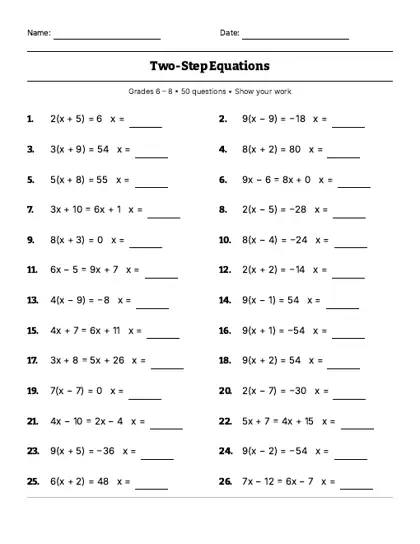
Multi-step equations worksheet: printable PDF with an answer key. · Make a fresh test
Equation practice · equation solver · balance scale · solving equations for kids · integers
Last reviewed
Questions parents ask
How do you solve equations with variables on both sides?
Subtract the smaller x term from both sides, then solve the two-step equation that is left.
What does no solution mean?
No number makes the equation true. The x terms cancel and leave something false, like 1 = 5.
What does infinitely many solutions mean?
Every number works. The x terms cancel and leave something true, like 8 = 8.
Which x term should you move?
Usually the smaller one, so the x term left over is positive.
What grade learns variables on both sides?
Grade 8 under Common Core 8.EE.C.7. In India, class 8.