
Equation word problems
To solve an equation word problem, choose a letter for the unknown, write an equation from the story, solve it and check it makes sense.
The idea: turn the story into an equation
Every equation word problem hides an equation. The job is to find it: decide what the unknown is, give it a letter, and write the story in symbols.
Once the equation is written, solving it is the easy part. The writing expressions lesson covers the key words.
See it: pictures to draw with your child
Copy these onto paper or a whiteboard. A quick sketch makes the idea concrete before any written method.
A five-step plan
- Read the whole problem and find what you are asked.
- Choose a letter for the unknown and write what it means.
- Write an equation using the facts in the story.
- Solve it with inverse operations.
- Check the answer in the story, not just the equation.
Common types of equation word problem
Money: a taxi costs $3 plus $2 a mile and a ride cost $13: 3 + 2m = 13, so m = 5. Ages: Sam is 3 years older than Ana and their ages add to 25: a + a + 3 = 25, so Ana is 11.
Perimeter: a rectangle twice as long as it is wide has a perimeter of 36: 6w = 36, so w = 6. Consecutive numbers: two numbers in a row add to 31: n + n + 1 = 31, so n = 15.
Check your equation
Type the equation you wrote and compare the steps.
Key words
- Unknown: the quantity you are asked to find.
- Define the variable: say what the letter stands for: let t = number of tickets.
- Translate: turn words into symbols: “is” becomes =, “twice” becomes 2×.
- Consecutive numbers: numbers in a row, like n, n + 1, n + 2.
- Reasonable answer: an answer that makes sense in the story.
Turning key words into symbols
- Add: sum, more than, plus, increased by, total.
- Subtract: difference, less than, minus, decreased by, fewer.
- Multiply: product, times, twice, double, of.
- Divide: quotient, shared equally, per, half of.
- Equals: is, gives, makes, is the same as.
Watch the order for “less than”: “5 less than n” is n − 5, not 5 − n.
Try guess and check first
If a problem feels hard, try a number. “Two numbers in a row add to 45.” Try 20 and 21: 41, too small. Try 22 and 23: 45 (correct).
Then write what you did with a letter: n + (n + 1) = 45. Guessing first often shows how to write the equation.
Equations win when the numbers get big or awkward, but a good guess is a great starting point.
Teaching tip: draw a bar model
A bar model turns the story into a picture before any letters appear. For “Ben has $10 more than Cal, and they have $60 together”, draw two bars.
Cal’s bar is one unknown block. Ben’s bar is the same block plus 10. Together, two blocks and 10 make 60, so one block is 25.
The bar model and the equation c + c + 10 = 60 say the same thing. Children who draw first write better equations.
Quiz: equation word problems
Write an equation, solve it, and type the answer.
Where this fits: equations step by step
- What is an equation
- Variables
- Algebraic expressions
- Evaluating expressions
- Writing expressions
- Inverse operations
- One-step equations
- Combining like terms
- Distributive property with variables
- Two-step equations
- Equations with fractions and decimals
- Solving inequalities
- Multi-step equations
- Variables on both sides
- Systems of equations
- Equation word problems (this page)
What to say to your child
A short script for teaching it the first time. Pause after each line and let your child do the next step.
- “What are we asked to find?” (How many miles.)
- “Let m be the miles. What does the taxi cost?” (3 + 2m.)
- “What equation can we write?” (3 + 2m = 13.)
- “Solve it.” (m = 5.)
- “Check in the story: $3 + 5 × $2?” ($13. It works.)
More worked examples
Example 1: number puzzle
A number tripled, plus 4, is 31. 3n + 4 = 31, so n = 9.
Example 2: savings
Mia has $12 and saves $5 a week. When will she have $47? 12 + 5w = 47, so w = 7.
Example 3: perimeter
A square’s perimeter is 52 cm. 4s = 52, so each side is 13 cm.
Example 4: sharing
$60 is shared so Ben gets $10 more than Cal. c + c + 10 = 60, so Cal gets $25.
Practice questions (answers below)
Ask these out loud or write them down. Check each answer, and ask “how did you get that?” for one or two.
- A number plus 15 is 42
- Four times a number is 76
- Twice a number minus 7 is 19
- A pen costs $3; 6 pens and a $4 bag cost?
- Tickets cost $8 each plus a $5 fee; total $45. How many tickets?
- Two numbers in a row add to 45
- A rectangle is 3 times as long as wide; perimeter 48
- Ali is 4 years older than Bea; ages add to 30
- A plumber charges $40 plus $25 an hour; bill $140
- Stretch: three numbers in a row add to 72
Show the answers
- 27
- 19
- 13
- $22
- 5
- 22 and 23
- 6 by 18
- Bea 13, Ali 17
- 4 hours
- 23, 24, 25
Common mistakes
How to teach it at home
Make up a story
Give an equation like 2x + 5 = 17 and ask your child to write a story to match.
Family ages
Make age puzzles from your own family and solve them together.
Shopping maths
Use real prices: “3 notebooks and a $2 pen cost $14. How much is a notebook?”
By grade
- Grade 6 (6.EE.B.7): one-step word problems.
- Grade 7 (7.EE.B.4): two-step word problems, including with negatives and fractions.
- Grade 8: problems that need x on both sides or a system of equations.
- In India, word problems are part of class 7 and class 8 equations.
More for each grade: Grade 6 math and the CBSE class 6 maths guide; Grade 7 math and the CBSE class 7 maths guide; Grade 8 math and the CBSE class 8 maths guide.
Worksheets and practice
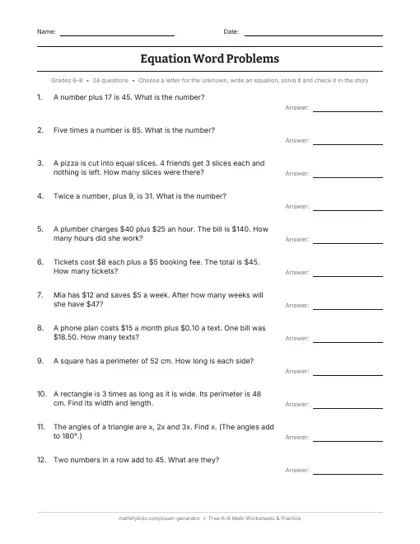
Equation word problems worksheet: printable PDF with an answer key. · Make a fresh test
Equation practice · equation solver · balance scale · solving equations for kids · integers
Last reviewed
Questions parents ask
How do you solve equation word problems?
Choose a letter for the unknown, write an equation from the story, solve it and check the answer in the story.
How do you write an equation from a word problem?
Turn each fact into symbols: “3 more than” is + 3, “twice” is 2×, “is” is =.
What letter should I use?
Any letter, but a meaningful one helps: m for miles, t for tickets.
Why check in the story?
An answer can solve the equation but still make no sense, like a negative number of tickets.
What grade learns equation word problems?
Grades 6 to 8 under Common Core 6.EE.B.7 and 7.EE.B.4. In India, class 7 and 8.