
Equations with fractions and decimals
To solve equations with fractions, multiply both sides by the denominator or by the reciprocal. Decimals work just like whole numbers.
The idea: the same steps, different numbers
Fractions and decimals don’t change how equations work. You still undo each operation with its inverse on both sides.
The new part is choosing the easiest inverse. Dividing by a fraction is the same as multiplying by its reciprocal, and that is usually simpler.
See it: pictures to draw with your child
Copy these onto paper or a whiteboard. A quick sketch makes the idea concrete before any written method.
Three kinds of fraction equation
- x divided by a number: x/4 = 3. Multiply both sides by 4: x = 12.
- A fraction coefficient: (2/3)x = 8. Multiply both sides by the reciprocal 3/2: x = 12.
- Fractions on both sides: x/2 + 1/3 = 5/6. Multiply every term by 6 to clear the fractions: 3x + 2 = 5, so x = 1.
Try fractions and decimals
Type x/4 = 3, (2/3)x = 8 or 0.5x + 1.2 = 3.7.
Equations with decimals
Solve decimal equations the same way as whole-number ones: 0.5x + 1.2 = 3.7 gives 0.5x = 2.5, so x = 5.
If decimals are awkward, multiply every term by 10 or 100 first. 0.5x + 1.2 = 3.7 becomes 5x + 12 = 37, so 5x = 25 and x = 5.
Key words
- Reciprocal: a fraction turned upside down: the reciprocal of 2/3 is 3/2.
- Denominator: the bottom number of a fraction.
- Lowest common denominator: the smallest number all the denominators divide into.
- Clear fractions: multiply every term so no fractions are left.
- Rational number: any number that can be written as a fraction, including decimals that end.
Clearing fractions with the lowest common denominator
In x/3 + x/4 = 7, the denominators are 3 and 4. The lowest common denominator is 12.
Multiply every term by 12: 4x + 3x = 84. So 7x = 84 and x = 12.
Check: 12/3 + 12/4 = 4 + 3 = 7 (correct). Clearing fractions first turns a hard equation into an easy whole-number one.
How parents can help
Use recipes and sharing. “Two thirds of the cake is 8 slices. How many slices in the whole cake?” That is (2/3)x = 8, so 12.
Money gives easy decimal practice. “Half the price plus $1.50 is $6. What is the price?” ($9.)
Ask your child to explain each step out loud. Explaining is the best test of real understanding.
If they get stuck, swap the fraction for a whole number first, solve that, then put the fraction back.
Teaching tip: link to fraction of an amount
Many children already know how to find a fraction of an amount. Two thirds of 12 is 8, because 12 ÷ 3 × 2 = 8.
An equation like (2/3)x = 8 asks the same question backwards: two thirds of what is 8? Working backwards, 8 ÷ 2 × 3 = 12.
That is exactly multiplying by the reciprocal 3/2. Linking the two ideas makes the reciprocal rule feel sensible instead of magic.
Use bar models too. Draw a bar split into three equal parts and shade two of them. If the shaded part is 8, each third is 4, so the whole bar is 12. The picture and the equation agree.
Quiz: equations with fractions and decimals
Type the value of x. Use a decimal point if you need one.
Where this fits: equations step by step
- What is an equation
- Variables
- Algebraic expressions
- Evaluating expressions
- Writing expressions
- Inverse operations
- One-step equations
- Combining like terms
- Distributive property with variables
- Two-step equations
- Equations with fractions and decimals (this page)
- Solving inequalities
- Multi-step equations
- Variables on both sides
- Systems of equations
- Equation word problems
What to say to your child
A short script for teaching it the first time. Pause after each line and let your child do the next step.
- “In x/4 = 3, what was done to x?” (Divided by 4.)
- “What undoes that?” (Multiplying by 4.)
- “So x = …?” (12.)
- “In (2/3)x = 8, what do we multiply by?” (The reciprocal, 3/2.)
- “8 × 3/2 = …?” (12.)
More worked examples
Example 1: divided by
x/5 = 7. Multiply by 5: x = 35.
Example 2: fraction coefficient
(3/4)x = 9. Multiply by 4/3: x = 12.
Example 3: two steps
x/3 + 2 = 6. Subtract 2: x/3 = 4. Multiply by 3: x = 12.
Example 4: decimals
1.5x − 2 = 4. Add 2: 1.5x = 6. Divide by 1.5: x = 4.
Practice questions (answers below)
Ask these out loud or write them down. Check each answer, and ask “how did you get that?” for one or two.
- x/6 = 4
- x/3 = −5
- (1/2)x = 7
- (2/5)x = 6
- x/4 + 1 = 6
- 0.2x = 3
- x + 1.4 = 3.9
- 2.5x = 10
- x/2 − 3 = 4
- Stretch: x/2 + x/3 = 10
Show the answers
- 24
- −15
- 14
- 15
- 20
- 15
- 2.5
- 4
- 14
- 12
Common mistakes
How to teach it at home
Sharing problems
“A third of the pizza is 4 slices. How many slices in all?” (x/3 = 4, so 12.)
Money decimals
“Half the cost plus $1.20 is $3.70. What is the cost?” ($5.)
Reciprocal snap
Call out fractions; your child says the reciprocal as fast as possible.
By grade
- Grade 6 (6.EE.B.7): one-step equations with fractions and decimals.
- Grade 7 (7.EE.B.4a): two-step equations with rational numbers.
- Grade 8: clearing fractions in multi-step equations.
- In India, this is part of class 8 linear equations. Next: solving inequalities.
More for each grade: Grade 7 math and the CBSE class 7 maths guide.
Worksheets and practice
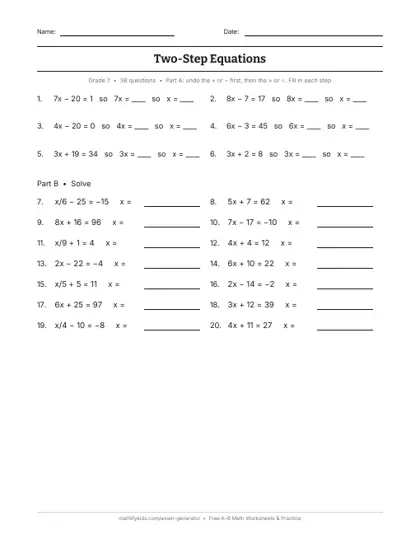
Two-step equations worksheet: printable PDF with an answer key. · Make a fresh test
Equation practice · equation solver · balance scale · solving equations for kids · integers
Last reviewed
Questions parents ask
How do you solve equations with fractions?
Multiply both sides by the denominator, or by the reciprocal of a fraction coefficient, so the fraction disappears.
How do you solve (2/3)x = 8?
Multiply both sides by 3/2: x = 12.
How do you get rid of fractions in an equation?
Multiply every term on both sides by the lowest common denominator.
How do you solve equations with decimals?
The same way as whole numbers, or multiply every term by 10 or 100 first to remove the decimals.
What grade learns equations with fractions?
Grade 6 for one step and grade 7 for two steps, under Common Core 6.EE.B.7 and 7.EE.B.4a.