
What is a variable?
A variable is a letter, like x or n, that stands for a number. 3x means 3 × x. Pictures and a quiz for kids, parent help below.
🧒 Kids: meet the mystery number!
A variable is a mystery number wearing a letter costume. x might be 5 today and 9 tomorrow. Then try the quiz!
💡 Trick: 3x means 3 × x. If x = 4, then 3x is 12!
More equations: What is an equation · Variables · Algebraic expressions · Evaluating expressions · Writing expressions · Inverse operations
This part is for grown-ups: the key idea, pictures to draw, what to say, common mistakes, questions with answers and a free worksheet.
The trick: a letter next to a number means multiply
A variable is a letter that stands for a number. When a number is written right next to a variable, they are multiplied: 3x means 3 × x. When x is on its own, it means 1x.
- 3x when x = 4: 3 × 4 = 12
- x + 5 when x = 2: 2 + 5 = 7
- n ÷ 2 when n = 10: 5
- x on its own: means 1 × x
Patterns to spot
- Any letter can be a variable; x, n and y are the most common.
- 3x and x3 mean the same, but we always write the number first.
- x means 1x, so x + x = 2x.
- The same letter in one problem always stands for the same number.
- Different letters can stand for different numbers.
- Changing the value of a variable changes the value of the expression.
Key words
- Variable: a letter that stands for a number we don’t know yet or a number that can change.
- Unknown: a variable whose value we want to find.
- Coefficient: the number in front of a variable: 3 in 3x.
- Term: a number, a variable, or a number times a variable, like 3x or 7.
- Substitute: replace a variable with a number.
Why it matters: Variables let children write a rule once and use it for any number. They turn “3 times a number plus 2” into 3n + 2, which is shorter and works every time. Every formula, from area to speed, is written with variables.
See it: pictures to draw with your child
Draw these on paper or a whiteboard. A quick sketch makes the idea concrete before any rules.
What your child already knows
Children already fill in boxes like 4 + ? = 9 and know their times tables. A variable is simply a box with a name. Writing 3x for 3 × x is new, so practice it slowly.
In real life: Formulas use variables: the area of a rectangle is A = l × w, and the cost of n tickets at $5 is 5n. A recipe that serves p people uses variables too.
Two jobs a variable can do
Sometimes a variable is an unknown: one number we want to find. In x + 4 = 9, x can only be 5.
Sometimes a variable can change. In the rule cost = 3n for n pencils at $3 each, n can be any number of pencils.
Both uses are normal. Ask your child “is this one number, or can it change?” to see which job the letter is doing.
Worked examples
Example 1: Read a variable
- In 5n, the 5 is the coefficient and n is the variable. 5n means 5 × n.
Example 2: Find the value
- Find 4x + 1 when x = 3.
- Replace x with 3: 4 × 3 + 1 = 13.
Example 3: Write with a variable
- A pen costs $2.
- Write the cost of n pens.
- Each pen is $2, so n pens cost 2n dollars.
Common mistakes
What to say to your child
A short script for your first session. Pause after each line and let your child answer.
- “A variable is a letter for a number we don’t know yet.”
- “What does 3x mean?” (3 times x.)
- “If x is 4, what is 3x?” (12.)
- “What is x + x?” (2x.)
- “Can x be 7 in one problem and 2 in another?” (Yes.)
Questions to try (answers below)
Ask these out loud or write them down. The last one is a stretch.
- What does 6y mean?
- Find 2x when x = 9
- Find x + 7 when x = 5
- Find 5n − 3 when n = 4
- What is the coefficient in 8m?
- What is x + x + x?
- Write the cost of b books at $6 each
- Find 10 − k when k = 3
- Stretch: find 2a + 3b when a = 4 and b = 5
Show the answers
- 6 × y
- 18
- 12
- 17
- 8
- 3x
- 6b
- 7
- 23
Games to play at home
Mystery bag game
Hide counters in a bag and call the bag x. Write expressions like x + 2 and count.
Letter prices
Give each letter a price, like a = 2. Work out the value of words.
Rule machine
Say a rule like “times 3”. Your child gives a number in and says what comes out.
A 5-day plan for variables
Ten minutes a day is enough. Short, regular practice works far better than one long session.
- Day 1: Learn it with real things: a kitchen scale, cups and counters, or the pictures above.
- Day 2: Read the script together, then ask the first four questions.
- Day 3: Do the quiz at the top of the page and read the hints for anything missed.
- Day 4: Play one of the games at home for ten minutes.
- Day 5: Ask the rest of the questions, then do a round of the matching equation practice skill.
By grade
Grade 6 (Common Core 6.EE.B.6 and 6.EE.A.2a) uses variables to stand for unknown or changing numbers and writes expressions with them. Grade 7 and 8 build on this for equations and functions. In India, letter-numbers appear in the class 7 chapter “Expressions using Letter-Numbers”.
More for each grade: Grade 6 math and the CBSE class 6 maths guide.
What comes next
Next, learn about algebraic expressions and evaluating expressions. See what is an equation for how variables are solved for.
Worksheet and more practice
Print a free worksheet with an answer key, or keep practicing online with equation practice.
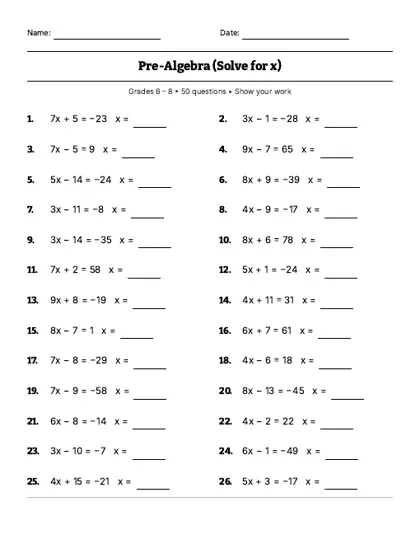 Solving equations
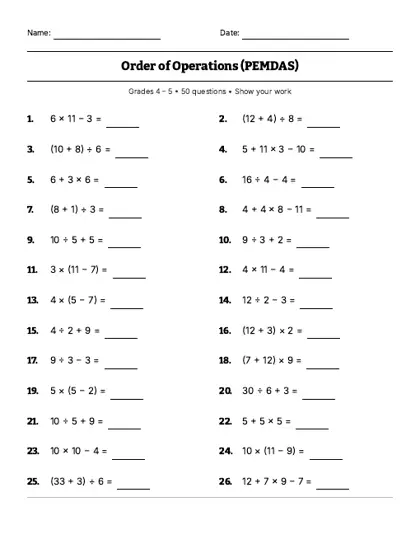 Order of operations
Printable worksheets: evaluating expressions · combining like terms · one-step equations · make a fresh equations test · make an expressions test
More: solving equations for kids · equation solver · balance scale · equation practice · order of operations · integers
Last reviewed
Questions parents ask
What is a variable in math?
A letter, like x or n, that stands for a number we don’t know or a number that can change.
What does 3x mean?
3 times x. A number written next to a letter means multiply.
Why do we use letters in math?
Letters let us write a rule once and use it for any number, like cost = 3n.
Is x always the same number?
No. In each problem x stands for one value, but it can be different in another problem.
What grade learns variables?
Grade 6 under Common Core 6.EE.B.6. In India, class 7.